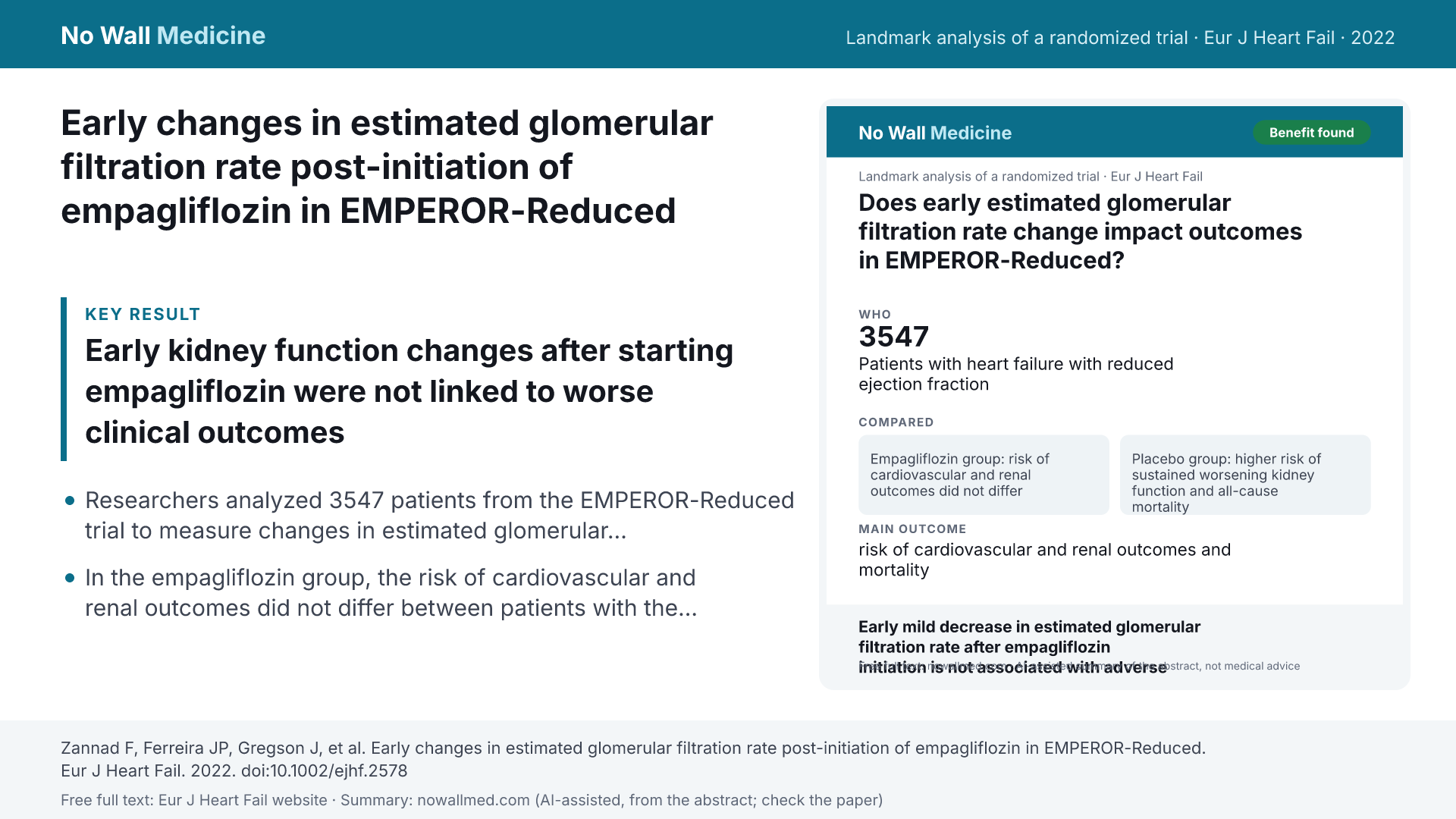
Early kidney function changes after starting empagliflozin were not linked to worse clinical outcomes
Early changes in estimated glomerular filtration rate post-initiation of empagliflozin in EMPEROR-Reduced
Landmark analysis of a randomized trialBenefit found
Does early estimated glomerular filtration rate change impact outcomes in EMPEROR-Reduced?
Who
3547
Patients with heart failure with reduced ejection fraction
Compared
Empagliflozin group: risk of cardiovascular and renal outcomes did not differ
Placebo group: higher risk of sustained worsening kidney function and all-cause mortality
Main outcome
risk of cardiovascular and renal outcomes and mortality
Result: hazard ratio 2.38 (95% CI 1.25-4.55) and HR 1.37 (95% CI 1.01-1.85)
Bottom line: Early mild decrease in estimated glomerular filtration rate after empagliflozin initiation is not associated with adverse clinical outcomes.
Eur J Heart Fail · 2022-07-07Download image
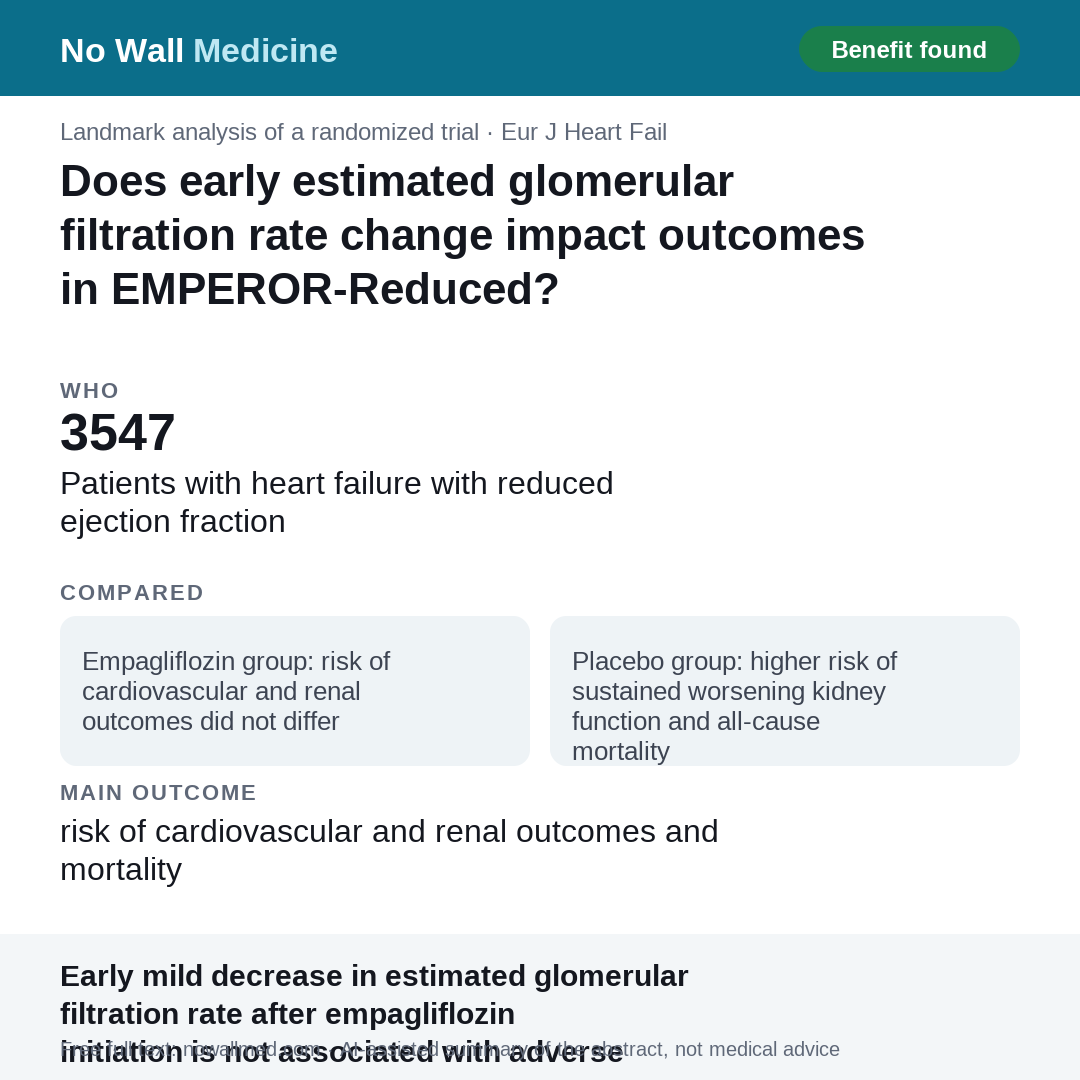
Clinical question: Does early estimated glomerular filtration rate change impact outcomes in EMPEROR-Reduced?
Why it matters: It was unknown how early changes in kidney function after starting sodium-glucose cotransporter 2 inhibitors affect clinical outcomes in patients with heart failure and reduced ejection fraction.
Key points
- Researchers analyzed 3547 patients from the EMPEROR-Reduced trial to measure changes in estimated glomerular filtration rate, a measure of kidney function, during the first 4 weeks of treatment.
- In the empagliflozin group, the risk of cardiovascular and renal outcomes did not differ between patients with the largest decrease in kidney function and those with an increase.
- In the placebo group, patients with the largest early decrease in kidney function had a higher risk of sustained worsening kidney function (hazard ratio 2.38) and all-cause mortality (hazard ratio 1.37).
Headline and key points written with AI from the paper’s abstract, with every number checked against it. Read the paper before relying on them.
Was this summary helpful?
Subject terms
Cite this article
Zannad F, Ferreira JP, Gregson J, et al. Early changes in estimated glomerular filtration rate post-initiation of empagliflozin in EMPEROR-Reduced. Eur J Heart Fail. 2022. doi:10.1002/ejhf.2578
Spotted a mistake? Suggest a correction