Early clinical response with ixekizumab is associated with better long-term outcomes in axial spondyloarthritis
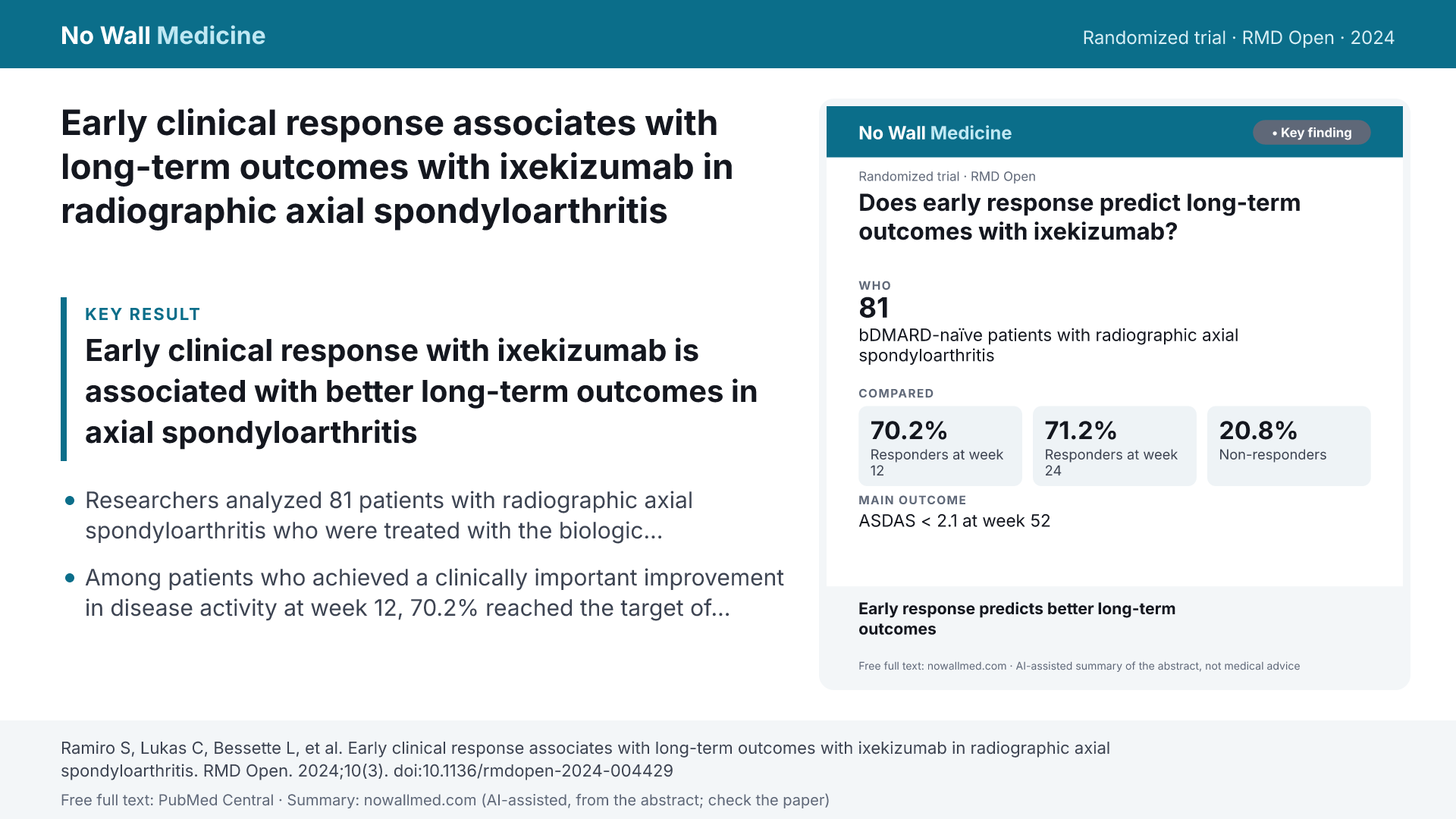
Early clinical response associates with long-term outcomes with ixekizumab in radiographic axial spondyloarthritis
Randomized trialBenefit found
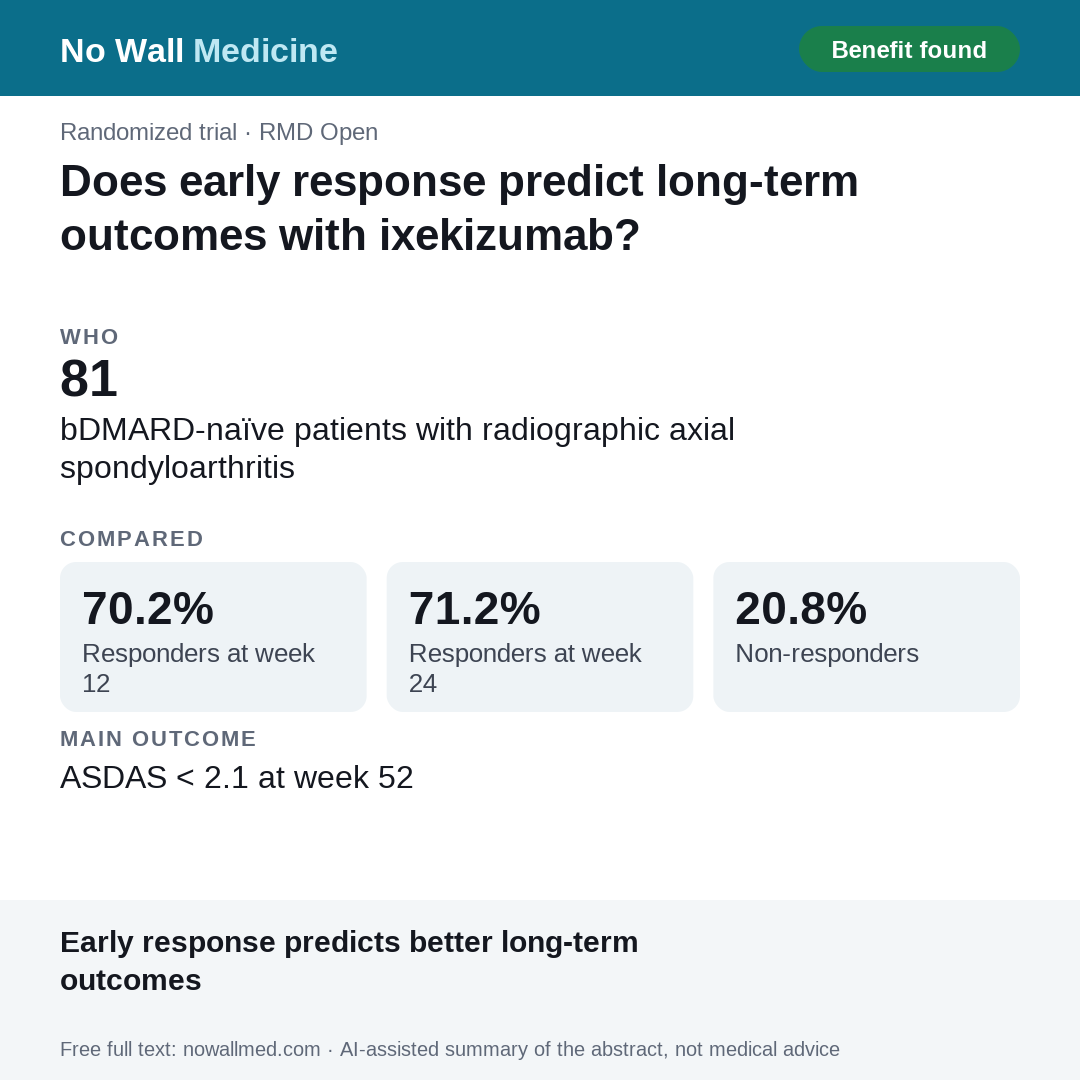
Does early response predict long-term outcomes with ixekizumab?
Who
81
bDMARD-naïve patients with radiographic axial spondyloarthritis
Compared
70.2%Responders at week 12 (33/47)
71.2%Responders at week 24 (37/52)
20.8%Non-responders (5/24)
Main outcome
ASDAS < 2.1 at week 52
Bottom line: Early response predicts better long-term outcomes
RMD Open · 2024-07-14Download image
Clinical question: Does early response predict long-term outcomes with ixekizumab?
Why it matters: It is unknown if achieving specific disease activity targets at week 12 or week 24 predicts long-term success with ixekizumab in patients with radiographic axial spondyloarthritis.
Key points
- Researchers analyzed 81 patients with radiographic axial spondyloarthritis who were treated with the biologic drug ixekizumab.
- Among patients who achieved a clinically important improvement in disease activity at week 12, 70.2% reached the target of low disease activity at week 52.
- Of the 24 patients who did not achieve clinically important improvement at either week 12 or week 24, only 20.8% reached the target at week 52.
Headline and key points written with AI from the paper’s abstract, with every number checked against it. Read the paper before relying on them.
Was this summary helpful?
Abstract
Background
The Assessment of SpondyloArthritis international Society-European Alliance of Associations for Rheumatology recommendations for axial spondyloarthritis (axSpA) management include patient assessment for biological disease-modifying antirheumatic drug (bDMARD) treatment response after at least 12 weeks of treatment. The current treat-to-target strategy for axSpA is to achieve inactive disease (ID; Axial Spondyloarthritis Disease Activity Score (ASDAS) <1.3) or at least low disease activity (LDA; 1.3≤ASDAS<2.1).To investigate the association between treatment response at week 12 and/or week 24 and attainment of the ASDAS<2.1 treat-to-target recommendation at week 52 in bDMARD-naïve patients with radiographic (r-)axSpA treated with ixekizumab (IXE). Methods
This post hoc analysis included patients randomly assigned to IXE 80 mg every 4 weeks from COAST-V (NCT02696785), a phase 3 trial in bDMARD-naïve patients with r-axSpA. The proportion of patients who achieved ASDAS<2.1 at week 52 was measured among those who attained or not clinically important improvement (CII, ∆ASDAS≥1.1) response, and among those with ID, LDA and high or very high disease activity at week 12 and/or week 24. Non-response was assumed for missing data. Results
Amongst 81 patients, 47 (58.0%) achieved ASDAS CII at week 12, with 70.2% (n=33) achieving ASDAS<2.1 at week 52. At week 24, 52 (64.2%) patients achieved ASDAS CII, with 71.2% (n=37) achieving ASDAS<2.1 at week 52. Of the 24 patients who did not achieve ASDAS CII at either week 12 or week 24, 5 (20.8%) achieved ASDAS<2.1 at week 52. Conclusion
This analysis reinforces the current recommendation that continuing treatment in those achieving ASDAS CII at week 12 and/or week 24 increases the likelihood of obtaining ID/LDA at week 52. Trial registration number
NCT02696785.
Abstract reproduced under the article’s CC BY NC licence.
Subject terms
Cite this article
Ramiro S, Lukas C, Bessette L, Wickersham P, Panni T, Bolce R. Early clinical response associates with long-term outcomes with ixekizumab in radiographic axial spondyloarthritis. RMD Open. 2024. doi:10.1136/rmdopen-2024-004429
Spotted a mistake? Suggest a correction