Early CT coronary angiography did not change one year clinical outcomes for suspected acute coronary syndrome
Early computed tomography coronary angiography in patients with suspected acute coronary syndrome: randomised controlled trial
Randomised controlled trialNo clear difference
Does early computed tomography coronary angiography improve one year clinical outcomes in suspected acute coronary syndrome?
Who
1748
Adults with suspected acute coronary syndrome and intermediate risk · 37 hospitals in the UK
Compared
5.8%Early computed tomography coronary angiography
6.1%Standard of care only
Main outcome
All cause death or subsequent type 1 or 4b myocardial infarction
Result: adjusted hazard ratio 0.91 (95% confidence interval 0.62 to 1.35)
Bottom line: Early computed tomography coronary angiography did not improve one year clinical outcomes in intermediate risk patients with suspected acute coronary syndrome.
BMJ · 2021-09-29Download image
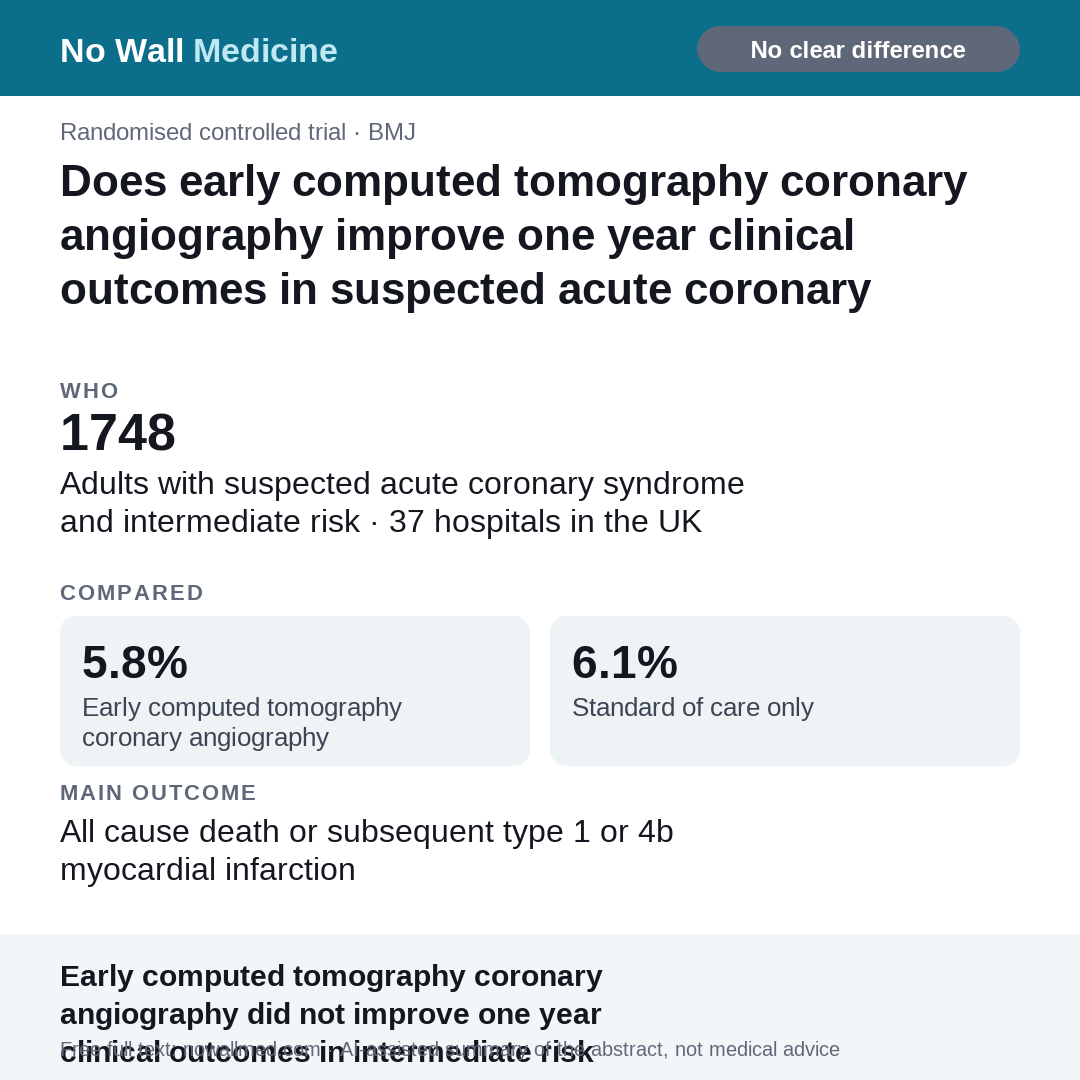
Clinical question: Does early computed tomography coronary angiography improve one year clinical outcomes in suspected acute coronary syndrome?
Why it matters: It was unknown if performing early computed tomography coronary angiography improves one year clinical outcomes for intermediate risk patients with suspected acute coronary syndrome.
Key points
- Researchers studied 1748 adults with suspected acute coronary syndrome across 37 hospitals, comparing early computed tomography coronary angiography to standard care.
- The primary endpoint of death or heart attack occurred in 5.8% of the early imaging group and 6.1% of the standard care group.
- Early imaging was associated with fewer invasive coronary angiographies but was linked to a median hospital stay increase of 0.21 days.
Headline and key points written with AI from the paper’s abstract, with every number checked against it. Read the paper before relying on them.
Was this summary helpful?
Abstract
Objectives
To establish if the use of early computed tomography (CT) coronary angiography improves one year clinical outcomes in patients presenting to the emergency department with acute chest pain and at intermediate risk of acute coronary syndrome and subsequent clinical events. Design
Randomised controlled trial. Setting
37 hospitals in the UK. Participants
Adults with suspected or a provisional diagnosis of acute coronary syndrome and one or more of previous coronary heart disease, raised levels of cardiac troponin, or abnormal electrocardiogram. Interventions
Early CT coronary angiography and standard of care compared with standard of care only. Main outcome measures
Primary endpoint was all cause death or subsequent type 1 or 4b myocardial infarction at one year. Results
Between 23 March 2015 and 27 June 2019, 1748 participants (mean age 62 years (standard deviation 13), 64% men, mean global registry of acute coronary events (GRACE) score 115 (standard deviation 35)) were randomised to receive early CT coronary angiography (n=877) or standard of care only (n=871). Median time from randomisation to CT coronary angiography was 4.2 (interquartile range 1.6-21.6) hours. The primary endpoint occurred in 51 (5.8%) participants randomised to CT coronary angiography and 53 (6.1%) participants who received standard of care only (adjusted hazard ratio 0.91 (95% confidence interval 0.62 to 1.35), P=0.65). Invasive coronary angiography was performed in 474 (54.0%) participants randomised to CT coronary angiography and 530 (60.8%) participants who received standard of care only (adjusted hazard ratio 0.81 (0.72 to 0.92), P=0.001). There were no overall differences in coronary revascularisation, use of drug treatment for acute coronary syndrome, or subsequent preventive treatments between the two groups. Early CT coronary angiography was associated with a slightly longer time in hospital (median increase 0.21 (95% confidence interval 0.05 to 0.40) days from a median hospital stay of 2.0 to 2.2 days). Conclusions
In intermediate risk patients with acute chest pain and suspected acute coronary syndrome, early CT coronary angiography did not alter overall coronary therapeutic interventions or one year clinical outcomes, but reduced rates of invasive angiography while modestly increasing length of hospital stay. These findings do not support the routine use of early CT coronary angiography in intermediate risk patients with acute chest pain and suspected acute coronary syndrome. Trial registration
ISRCTN19102565, NCT02284191.
Abstract reproduced under the article’s CC BY licence.
Subject terms
Cite this article
Gray AJ, Roobottom C, Smith JE, Goodacre S, Oatey K, O'Brien R. Early computed tomography coronary angiography in patients with suspected acute coronary syndrome: randomised controlled trial. BMJ. 2021. doi:10.1136/bmj.n2106
Spotted a mistake? Suggest a correction
Top studies every Monday
The week’s key trials and guidelines in your specialties, plus any topics you follow. By email, free.
Get the weekly digest