Implementation of a postpartum hemorrhage detection and treatment bundle showed high fidelity and acceptability
Early detection and a treatment bundle strategy for postpartum haemorrhage: a mixed-methods process evaluation
Mixed-methods process evaluationBenefit found
How was the E-MOTIVE intervention implemented for postpartum haemorrhage?
Who
2578
Pregnant women and people experiencing postpartum haemorrhage · Kenya, Nigeria, South Africa, and Tanzania
Compared
Intervention sites: 96.9% fidelity to treatment bundle delivery
Control sites
Main outcome
Fidelity, adoption, adaptation, acceptability, feasibility, and contamination
Bottom line: The E-MOTIVE intervention showed high levels of fidelity, feasibility, and acceptability across multiple countries.
Limitation: Barriers to pregnant women's and people's acceptability were reported by health workers.
Funded by: Bill and Melinda Gates Foundation and WHO co-sponsored programme
Lancet Glob Health · 2025-02-01Download image
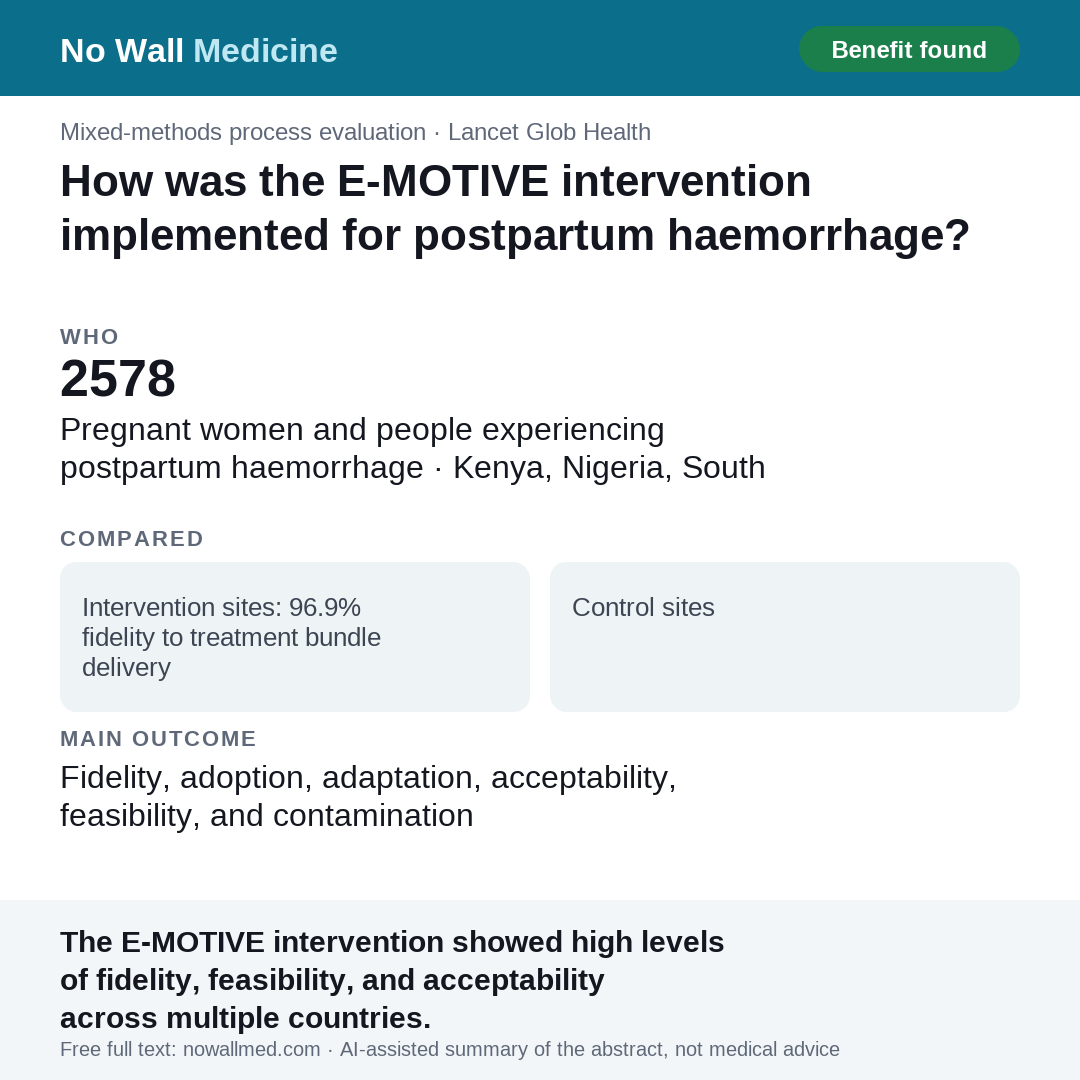
Clinical question: How was the E-MOTIVE intervention implemented for postpartum haemorrhage?
Why it matters: It was unknown how effectively a specific detection and treatment bundle for postpartum hemorrhage could be implemented in real-world clinical settings across multiple countries.
Key points
- Researchers evaluated the implementation of a detection and treatment bundle across Kenya, Nigeria, South Africa, and Tanzania through observations of 2578 births and 889 surveys.
- Fidelity to the calibrated blood-collection drape was 100% in observations and 98.3% in surveys, while treatment bundle delivery fidelity was 96.9% in 286 of 295 observed cases.
- Treatment initiation occurred within 15 minutes in 66.8% of 295 birth observations, though health workers reported barriers to patient acceptability.
Headline and key points written with AI from the paper’s abstract, with every number checked against it. Read the paper before relying on them.
Abstract
Background
Postpartum haemorrhage is a leading cause of maternal mortality. A multicountry, cluster-randomised trial (E-MOTIVE) demonstrated a 60% reduction in adverse postpartum haemorrhage outcomes. The E-MOTIVE intervention included early postpartum haemorrhage detection using calibrated blood-collection drapes, followed by a postpartum haemorrhage treatment bundle (ie, uterine massage, oxytocics, tranexamic acid, intravenous fluids, examination and escalation [MOTIVE]), supported by implementation strategies. We report a mixed-methods process evaluation assessing the implementation of the E-MOTIVE intervention in Kenya, Nigeria, South Africa, and Tanzania. Methods
In this mixed-methods process evaluation, data sources were observations of health workers providing clinical care to pregnant women and pregnant people during vaginal birth and postpartum haemorrhage at intervention sites, and surveys and qualitative interviews with health workers at intervention and control sites. Intervention sites received the calibrated drapes, MOTIVE bundle, and implementation strategies and control sites used uncalibrated drapes. Primary implementation outcomes included fidelity, adoption, adaptation, acceptability, feasibility, and contamination to the calibrated drape, MOTIVE bundle, and implementation strategies. Findings
Between June 1, 2022, and Jan 31, 2023, 2578 births were observed, 295 pregnant women and people had postpartum haemorrhage, 47 qualitative interviews were done, and 889 surveys were completed. Fidelity to calibrated drape use was high (birth observations 2578 [100%] of 2578; survey 451 [98·3%] of 459). Among health workers, calibrated drape acceptability was high; however, they reported barriers to pregnant women's and people's acceptability. Fidelity to postpartum haemorrhage treatment bundle delivery was high (birth observations 286 [96·9%] of 295), with moderate to high fidelity in median time from postpartum haemorrhage diagnosis to final treatment initiation (≤15 min initiation time in 191 [66·8%] of 295 birth observations, 16-20 min in 42 [14·7%] birth observations), and high acceptability and feasibility. Research midwives participated in clinical assessments after birth and bundle delivery in some sites (mixed fidelity). Interpretation
This process evaluation shows generally high levels of fidelity, feasibility, and acceptability of the calibrated drape and treatment bundle across evaluation methods and countries. The E-MOTIVE intervention should be included in national policies, with consideration for health workforce, supplies, and medication issues, which might need addressing for successful implementation. Funding
The Bill and Melinda Gates Foundation and the UNDP-UNFPA-UNICEF-WHO-World Bank Special Programme of Research, Development and Research Training in Human Reproduction, a co-sponsored programme of WHO. Translation
For the Swahili translation of the abstract see Supplementary Materials section.
Abstract reproduced under the article’s CC BY licence.
Topics
Cite this article
Bohren MA, Miller S, Mammoliti KM, Galadanci H, Fawcus S, Moran N. Early detection and a treatment bundle strategy for postpartum haemorrhage: a mixed-methods process evaluation. Lancet Glob Health. 2025. doi:10.1016/S2214-109X(24)00454-6
Spotted a mistake? Suggest a correction
Top studies every Monday
The week’s key trials and guidelines in your specialties, by email. Free.
Get the weekly digest