Diagnosis of postpartum haemorrhage was faster in countries using a 300 mL blood loss threshold
When are postpartum haemorrhages diagnosed? A nested observational study within the E-MOTIVE cluster-randomised trial
Nested observational studyMixed results
How does postpartum haemorrhage diagnosis timing and method vary across four African countries?
Who
2578
Postpartum women at 39 hospitals · Nigeria, Kenya, Tanzania, and South Africa
Compared
Nigeria and Tanzania: 15 min
Kenya: 17 min
South Africa: 30 min
Main outcome
Median time from vaginal birth to postpartum haemorrhage diagnosis
Bottom line: Diagnosis timing was faster in countries using a 300 mL threshold with clinical signs compared to a 500 mL threshold.
Funded by: Bill & Melinda Gates Foundation and Ammalife
Lancet Glob Health · 2025-10-19Download image
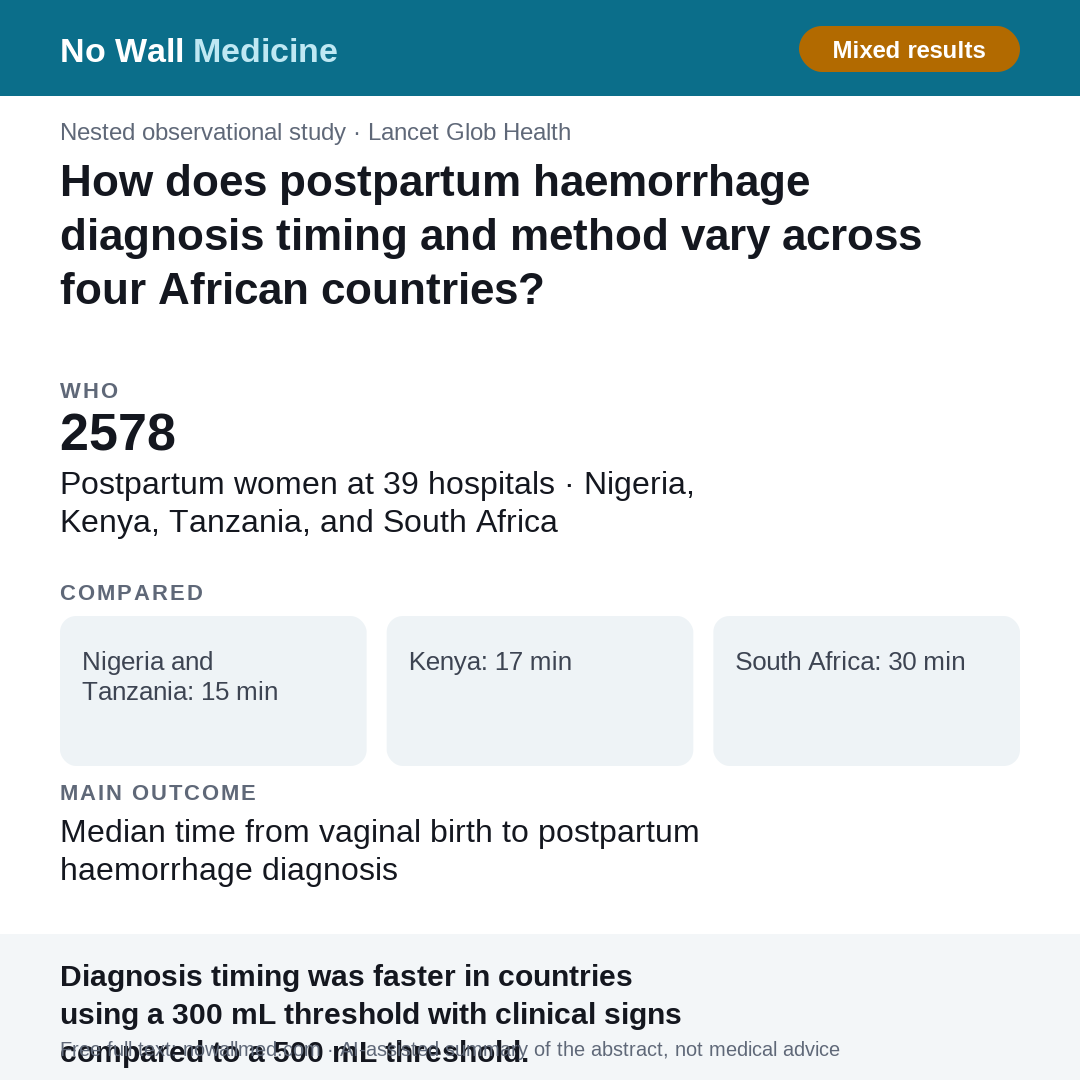
Clinical question: How does postpartum haemorrhage diagnosis timing and method vary across four African countries?
Why it matters: Current definitions of postpartum haemorrhage may underemphasize the early postpartum hours due to limited data on when these cases are actually diagnosed.
Key points
- Researchers observed 2578 women at 39 hospitals across Nigeria, Kenya, Tanzania, and South Africa to measure the time from vaginal birth to postpartum haemorrhage diagnosis.
- The median time to diagnosis was 15 min in Nigeria and Tanzania, 17 min in Kenya, and 30 min in South Africa.
- By 60 min, between 96% and 100% of postpartum haemorrhages were diagnosed across all four studied countries.
Headline and key points written with AI from the paper’s abstract, with every number checked against it. Read the paper before relying on them.
Abstract
Background
The definition of primary postpartum haemorrhage as blood loss of 500 mL or more within 24 h after vaginal birth underemphasises the early postpartum hours due to limited data on the timing of postpartum haemorrhage diagnosis. Understanding postpartum haemorrhage diagnosis timing and diagnostic methods is important for guiding diagnostic and therapeutic strategies. The E-MOTIVE trial evaluated early postpartum haemorrhage diagnosis and a bundled treatment approach, which resulted in a 60% relative reduction in adverse outcomes from bleeding compared with usual care. We aimed to compare timing from vaginal birth to postpartum haemorrhage diagnosis and the diagnostic methods used among four African countries implementing the intervention from the E-MOTIVE trial. Methods
Nested within the E-MOTIVE trial (NCT04341662), we conducted direct observations of health-care workers providing clinical care to postpartum women at 39 hospitals implementing the E-MOTIVE intervention across Nigeria, Kenya, Tanzania, and South Africa. One to two weeks of continuous observations were conducted from vaginal birth up to 2 h, between June 27, and Dec 18, 2022. Health-care workers were trained to use clinical judgement (ie, heavy vaginal blood loss, large blood clots expelled, or constant trickle) and various objective blood loss thresholds to diagnose postpartum haemorrhage. The objective blood loss thresholds used in Nigeria, Kenya, and Tanzania were 300 mL or more with at least one abnormal clinical sign (ie, pulse, blood pressure, uterine tone, and vaginal blood flow) or 500 mL or more. The objective blood loss threshold in South Africa was 500 mL or more. We descriptively analysed and compared timing from vaginal birth to postpartum haemorrhage diagnosis and diagnostic methods used between countries. Findings
Of 2578 women, 295 postpartum haemorrhages were diagnosed. The median time from vaginal birth to postpartum haemorrhage diagnosis was 15 min in Nigeria and Tanzania, 17 min in Kenya, and 30 min in South Africa. Diagnosis within 30 min ranged from 58% in South Africa to 86% in Tanzania. By 60 min, 96% to 100% of postpartum haemorrhages were diagnosed across all countries. All postpartum haemorrhages that required an intervention were diagnosed within 90 min. Nigeria, Kenya, and Tanzania commonly used blood loss of 300 mL or more combined with at least one abnormal clinical sign (47%, 65%, and 68%, respectively) while South Africa relied on a definition of 500 mL or more (81%) as the dominant diagnostic strategy. Interpretation
In countries where an objective blood loss threshold of 300 mL or more with at least one abnormal clinical sign was used, women received earlier interventions for postpartum bleeding, with a median time to diagnosis of 15-17 min. This was notably faster than in the country that predominantly used a 500 mL or more threshold, where the median time to diagnosis was 30 min. Regardless of whether the threshold was 300 mL or more with abnormal clinical signs or 500 mL or more alone, all postpartum haemorrhages were diagnosed within 90 min of vaginal birth. Funding
Bill & Melinda Gates Foundation and Ammalife.
Abstract reproduced under the article’s CC BY licence.
Topics
Cite this article
Mammoliti KM, Martin J, Devall A, Easter C, Althabe F, Funmi AL. When are postpartum haemorrhages diagnosed? A nested observational study within the E-MOTIVE cluster-randomised trial. Lancet Glob Health. 2025. doi:10.1016/S2214-109X(25)00302-X
Spotted a mistake? Suggest a correction