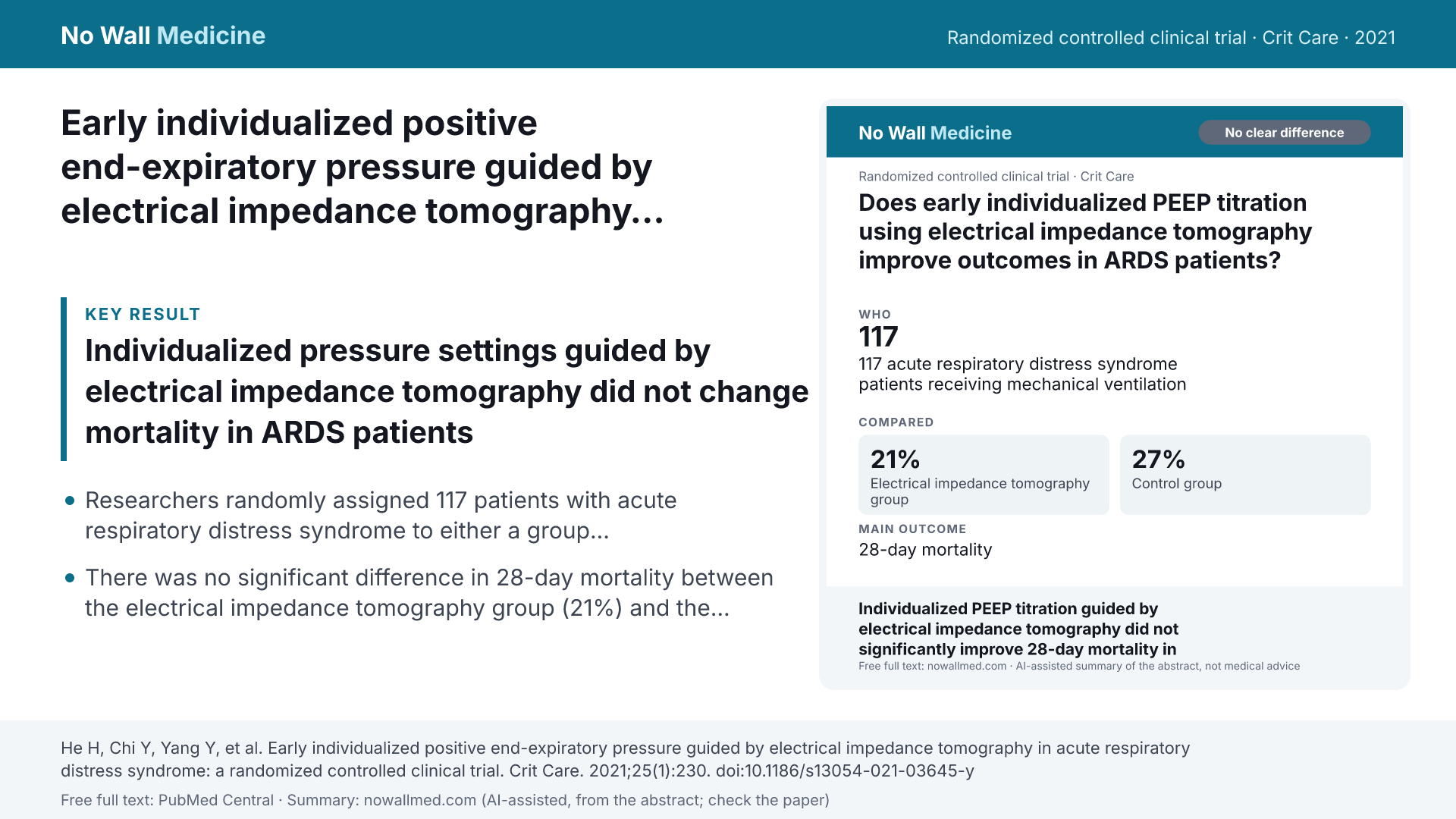
Individualized pressure settings guided by electrical impedance tomography did not change mortality in ARDS patients
Early individualized positive end-expiratory pressure guided by electrical impedance tomography in acute respiratory distress syndrome: a randomized controlled clinical trial
Randomized controlled clinical trialNo clear difference
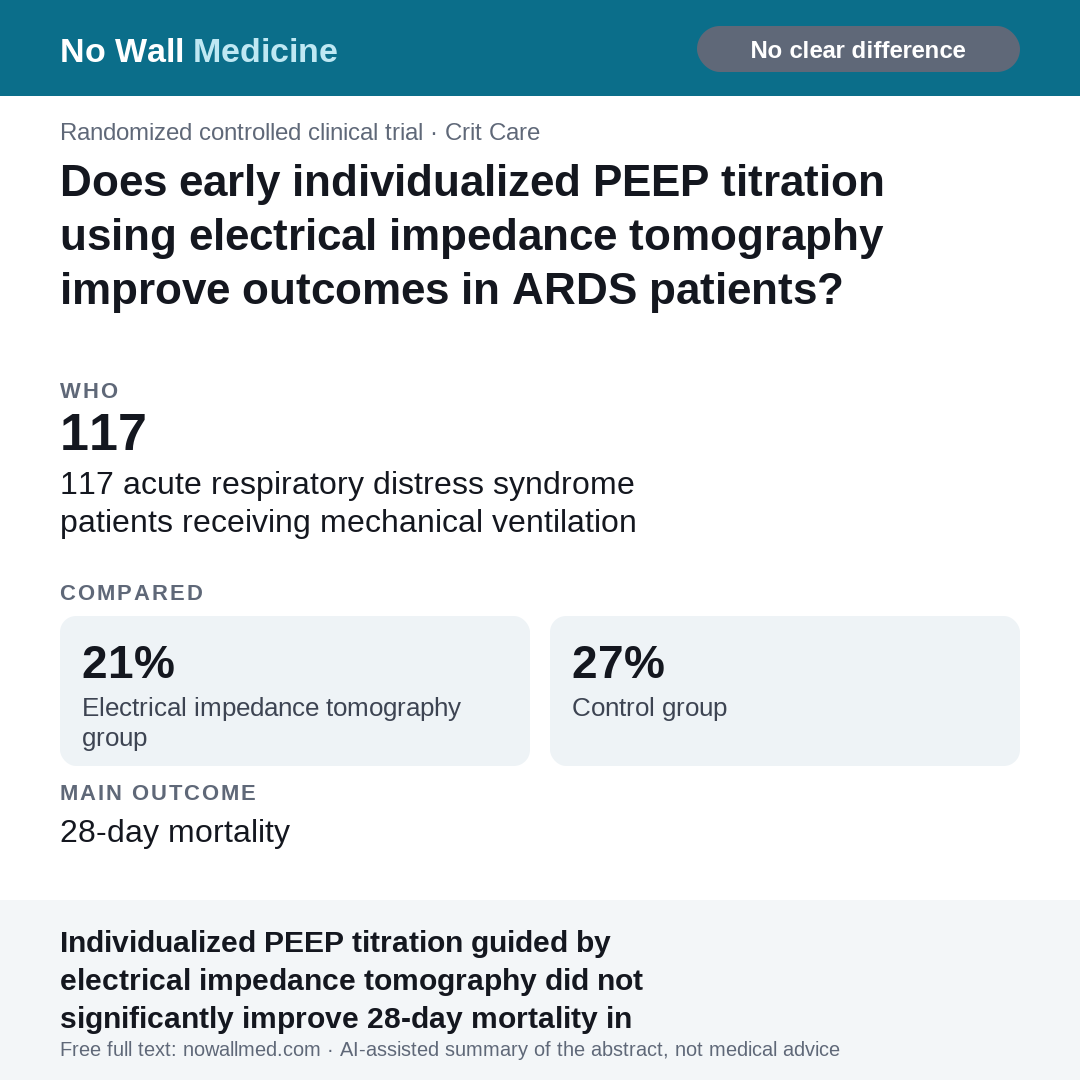
Does early individualized PEEP titration using electrical impedance tomography improve outcomes in ARDS patients?
Who
117
117 acute respiratory distress syndrome patients receiving mechanical ventilation
Compared
21%Electrical impedance tomography group
27%Control group
Main outcome
28-day mortality
Bottom line: Individualized PEEP titration guided by electrical impedance tomography did not significantly improve 28-day mortality in ARDS patients.
Crit Care · 2021-06-30Download image
Clinical question: Does early individualized PEEP titration using electrical impedance tomography improve outcomes in ARDS patients?
Why it matters: It was unknown whether using electrical impedance tomography to tailor positive end-expiratory pressure settings improves clinical outcomes for patients with acute respiratory distress syndrome.
Key points
- Researchers randomly assigned 117 patients with acute respiratory distress syndrome to either a group receiving pressure settings guided by electrical impedance tomography or a control group using a standard table.
- There was no significant difference in 28-day mortality between the electrical impedance tomography group (21%) and the control group (27%), nor in ICU length of stay or ventilator-free days.
- In a post hoc comparison, the electrical impedance tomography group showed significantly lower changes in Sequential Organ Failure Assessment scores at day 1 and day 2 compared to the control group.
Headline and key points written with AI from the paper’s abstract, with every number checked against it. Read the paper before relying on them.
Was this summary helpful?
Abstract
Background
Individualized positive end-expiratory pressure (PEEP) by electrical impedance tomography (EIT) has potential interest in the optimization of ventilation distribution in acute respiratory distress syndrome (ARDS). The aim of the study was to determine whether early individualized titration of PEEP with EIT improved outcomes in patients with ARDS. Methods
A total of 117 ARDS patients receiving mechanical ventilation were randomly assigned to EIT group (n = 61, PEEP adjusted based on ventilation distribution) or control group (n = 56, low PEEP/FiO2 table). The primary outcome was 28-day mortality. Secondary and exploratory outcomes were ventilator-free days, length of ICU stay, incidence of pneumothorax and barotrauma, and difference in Sequential Organ Failure Assessment (SOFA) score at day 1 (ΔD1-SOFA) and day 2 (ΔD2-SOFA) compared with baseline. Measurements and main results
There was no statistical difference in the value of PEEP between the EIT group and control group, but the combination of PEEP and FiO2 was different between groups. In the control group, a significantly positive correlation was found between the PEEP value and the corresponding FiO2 (r = 0.47, p < 0.00001) since a given matched table was used for PEEP settings. Diverse combinations of PEEP and FiO2 were found in the EIT group (r = 0.05, p = 0.68). There was no significant difference in mortality rate (21% vs. 27%, EIT vs. control, p = 0.63), ICU length of stay (13.0 (7.0, 25.0) vs 10.0 (7.0, 14.8), median (25th-75th percentile); p = 0.17), and ventilator-free days at day 28 (14.0 (2.0, 23.0) vs 19.0 (0.0, 24.0), p = 0.55) between the two groups. The incidence of new barotrauma was zero. Compared with control group, significantly lower ΔD1-SOFA and ΔD2-SOFA were found in the EIT group (p < 0.001) in a post hoc comparison. Moreover, the EIT group exhibited a significant decrease of SOFA at day 2 compared with baseline (paired t-test, difference by - 1 (- 3.5, 0), p = 0.001). However, the control group did show a similar decrease (difference by 1 (- 2, 2), p = 0.131). Conclusion
Our study showed a 6% absolute decrease in mortality in the EIT group: a statistically non-significant, but clinically non-negligible result. This result along with the showed improvement in organ function might justify further reserach to validate the beneficial effect of individualized EIT-guided PEEP setting on clinical outcomes of patients with ARDS. Trial registration
ClinicalTrials, NCT02361398. Registered 11 February 2015-prospectively registered, https://clinicaltrials.gov/show/NCT02361398 .
Abstract reproduced under the article’s CC BY licence.
Subject terms
Cite this article
He H, Chi Y, Yang Y, et al. Early individualized positive end-expiratory pressure guided by electrical impedance tomography in acute respiratory distress syndrome: a randomized controlled clinical trial. Crit Care. 2021. doi:10.1186/s13054-021-03645-y
Spotted a mistake? Suggest a correction