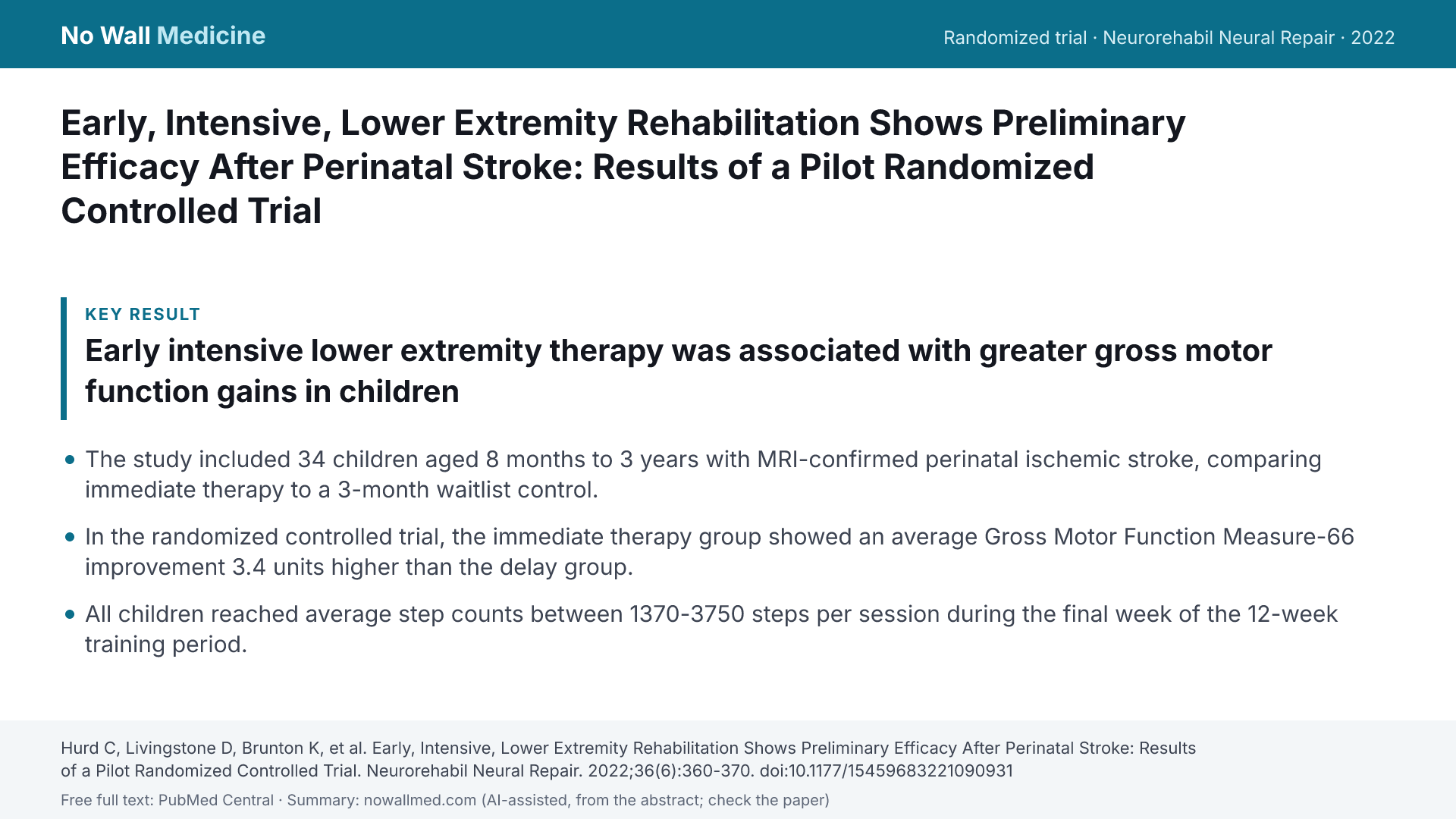
Early, Intensive, Lower Extremity Rehabilitation Shows Preliminary Efficacy After Perinatal Stroke: Results of a Pilot Randomized Controlled Trial
Key result: Early intensive lower extremity therapy was associated with greater gross motor function gains in children
Key points
- The study included 34 children aged 8 months to 3 years with MRI-confirmed perinatal ischemic stroke, comparing immediate therapy to a 3-month waitlist control.
- In the randomized controlled trial, the immediate therapy group showed an average Gross Motor Function Measure-66 improvement 3.4 units higher than the delay group.
- All children reached average step counts between 1370-3750 steps per session during the final week of the 12-week training period.
Discussion prompts
- Would these patients look like yours? Who was left out?
- Is the main outcome one that matters to patients?
- Is the difference large enough to change what you do?
Cite: Hurd C, Livingstone D, Brunton K, et al. Early, Intensive, Lower Extremity Rehabilitation Shows Preliminary Efficacy After Perinatal Stroke: Results of a Pilot Randomized Controlled Trial. Neurorehabil Neural Repair. 2022;36(6):360-370. doi:10.1177/15459683221090931
Free full text: PubMed Central · Summary and visual abstract: nowallmed.com/a/early-intensive-lower-extremity-rehabilitation-shows-preliminary-1nwkbi3/ (AI-assisted from the abstract; check the paper before relying on it).