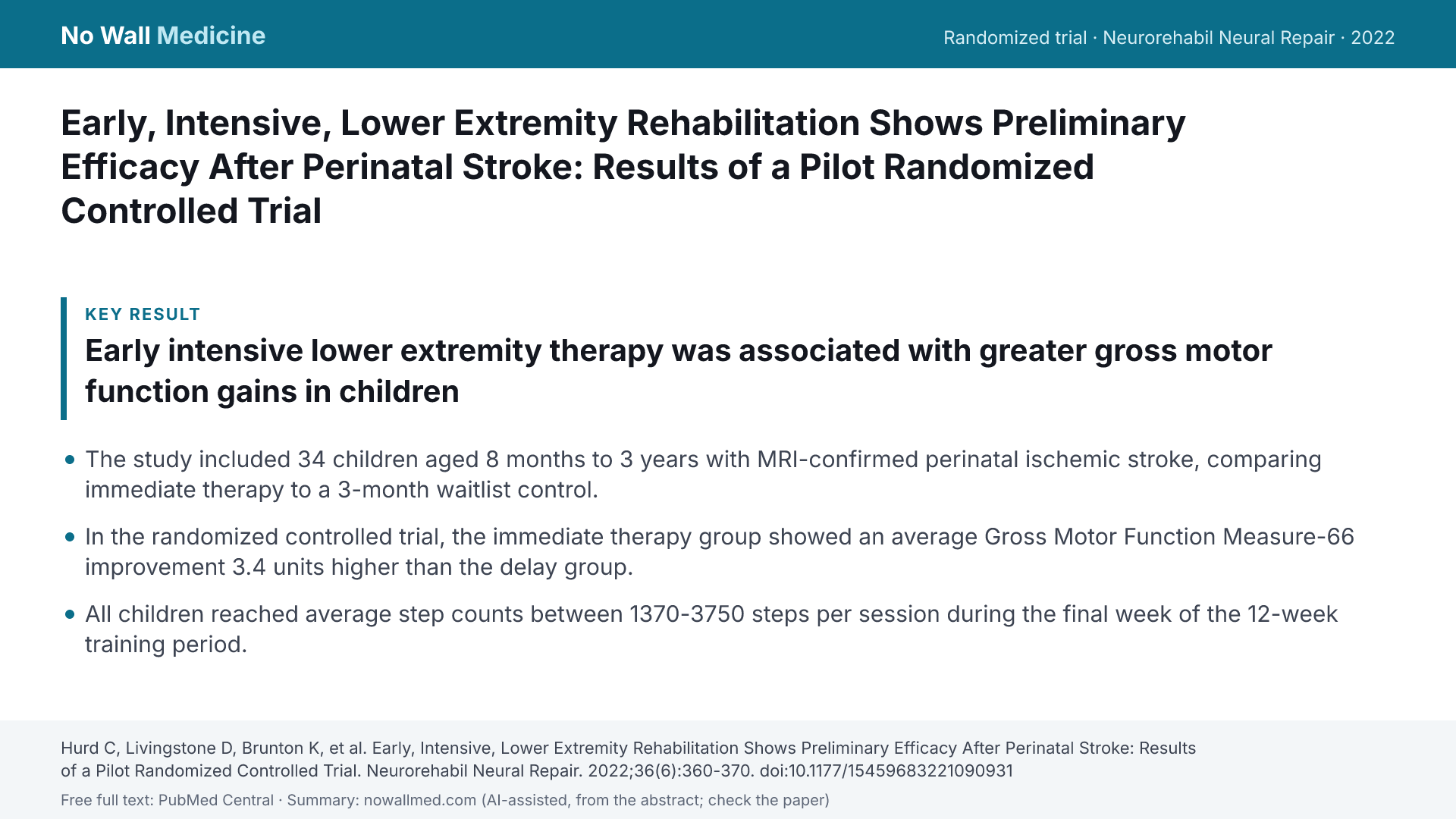
Early intensive lower extremity therapy was associated with greater gross motor function gains in children
Early, Intensive, Lower Extremity Rehabilitation Shows Preliminary Efficacy After Perinatal Stroke: Results of a Pilot Randomized Controlled Trial
Why it matters: It is unknown if early, intensive, play-based interventions for the lower limbs are feasible or effective for gross motor function in children after a perinatal stroke.
Key points
- The study included 34 children aged 8 months to 3 years with MRI-confirmed perinatal ischemic stroke, comparing immediate therapy to a 3-month waitlist control.
- In the randomized controlled trial, the immediate therapy group showed an average Gross Motor Function Measure-66 improvement 3.4 units higher than the delay group.
- All children reached average step counts between 1370-3750 steps per session during the final week of the 12-week training period.
Headline and key points written with AI from the paper’s abstract, with every number checked against it. Read the paper before relying on them.
Was this summary helpful?
Subject terms
Cite this article
Hurd C, Livingstone D, Brunton K, et al. Early, Intensive, Lower Extremity Rehabilitation Shows Preliminary Efficacy After Perinatal Stroke: Results of a Pilot Randomized Controlled Trial. Neurorehabil Neural Repair. 2022. doi:10.1177/15459683221090931
Spotted a mistake? Suggest a correction