Early mobilization in patients with aneurysmal subarachnoid haemorrhage may im-prove functional status and reduce cerebral vasospasm rate: a systematic review with meta-analysis
Systematic review with meta-analysisBenefit found
Is early mobilization safe and effective in patients with aneurysmal subarachnoid haemorrhage?
Who
1,757
Patients with aneurysmal subarachnoid haemorrhage
Compared
Early mobilization
Control
Main outcome
Modified Rankin Scale score and cerebral vasospasm rate
Result: mean difference -1.39 (95% CI -2.51 to -0.28) for mRS at discharge
Bottom line: Early mobilization improves functional status and reduces radiological and clinical cerebral vasospasm rates in patients.
J Rehabil Med · 2024-10-18Download image
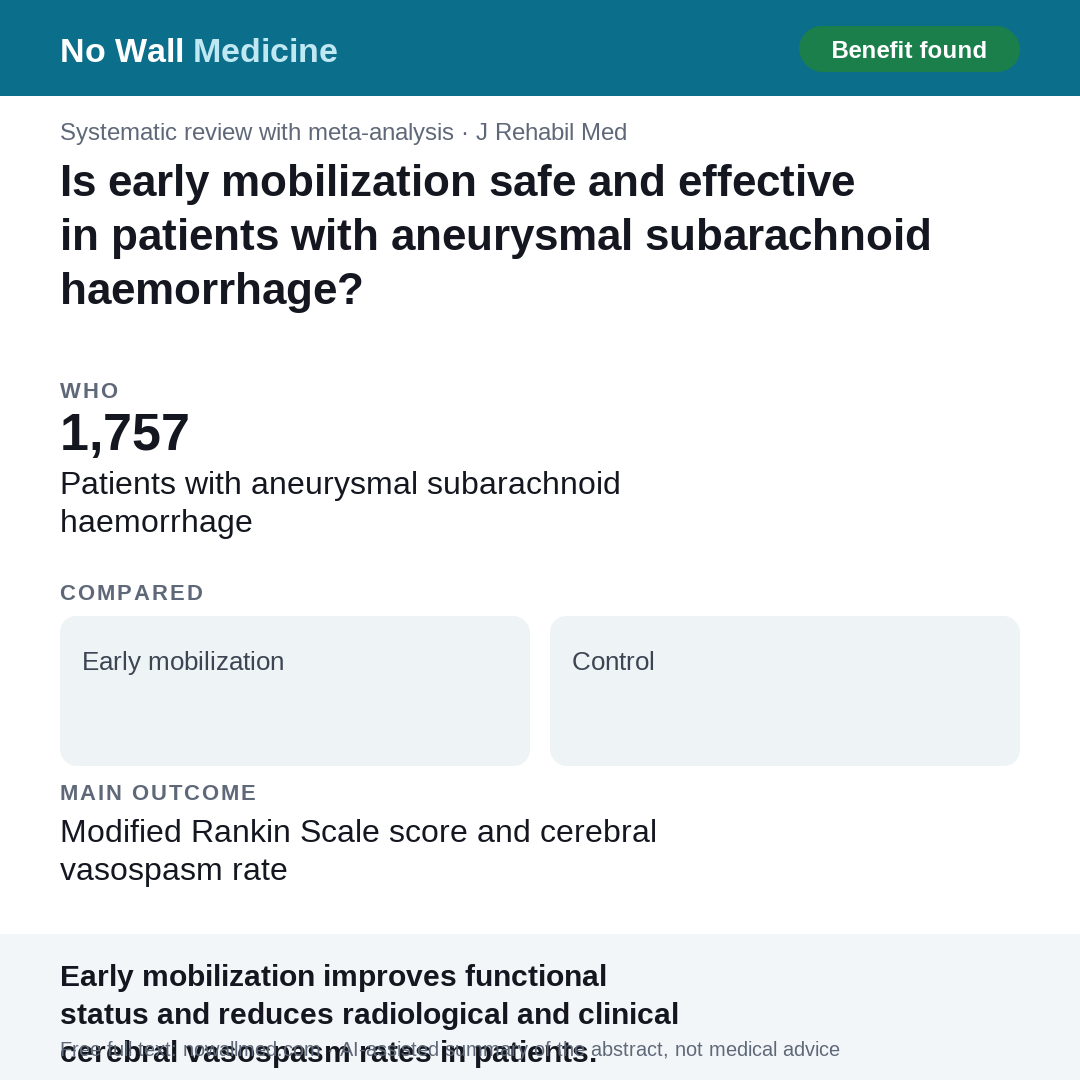
Clinical question: Is early mobilization safe and effective in patients with aneurysmal subarachnoid haemorrhage?
Abstract
Objective
The primary aim of this study was to evaluate the safety and efficacy of early mobilization in patients with aneurysmal subarachnoid haemorrhage. Design
Systematic review with meta-analysis of randomized controlled studies and observational studies. Patients
Patients with aneurysmal subarachnoid haemorrhage. Methods
PubMed, Embase, CINAHL, Web of Science, Pedro, and the Cochrane Library databases were searched. A systematic review and meta-analysis were performed. Screening and data extraction were performed by 2 independent reviewers. Results
Sixteen studies involving 1,757 patients were included. Meta-analysis of the data estimated that early mobilization improved mRS score at discharge (mean difference -1.39, 95% CI -2.51 to -0.28, I2 = 86%) and at 3 months (mean difference -1.10, 95% CI -1.54 to -0.66, I2 = 7%). Early mobilization was associated with a reduction in cerebral vasospasm rate, both radiological (OR 0.66, 95% CI 0.45 to 0.96, I2 = 7%) and clinical (OR 0.44, 95% CI 0.27 to 0.72, I2 = 8%); 6% of mobilization sessions involved adverse events, mostly haemodynamic changes. Conclusion
This review found moderate-quality evidence supporting the safety and effectiveness of early mobilization in patients with SAH. Further randomized controlled trials are needed to identify the appropriate mobilization strategy and confirm these results.
Topics
Cite this article
Foudhaili A, Leclere B, Martinache F, Chauvin A, Vitiello D, Chousterman B. Early mobilization in patients with aneurysmal subarachnoid haemorrhage may im-prove functional status and reduce cerebral vasospasm rate: a systematic review with meta-analysis. J Rehabil Med. 2024. doi:10.2340/jrm.v56.41225
Spotted a mistake? Suggest a correction
Top studies every Monday
The week’s key trials and guidelines in your specialties, by email. Free.
Get the weekly digest