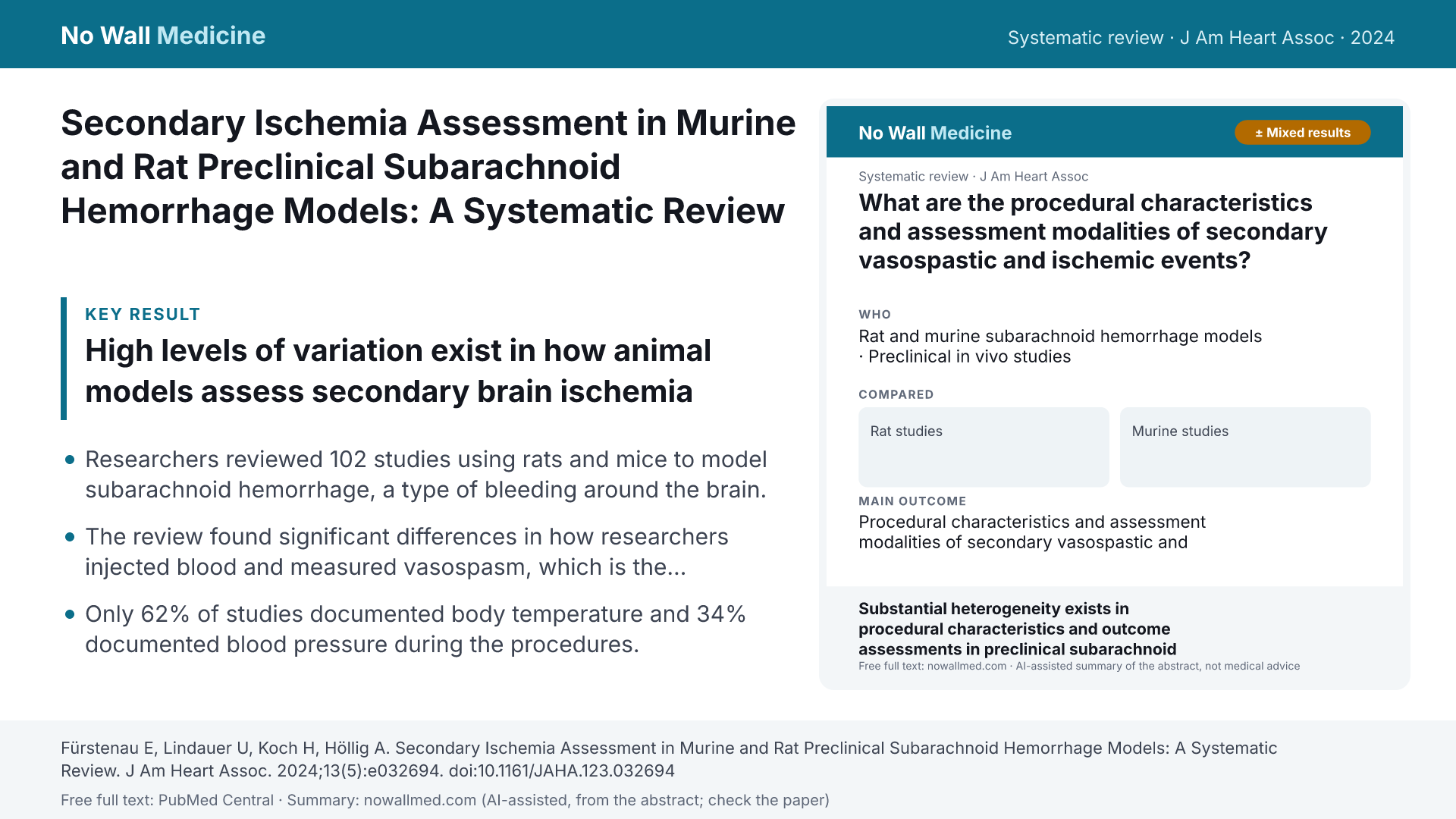
High levels of variation exist in how animal models assess secondary brain ischemia
Secondary Ischemia Assessment in Murine and Rat Preclinical Subarachnoid Hemorrhage Models: A Systematic Review
Systematic reviewMixed results
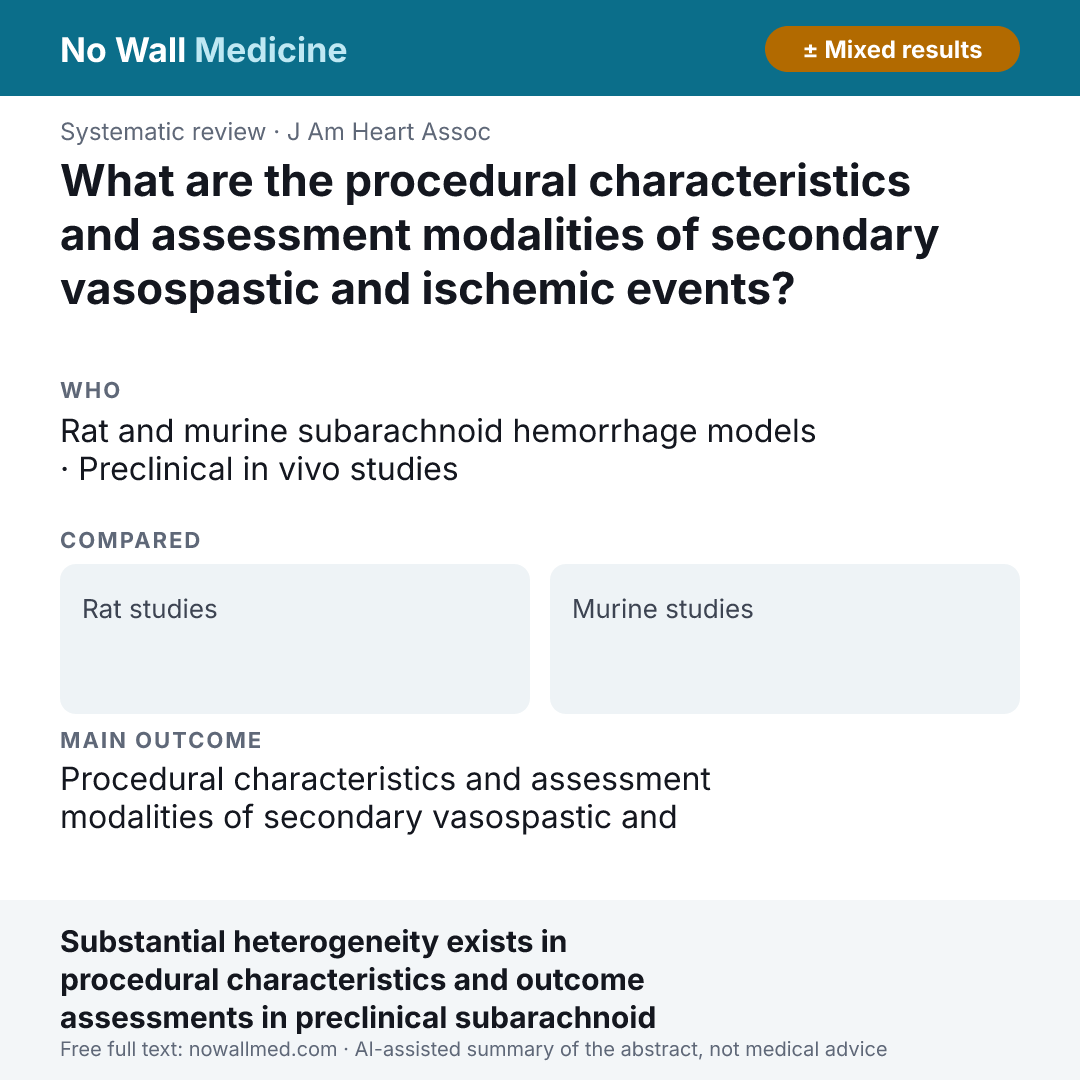
What are the procedural characteristics and assessment modalities of secondary vasospastic and ischemic events?
Who
Rat and murine subarachnoid hemorrhage models · Preclinical in vivo studies
Compared
Rat studies
Murine studies
Main outcome
Procedural characteristics and assessment modalities of secondary vasospastic and ischemic events
Bottom line: Substantial heterogeneity exists in procedural characteristics and outcome assessments in preclinical subarachnoid hemorrhage research.
J Am Heart Assoc · 2024-02-29 · PROSPERO CRD42022337279
Why it matters: The lack of standardized experimental setups and outcome assessments in animal models may contribute to why successful preclinical treatments fail in human clinical trials.
Headline and visual abstract written with AI from the paper’s abstract, with every number checked against it. Read the paper before relying on them.
Was this summary helpful?
Subject terms
Cite this article
Fürstenau E, Lindauer U, Koch H, Höllig A. Secondary Ischemia Assessment in Murine and Rat Preclinical Subarachnoid Hemorrhage Models: A Systematic Review. J Am Heart Assoc. 2024;13(5):e032694. doi:10.1161/JAHA.123.032694
Spotted a mistake? Suggest a correction