Trial protocol describes study of nintedanib for patients with subacute lung injury after COVID-19
Early nintedanib deployment in COVID-19 interstitial lung disease (ENDCOV-I): study protocol of a randomised, double-blind, placebo-controlled trial
Randomised, double-blind, placebo-controlled trialUnclear result
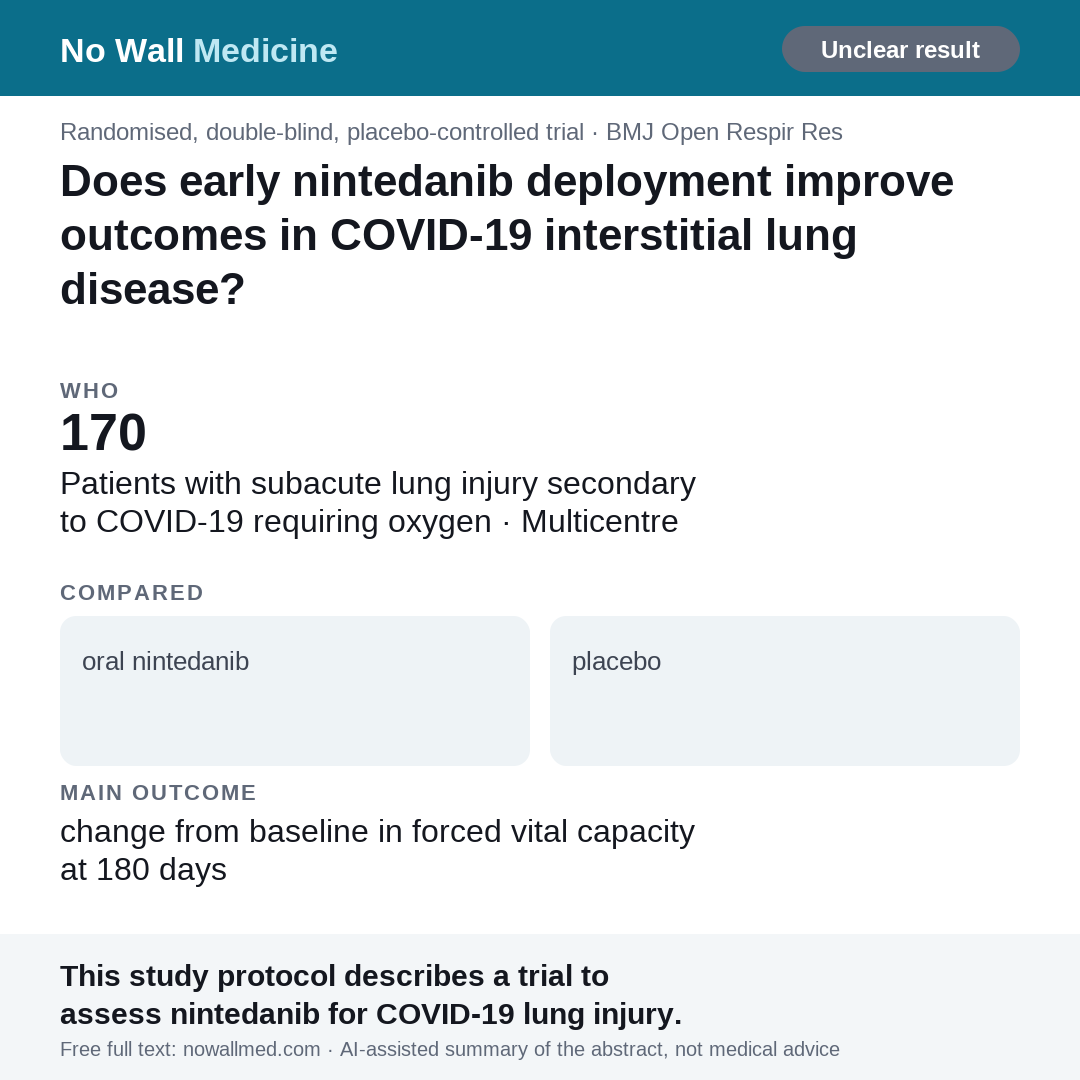
Does early nintedanib deployment improve outcomes in COVID-19 interstitial lung disease?
Who
170
Patients with subacute lung injury secondary to COVID-19 requiring oxygen · Multicentre
Compared
oral nintedanib
placebo
Main outcome
change from baseline in forced vital capacity at 180 days
Bottom line: This study protocol describes a trial to assess nintedanib for COVID-19 lung injury.
BMJ Open Respir Res · 2025-04-10Download image
Clinical question: Does early nintedanib deployment improve outcomes in COVID-19 interstitial lung disease?
Why it matters: Limited randomized trial data exists regarding whether nintedanib can treat progressive fibrotic lung disease caused by post-COVID-19 lung injury.
Key points
- Researchers are conducting a multicentre, randomized, double-blind, placebo-controlled trial involving approximately 170 patients with subacute lung injury from COVID-19 who required oxygen supplementation.
- The study will compare oral nintedanib, a tyrosine-kinase inhibitor, to a placebo over 180 days to measure changes in forced vital capacity, a measure of lung volume.
- Secondary outcomes include measuring the ability of lungs to transfer gas, walking distance, mortality, and changes in high-resolution computed tomography scans.
Headline and key points written with AI from the paper’s abstract, with every number checked against it. Read the paper before relying on them.
Was this summary helpful?
Abstract
Introduction
In December 2019, the novel SARS-CoV-2 triggered a global pneumonia outbreak, leading to millions of deaths worldwide. A subset of survivors faces increased morbidity and mortality, particularly due to subacute lung injury evolving to chronic fibrosing interstitial lung disease. While nintedanib, a tyrosine-kinase inhibitor, shows promise in treating progressive fibrotic lung disease, limited randomised trial data exists for post-COVID-19-induced lung injury. We hypothesise that treatment with nintedanib may attenuate advancement to the fibrotic stages, offering a potential avenue for improving outcomes in this specific patient subset. Methods and analysis
We describe the design of a multicentre, randomised, double-blind, placebo-controlled trial involving approximately 170 patients with subacute lung injury secondary to COVID-19, who required respiratory support with oxygen supplementation. Patients are randomised by site and disease phenotype (fibrotic vs non-fibrotic) in a 1:1 ratio to either oral nintedanib or placebo. Patients will be followed for 180 days. The primary endpoint is to assess change from baseline in forced vital capacity (FVC, mL) at 180 days. Secondary objectives include change in FVC (mL) at 90 days; diffusing capacity of carbon monoxide (% of predicted) and 6-min walk test (feet) at 180 days; and mortality at 90 and 180 days. Qualitative and quantitative changes in high-resolution computerised tomography (HRCT), change in patient-reported outcome measures (PROMs) and safety endpoints will also be assessed. Analysis will be performed according to the intention-to-treat principle. Ethics and dissemination
The study is conducted in accordance with the Good Clinical Practices as outlined by the Food and Drug Administration and the Declaration of Helsinki 2008. This study received approval from participating sites' Institutional Review Boards and committees, including The Ethics Committee of the Medical Board at the Mount Sinai Hospital (ID: HS#20-01166). The Independent Oversight Committee oversees study conduct, data and patient safety for the duration of the study investigation. The trial details presented align with the trial protocol V.8. (April 2022). Results will be presented at national and international conferences, published in a peer-reviewed journal and disseminated to patients, funders and researchers on data analysis completion. Trial registration number
NCT04619680. First posted 6 November 2020.
Abstract reproduced under the article’s CC BY NC licence.
Subject terms
Cite this article
Santibanez V, Mathur A, Zatakia J, Ng N, Cohen M, Bagiella E. Early nintedanib deployment in COVID-19 interstitial lung disease (ENDCOV-I): study protocol of a randomised, double-blind, placebo-controlled trial. BMJ Open Respir Res. 2025. doi:10.1136/bmjresp-2024-002323
Spotted a mistake? Suggest a correction
Top studies every Monday
The week’s key trials and guidelines in your specialties, plus any topics you follow. By email, free.
Get the weekly digest