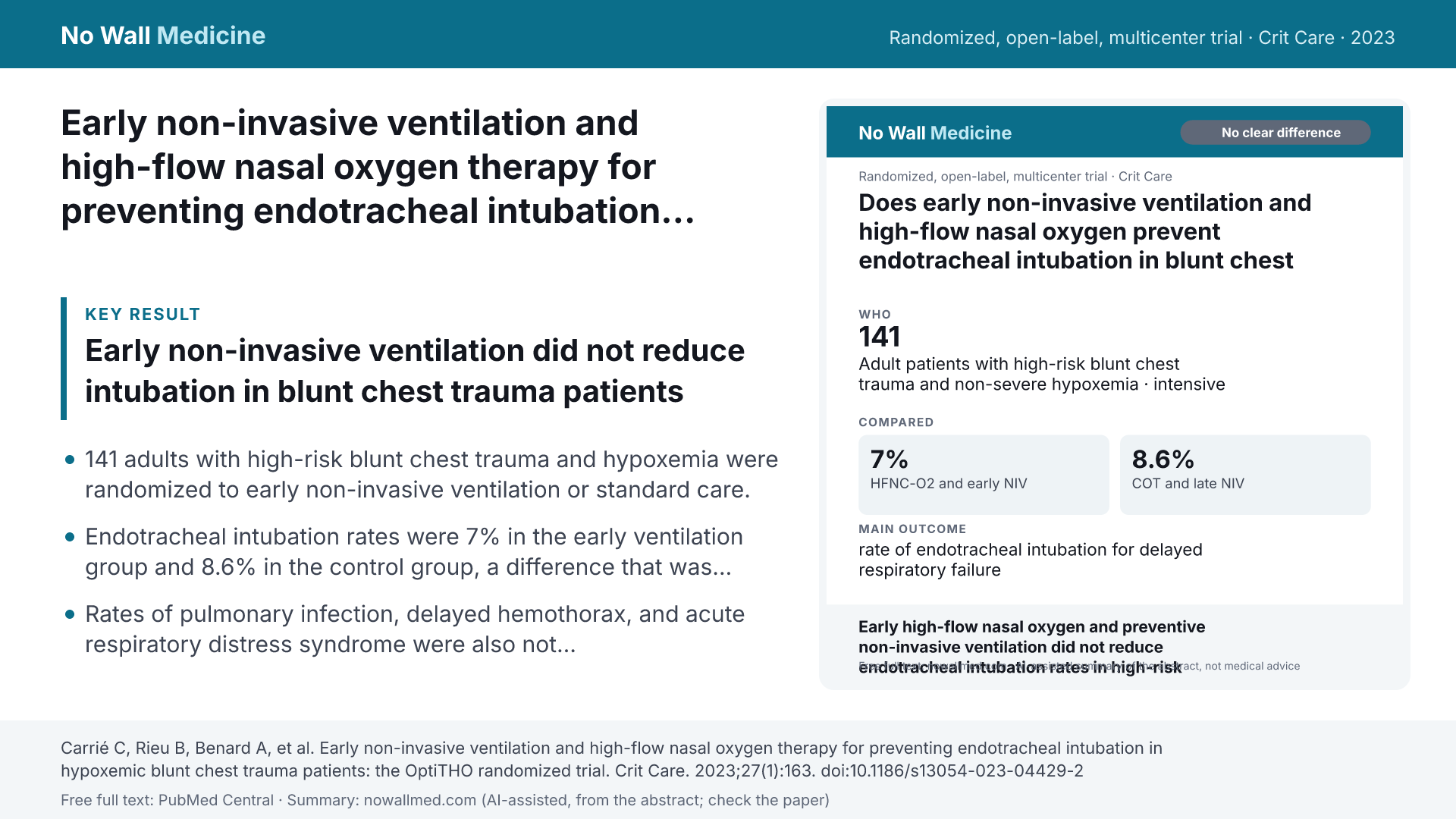
Early non-invasive ventilation and high-flow nasal oxygen therapy for preventing endotracheal intubation in hypoxemic blunt chest trauma patients: the OptiTHO randomized trial
Key result: Early non-invasive ventilation did not reduce intubation in blunt chest trauma patients
Key points
- 141 adults with high-risk blunt chest trauma and hypoxemia were randomized to early non-invasive ventilation or standard care.
- Endotracheal intubation rates were 7% in the early ventilation group and 8.6% in the control group, a difference that was not significant.
- Rates of pulmonary infection, delayed hemothorax, and acute respiratory distress syndrome were also not significantly different between groups.
Why it matters: The benefit-risk ratio of prophylactic non-invasive ventilation and high-flow nasal oxygen therapy during early blunt chest trauma remains controversial.
Limitation the authors note: Study enrollment was stopped for futility after a 2-year study period and randomization of 141 patients.
Discussion prompts
- Would these patients look like yours? Who was left out?
- Is the main outcome one that matters to patients?
- Is the difference large enough to change what you do?
Cite: Carrié C, Rieu B, Benard A, et al. Early non-invasive ventilation and high-flow nasal oxygen therapy for preventing endotracheal intubation in hypoxemic blunt chest trauma patients: the OptiTHO randomized trial. Crit Care. 2023;27(1):163. doi:10.1186/s13054-023-04429-2
Free full text: PubMed Central · Summary and visual abstract: nowallmed.com/a/early-non-invasive-ventilation-and-high-flow-nasal-oxygen-therapy-for-1nvmrmc/ (AI-assisted from the abstract; check the paper before relying on it).