Early non-response as a predictor of later non-response to antipsychotics in schizophrenia: a randomized trial
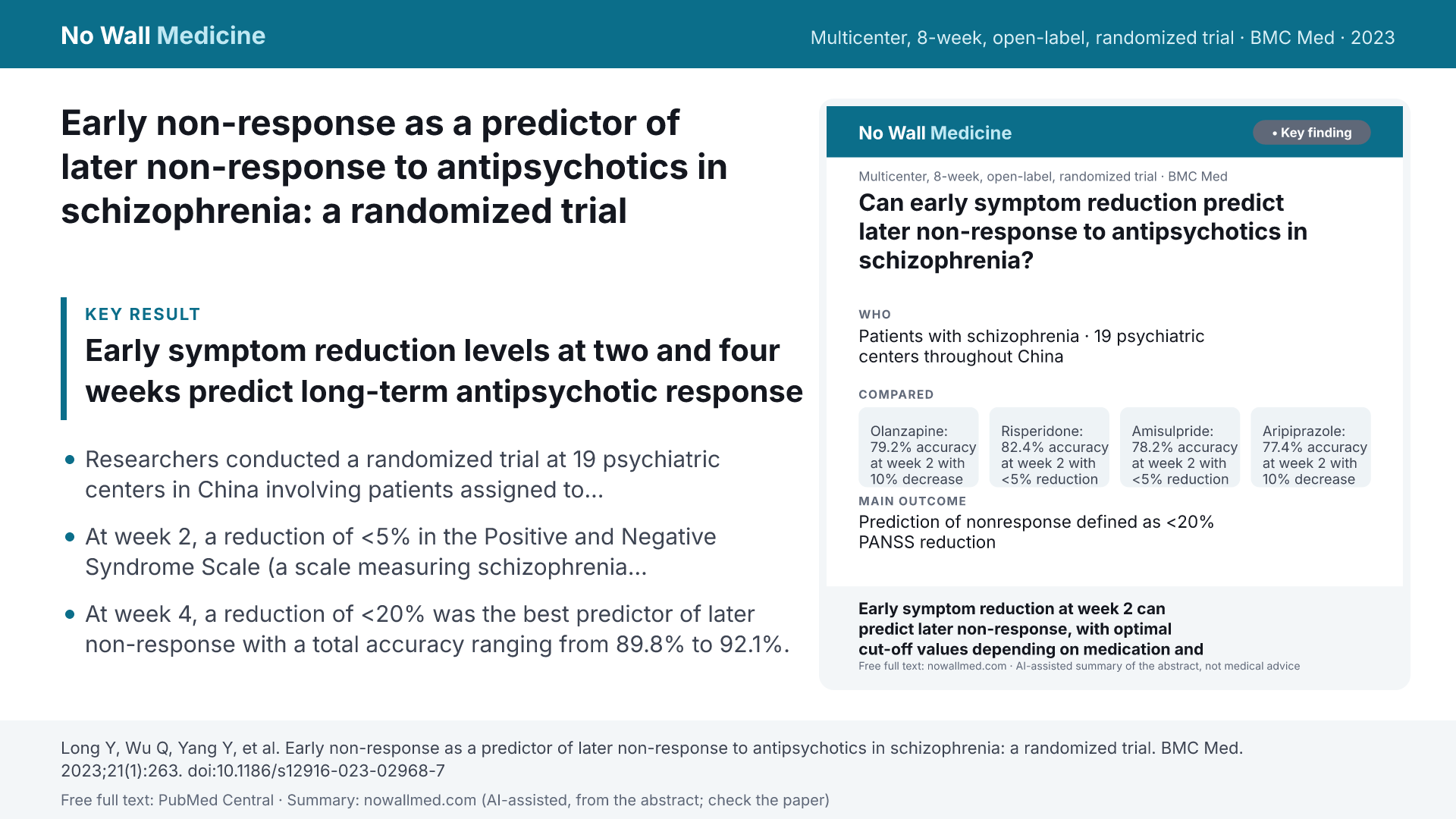
Key result: Early symptom reduction levels at two and four weeks predict long-term antipsychotic response
Multicenter, 8-week, open-label, randomized trialKey finding
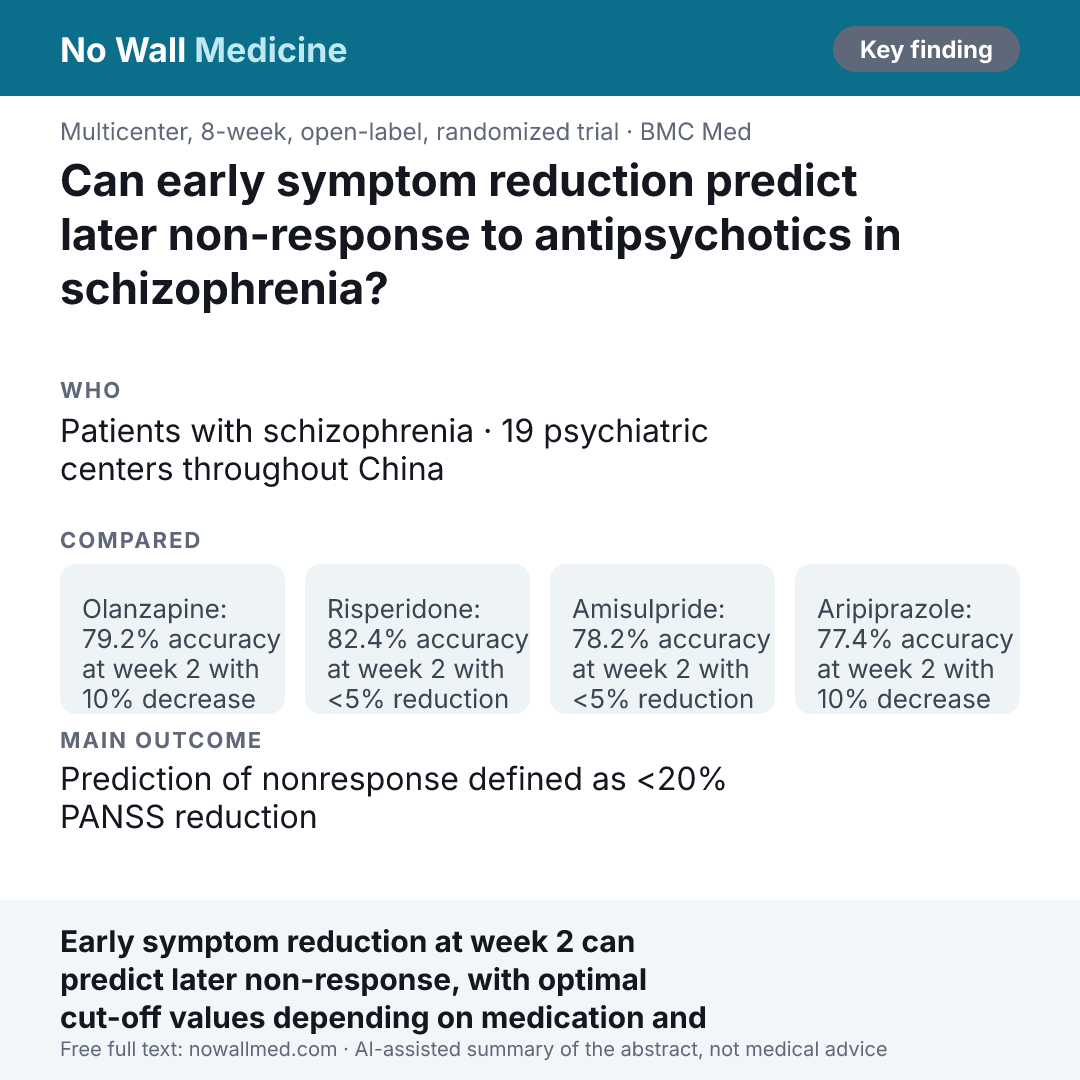
Can early symptom reduction predict later non-response to antipsychotics in schizophrenia?
Who
Patients with schizophrenia · 19 psychiatric centers throughout China
Compared
Olanzapine: 79.2% accuracy at week 2 with 10% decrease
Risperidone: 82.4% accuracy at week 2 with <5% reduction
Amisulpride: 78.2% accuracy at week 2 with <5% reduction
Aripiprazole: 77.4% accuracy at week 2 with 10% decrease
Main outcome
Prediction of nonresponse defined as <20% PANSS reduction
Bottom line: Early symptom reduction at week 2 can predict later non-response, with optimal cut-off values depending on medication and illness severity.
BMC Med · 2023-07-19 · Save PNG
Key points
- Researchers conducted a randomized trial at 19 psychiatric centers in China involving patients assigned to olanzapine, risperidone, amisulpride, or aripiprazole monotherapy.
- At week 2, a reduction of <5% in the Positive and Negative Syndrome Scale (a scale measuring schizophrenia symptoms) predicted later non-response with 75.0% to 82.4% accuracy depending on illness severity and medication.
- At week 4, a reduction of <20% was the best predictor of later non-response with a total accuracy ranging from 89.8% to 92.1%.
Why it matters: It is difficult to predict which patients with schizophrenia will fail to respond to antipsychotic medications in the long term based on early treatment stages.
Discussion prompts
- Would these patients look like yours? Who was left out?
- Is the main outcome one that matters to patients?
- Is the difference large enough to change what you do?
Cite: Long Y, Wu Q, Yang Y, et al. Early non-response as a predictor of later non-response to antipsychotics in schizophrenia: a randomized trial. BMC Med. 2023;21(1):263. doi:10.1186/s12916-023-02968-7
Free full text: PubMed Central · Summary and visual abstract: nowallmed.com/a/early-non-response-as-a-predictor-of-later-non-response-to-189apnt/ (AI-assisted from the abstract; check the paper before relying on it).