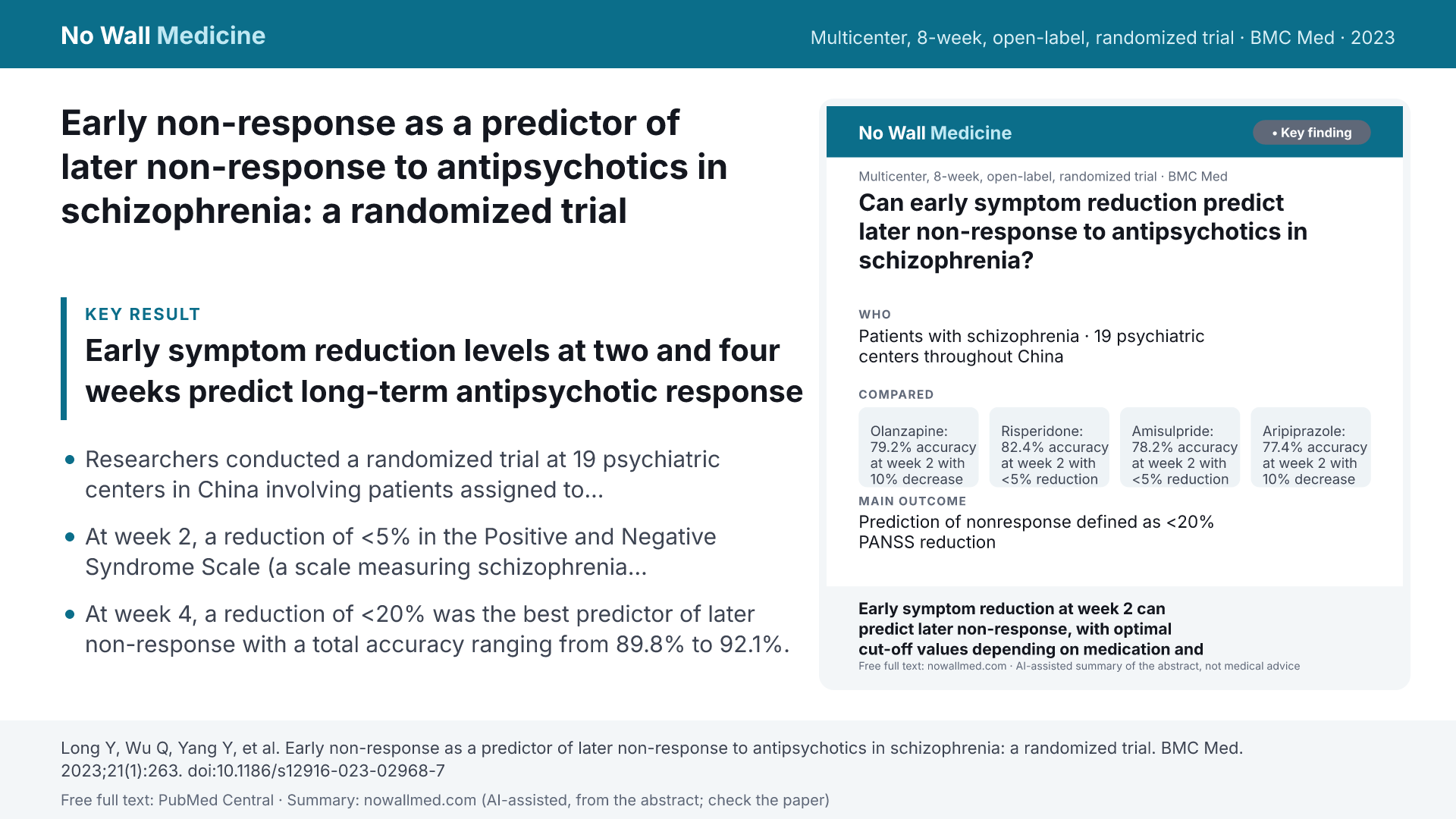
Early symptom reduction levels at two and four weeks predict long-term antipsychotic response
Early non-response as a predictor of later non-response to antipsychotics in schizophrenia: a randomized trial
Multicenter, 8-week, open-label, randomized trialBenefit found
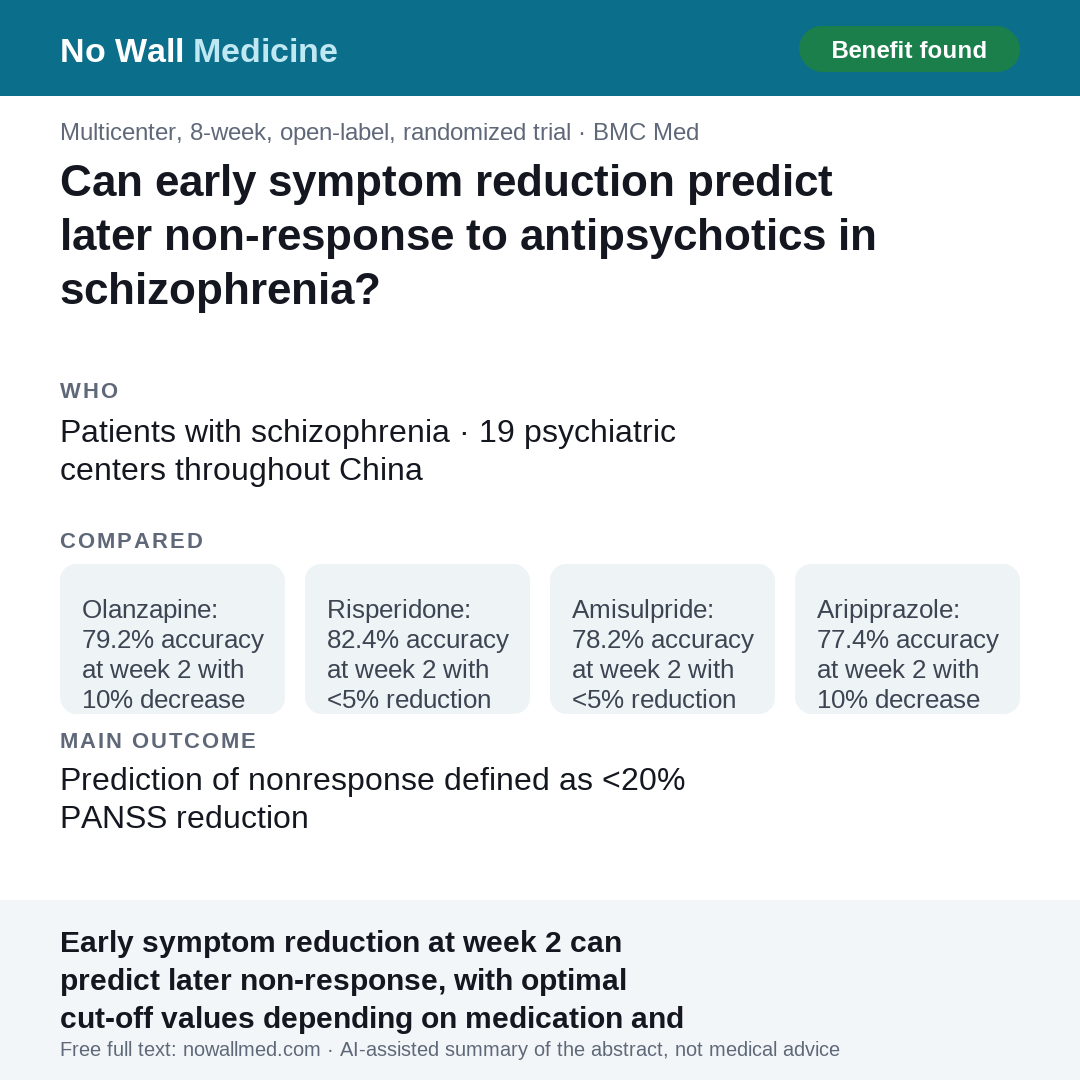
Can early symptom reduction predict later non-response to antipsychotics in schizophrenia?
Who
Patients with schizophrenia · 19 psychiatric centers throughout China
Compared
Olanzapine: 79.2% accuracy at week 2 with 10% decrease
Risperidone: 82.4% accuracy at week 2 with <5% reduction
Amisulpride: 78.2% accuracy at week 2 with <5% reduction
Aripiprazole: 77.4% accuracy at week 2 with 10% decrease
Main outcome
Prediction of nonresponse defined as <20% PANSS reduction
Bottom line: Early symptom reduction at week 2 can predict later non-response, with optimal cut-off values depending on medication and illness severity.
BMC Med · 2023-07-19Download image
Clinical question: Can early symptom reduction predict later non-response to antipsychotics in schizophrenia?
Why it matters: It is difficult to predict which patients with schizophrenia will fail to respond to antipsychotic medications in the long term based on early treatment stages.
Key points
- Researchers conducted a randomized trial at 19 psychiatric centers in China involving patients assigned to olanzapine, risperidone, amisulpride, or aripiprazole monotherapy.
- At week 2, a reduction of <5% in the Positive and Negative Syndrome Scale (a scale measuring schizophrenia symptoms) predicted later non-response with 75.0% to 82.4% accuracy depending on illness severity and medication.
- At week 4, a reduction of <20% was the best predictor of later non-response with a total accuracy ranging from 89.8% to 92.1%.
Headline and key points written with AI from the paper’s abstract, with every number checked against it. Read the paper before relying on them.
Was this summary helpful?
Subject terms
Cite this article
Long Y, Wu Q, Yang Y, et al. Early non-response as a predictor of later non-response to antipsychotics in schizophrenia: a randomized trial. BMC Med. 2023. doi:10.1186/s12916-023-02968-7
Spotted a mistake? Suggest a correction