Antipsychotic drugs were linked to impaired visuospatial working memory in healthy human volunteers
Effects of antipsychotics on human cognitive function: causal evidence from healthy volunteers following sustained D2/D3 antagonism, D2/D3 partial agonism and placebo
Double-blind, placebo-controlled crossover studyHarm found
Do sustained antipsychotics affect human cognitive function in healthy volunteers?
Who
50
Healthy humans
Compared
Amisulpride 400 mg daily: impaired Balanced Integration Score (p = 0.0079)
Aripiprazole 10 mg daily: impaired Balanced Integration Score (p = 0.015)
Placebo
Main outcome
Visuospatial working memory and sustained attention
Bottom line: Sustained dopamine D2/D3 receptor antagonism or partial agonism specifically impairs visuospatial working memory function in healthy humans.
Mol Psychiatry · 2025-07-19Download image
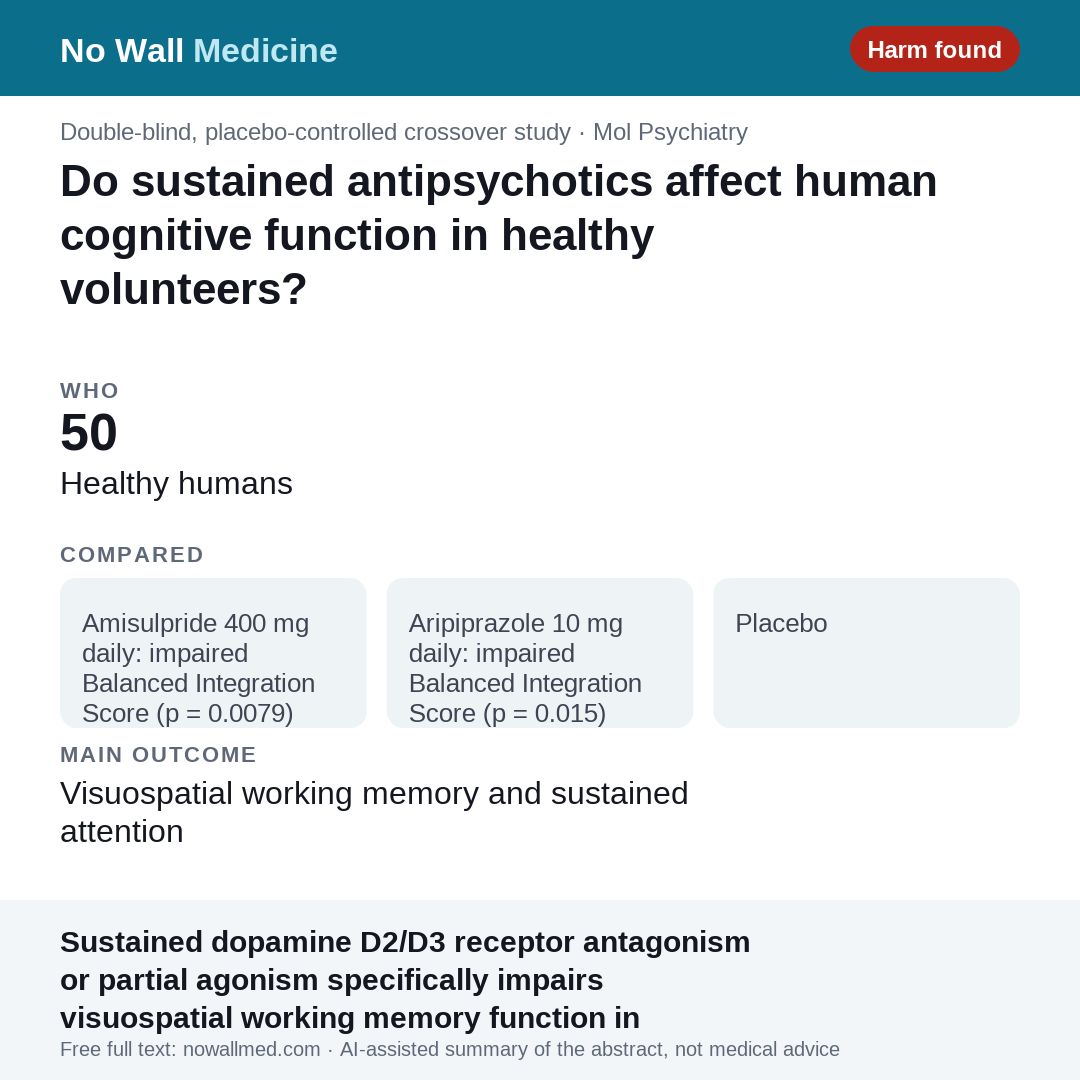
Clinical question: Do sustained antipsychotics affect human cognitive function in healthy volunteers?
Why it matters: Causal evidence regarding how sustained dopamine D2/D3 receptor modulation by antipsychotics affects human cognitive function is limited.
Key points
- Researchers conducted a double-blind, placebo-controlled crossover study with 50 healthy humans receiving either amisulpride, aripiprazole, or a placebo for 7 days.
- Both amisulpride and aripiprazole were linked to impairments in visuospatial working memory performance, specifically regarding response latency, compared to placebo.
- Neither drug was linked to changes in response accuracy, sustained attention, response inhibition, subjective alertness, or motor impairments.
Headline and key points written with AI from the paper’s abstract, with every number checked against it. Read the paper before relying on them.
Topics
Cite this article
Osugo M, Zahid U, Selvaggi P, Chilimidos A, Finelli V, Chapman GE. Effects of antipsychotics on human cognitive function: causal evidence from healthy volunteers following sustained D2/D3 antagonism, D2/D3 partial agonism and placebo. Mol Psychiatry. 2025. doi:10.1038/s41380-025-03116-8
Spotted a mistake? Suggest a correction
Top studies every Monday
The week’s key trials and guidelines in your specialties, plus any topics you follow. By email, free.
Get the weekly digest