Early norepinephrine for patients with septic shock: an updated systematic review and meta-analysis with trial sequential analysis
Systematic review and meta-analysisBenefit found
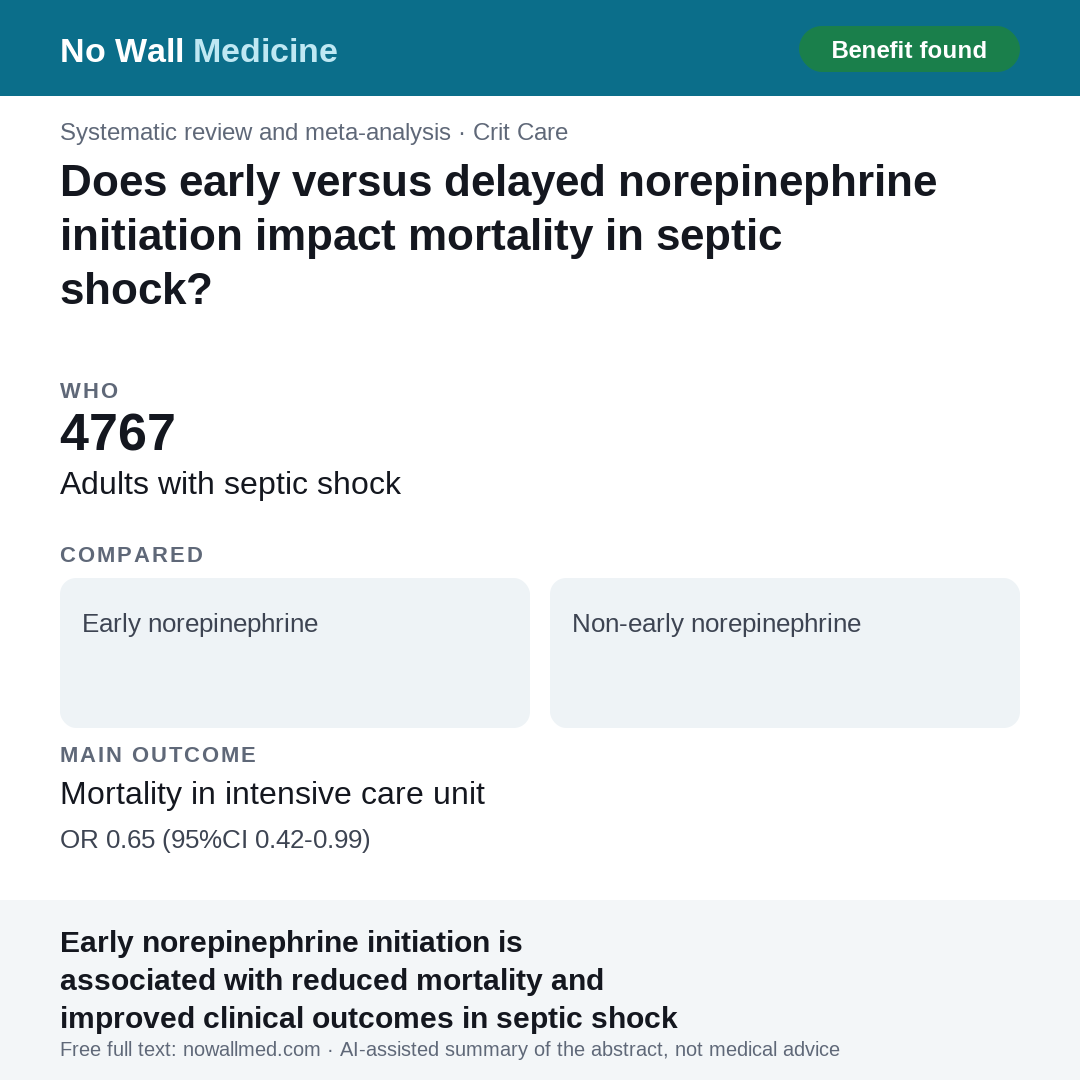
Does early versus delayed norepinephrine initiation impact mortality in septic shock?
Who
4767
Adults with septic shock
Compared
Early norepinephrine
Non-early norepinephrine
Main outcome
Mortality in intensive care unit
Result: OR 0.65 (95%CI 0.42-0.99)
Bottom line: Early norepinephrine initiation is associated with reduced mortality and improved clinical outcomes in septic shock patients.
Limitation: Trial sequential analysis indicated more data are needed to confirm findings.
Crit Care · 2025-05-06Download image
Clinical question: Does early versus delayed norepinephrine initiation impact mortality in septic shock?
Abstract
Background
The optimal timing for initiating norepinephrine in septic shock is debated. This updated systematic review and meta-analysis aimed to evaluate the impact of early versus delayed norepinephrine initiation on mortality and clinical outcomes in adults with septic shock. Methods
A systematic search in Pubmed, EMbase and the Cochrane Library to identify eligible randomized controlled trials, propensity score matching (PSM) and observational studies that compare early norepinephrine initiation with non-early norepinephrine initiation in patients with acute circulatory failure. The primary outcome was mortality in intensive care unit. Secondary outcomes included intensive care unit length of stay, fluid volume received at 6 h, norepinephrine dose, mechanical ventilation-free days, renal replacement therapy free days, and time to achieve a targeted mean arterial pressure (MAP). Meta-analysis and subgroup analysis were conducted to calculate odds ratio (OR) or mean difference with 95% confidence interval (95%CI) using random-effect model. Trial sequential analysis was conducted to evaluate the conclusiveness of evidence. Results
Ten studies (two RCT, three PSM and five observational studies) involving 4767 patients were included. Early norepinephrine significantly reduced mortality in RCT (OR 0.49, 95%CI 0.25-0.96; I2 = 45%, p = 0.04), pooled RCT and PSM (OR 0.65, 95%CI 0.42-0.99; I2 = 74%, p = 0.05), and observational studies (OR 0.71, 95%CI 0.54-0.94; I2 = 66%). The trial sequential analysis indicated more data are needed. Subgroup analyses showed reduced mortality with early norepinephrine when lactate was ≤ 3mmol/L and administered within 1 h. Secondary outcomes showed a reduced fluid volume at 6h (RCT + PSM: mean difference -502 mL, 95%CI -899 to -106; I2 = 91%, p = 0.01), faster MAP target achievement (RCT + PSM: mean difference -1.30h, 95%CI -1.75 to -0.85; I2 = 0%, p < 0.01), more mechanical ventilation-free days (RCT + PSM: mean difference 3.99 days, 95%CI 2.42-5.57; I2 = 32%, p < 0.01) and smaller cumulative norepinephrine dose (Observational: mean difference -3.44 mcg/kg, 95%CI -6.13 to -0.76; I2 = 0%, p = 0.01) in the early initiation group compare to the non-early initiation group. Conclusion
Early norepinephrine introduction in septic shock is associated with reduced mortality, decreased fluid volume administered at 6 h, faster time to achieve MAP target and more mechanical ventilation-free days. However, the trial sequential analysis indicates that further RCT are still needed to confirm these findings.
Topics
Cite this article
Shi R, Braïk R, Monnet X, Gu WJ, Ospina-Tascon G, Permpikul C. Early norepinephrine for patients with septic shock: an updated systematic review and meta-analysis with trial sequential analysis. Crit Care. 2025. doi:10.1186/s13054-025-05400-z
Spotted a mistake? Suggest a correction
Top studies every Monday
The week’s key trials and guidelines in your specialties, by email. Free.
Get the weekly digest