Early awake prone positioning was associated with lower mortality in patients with COVID-19
Early versus late awake prone positioning in non-intubated patients with COVID-19
Post hoc analysis of a randomized controlled trialBenefit found
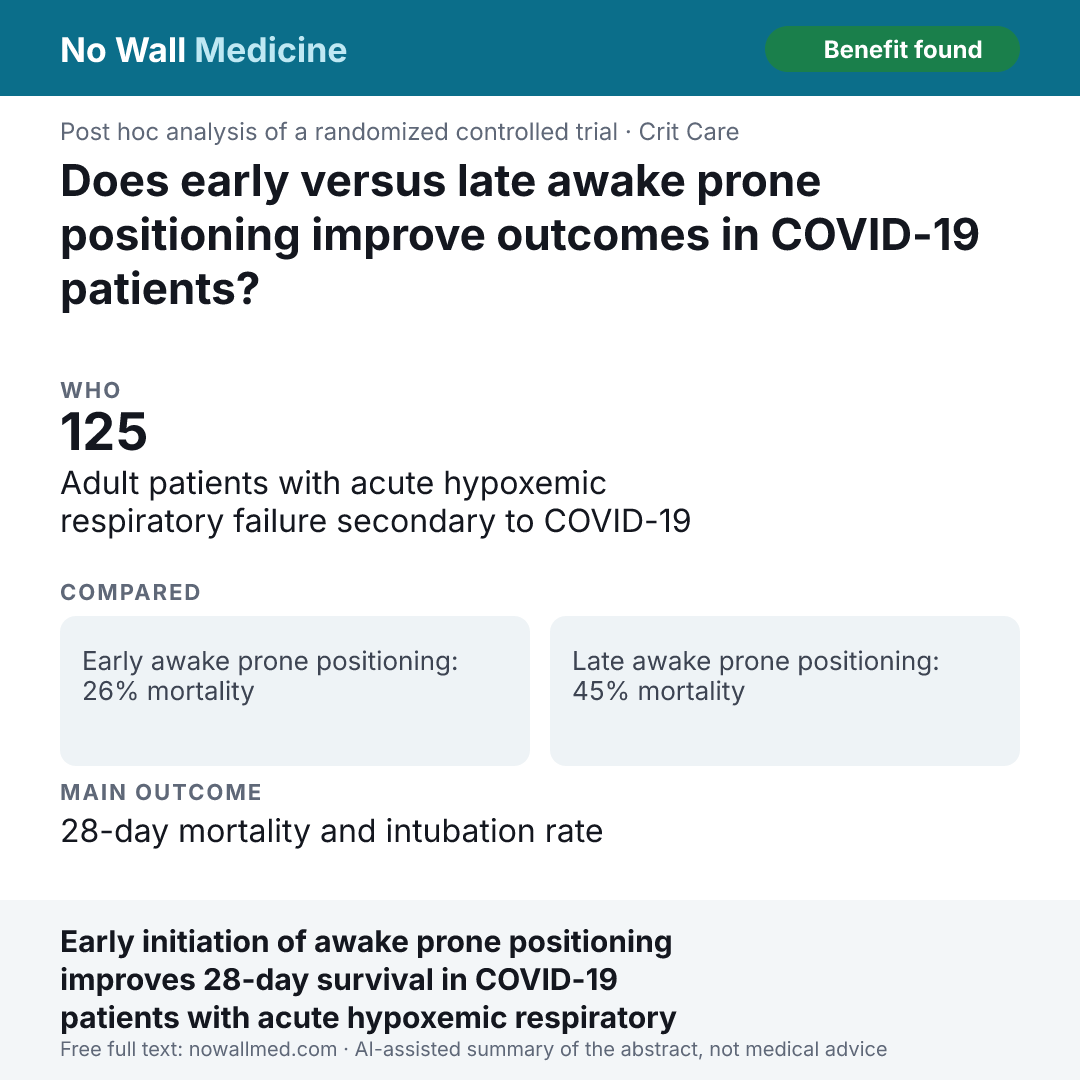
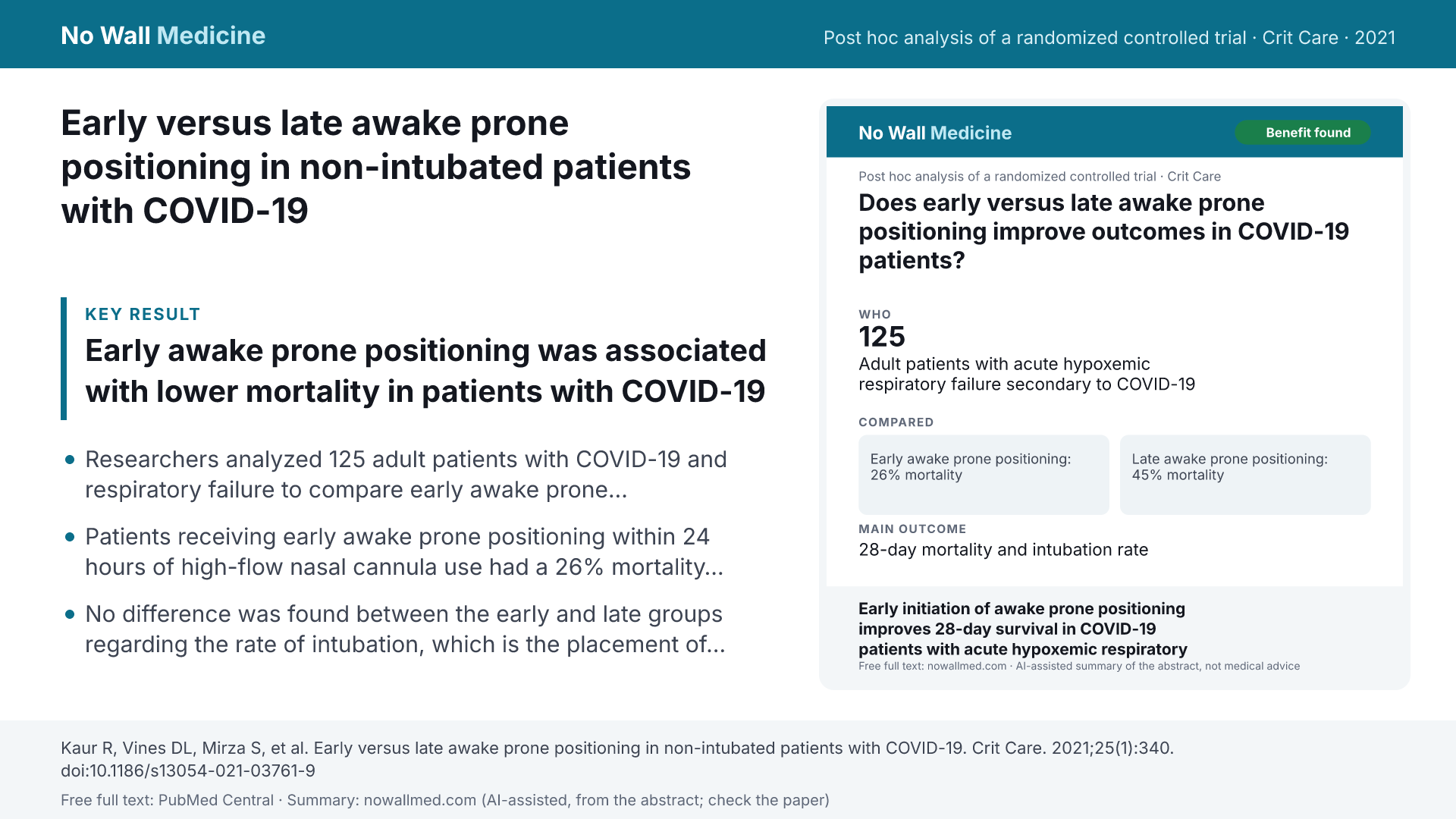
Does early versus late awake prone positioning improve outcomes in COVID-19 patients?
Who
125
Adult patients with acute hypoxemic respiratory failure secondary to COVID-19
Compared
Early awake prone positioning: 26% mortality
Late awake prone positioning: 45% mortality
Main outcome
28-day mortality and intubation rate
Bottom line: Early initiation of awake prone positioning improves 28-day survival in COVID-19 patients with acute hypoxemic respiratory failure.
Crit Care · 2021-09-17 · Save PNG
Same trial (NCT04325906)
Papers we list that report this registered trial, oldest first. Read a secondary analysis alongside the main results.
- Main results Benefit found
Awake prone positioning reduced treatment failure and intubation in patients with severe COVID-19 Lancet Respir Med 2021-08 - Secondary analysis Benefit found
This paper Crit Care 2021-09
Clinical question: Does early versus late awake prone positioning improve outcomes in COVID-19 patients?
Key points
- Researchers analyzed 125 adult patients with COVID-19 and respiratory failure to compare early awake prone positioning with late awake prone positioning.
- Patients receiving early awake prone positioning within 24 hours of high-flow nasal cannula use had a 26% mortality rate compared to 45% in the late group.
- No difference was found between the early and late groups regarding the rate of intubation, which is the placement of a breathing tube.
Headline and key points written with AI from the paper’s abstract, with every number checked against it. Read the paper before relying on them.
Was this summary helpful?
Abstract
Background
Awake prone positioning (APP) is widely used in the management of patients with coronavirus disease (COVID-19). The primary objective of this study was to compare the outcome of COVID-19 patients who received early versus late APP. Methods
Post hoc analysis of data collected for a randomized controlled trial (ClinicalTrials.gov NCT04325906). Adult patients with acute hypoxemic respiratory failure secondary to COVID-19 who received APP for at least one hour were included. Early prone positioning was defined as APP initiated within 24 h of high-flow nasal cannula (HFNC) start. Primary outcomes were 28-day mortality and intubation rate. Results
We included 125 patients (79 male) with a mean age of 62 years. Of them, 92 (73.6%) received early APP and 33 (26.4%) received late APP. Median time from HFNC initiation to APP was 2.25 (0.8-12.82) vs 36.35 (30.2-75.23) hours in the early and late APP group (p < 0.0001), respectively. Average APP duration was 5.07 (2.0-9.05) and 3.0 (1.09-5.64) hours per day in early and late APP group (p < 0.0001), respectively. The early APP group had lower mortality compared to the late APP group (26% vs 45%, p = 0.039), but no difference was found in intubation rate. Advanced age (OR 1.12 [95% CI 1.0-1.95], p = 0.001), intubation (OR 10.65 [95% CI 2.77-40.91], p = 0.001), longer time to initiate APP (OR 1.02 [95% CI 1.0-1.04], p = 0.047) and hydrocortisone use (OR 6.2 [95% CI 1.23-31.1], p = 0.027) were associated with increased mortality. Conclusions
Early initiation (< 24 h of HFNC use) of APP in acute hypoxemic respiratory failure secondary to COVID-19 improves 28-day survival. Trial registration ClinicalTrials.gov NCT04325906.
Abstract reproduced under the article’s CC BY licence.
Subject terms
Headline, design, result, key points, caveat and citation as plain text.
Cite this article
Kaur R, Vines DL, Mirza S, et al. Early versus late awake prone positioning in non-intubated patients with COVID-19. Crit Care. 2021;25(1):340. doi:10.1186/s13054-021-03761-9
Spotted a mistake? Suggest a correction