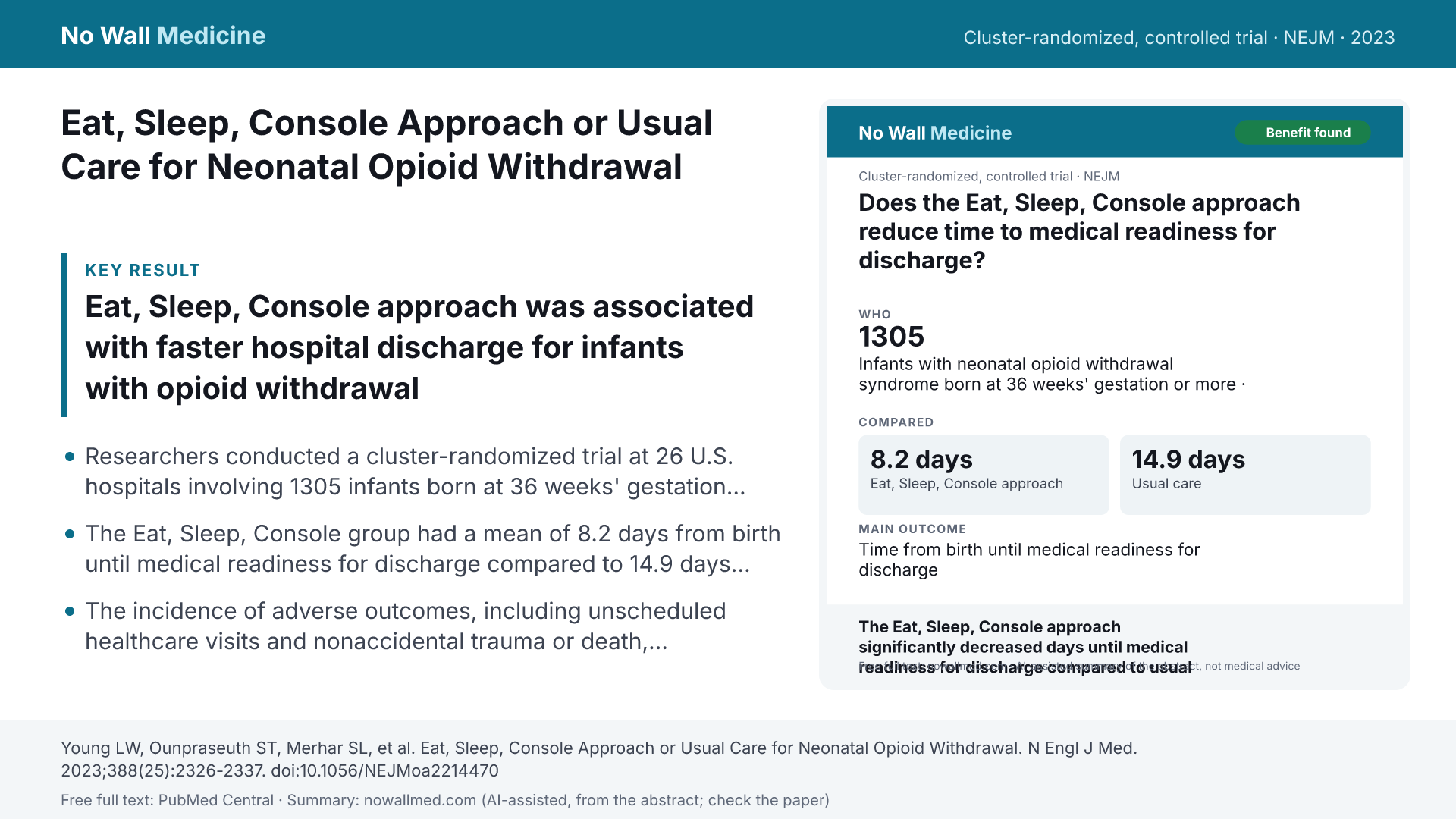
Eat, Sleep, Console approach was associated with faster hospital discharge for infants with opioid withdrawal
Eat, Sleep, Console Approach or Usual Care for Neonatal Opioid Withdrawal
Cluster-randomized, controlled trialBenefit found
Does the Eat, Sleep, Console approach reduce time to medical readiness for discharge?
Who
1305
Infants with neonatal opioid withdrawal syndrome born at 36 weeks' gestation or more · 26 United States hospitals
Compared
8.2 daysEat, Sleep, Console approach
14.9 daysUsual care
Main outcome
Time from birth until medical readiness for discharge
Result: rate ratio 0.55 (95% CI, 0.46 to 0.65)
Bottom line: The Eat, Sleep, Console approach significantly decreased days until medical readiness for discharge compared to usual care.
Funded by: National Institutes of Health Helping End Addiction Long-term Initiative
NEJM · 2023-04-30Download image
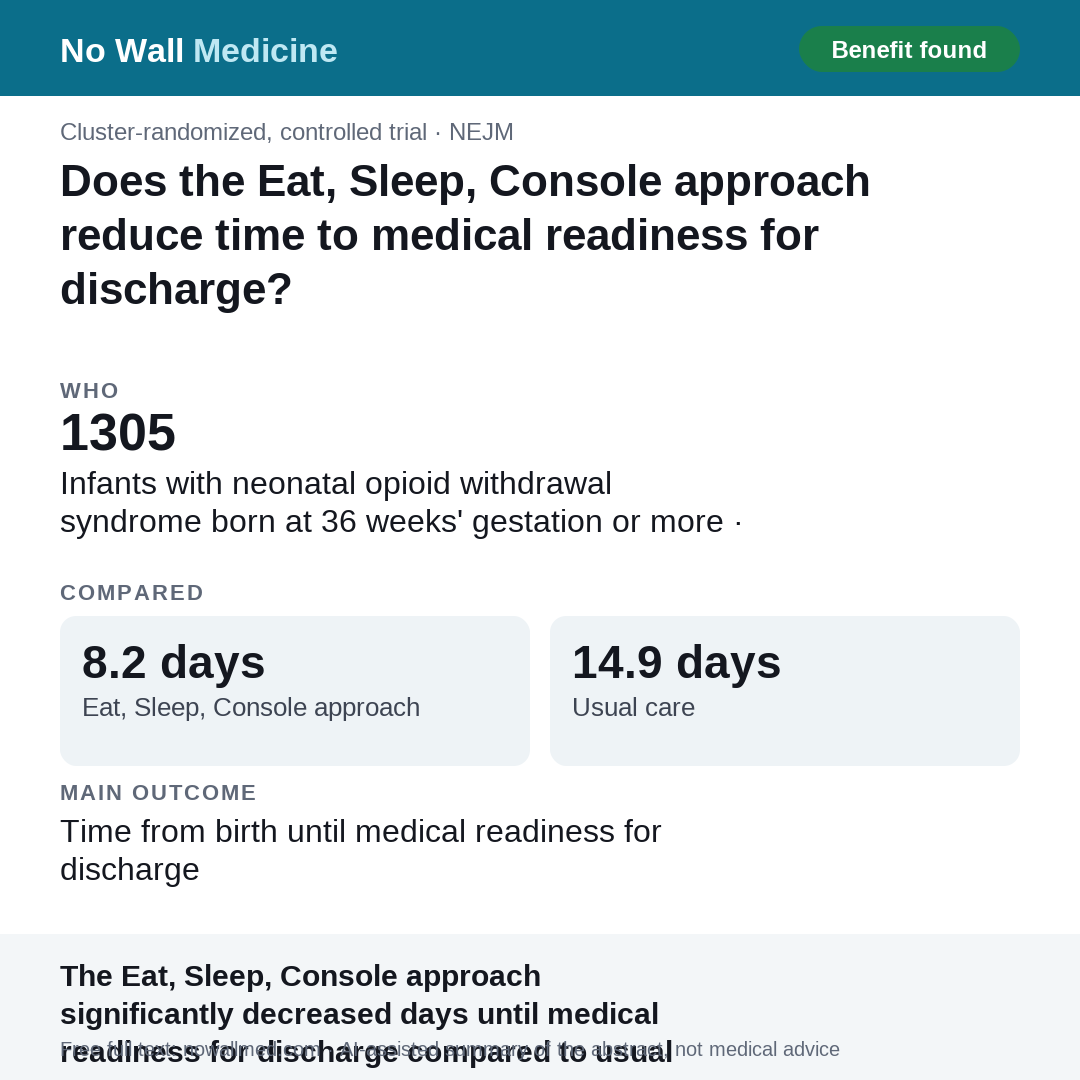
Clinical question: Does the Eat, Sleep, Console approach reduce time to medical readiness for discharge?
Why it matters: It was unknown if the Eat, Sleep, Console approach could safely reduce the time until infants are medically ready for discharge when applied across diverse sites.
Key points
- Researchers conducted a cluster-randomized trial at 26 U.S. hospitals involving 1305 infants born at 36 weeks' gestation or more with neonatal opioid withdrawal syndrome.
- The Eat, Sleep, Console group had a mean of 8.2 days from birth until medical readiness for discharge compared to 14.9 days in the usual care group.
- The incidence of adverse outcomes, including unscheduled healthcare visits and nonaccidental trauma or death, was similar between the two groups.
Headline and key points written with AI from the paper’s abstract, with every number checked against it. Read the paper before relying on them.
Was this summary helpful?
Subject terms
Cite this article
Young LW, Ounpraseuth ST, Merhar SL, et al. Eat, Sleep, Console Approach or Usual Care for Neonatal Opioid Withdrawal. NEJM. 2023. doi:10.1056/NEJMoa2214470
Spotted a mistake? Suggest a correction