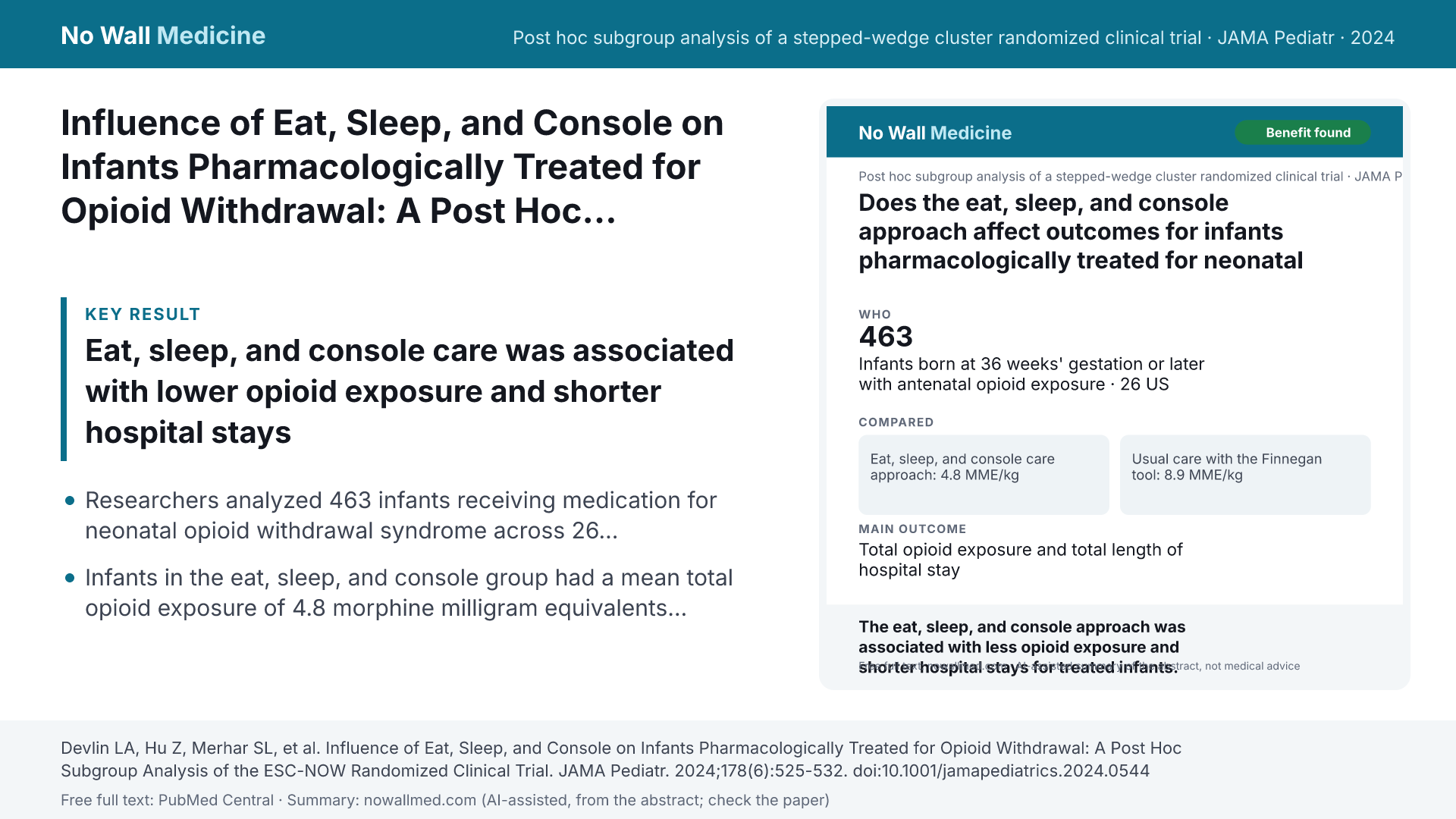
Eat, sleep, and console care was associated with lower opioid exposure and shorter hospital stays
Influence of Eat, Sleep, and Console on Infants Pharmacologically Treated for Opioid Withdrawal: A Post Hoc Subgroup Analysis of the ESC-NOW Randomized Clinical Trial
Post hoc subgroup analysis of a stepped-wedge cluster randomized clinical trialBenefit found
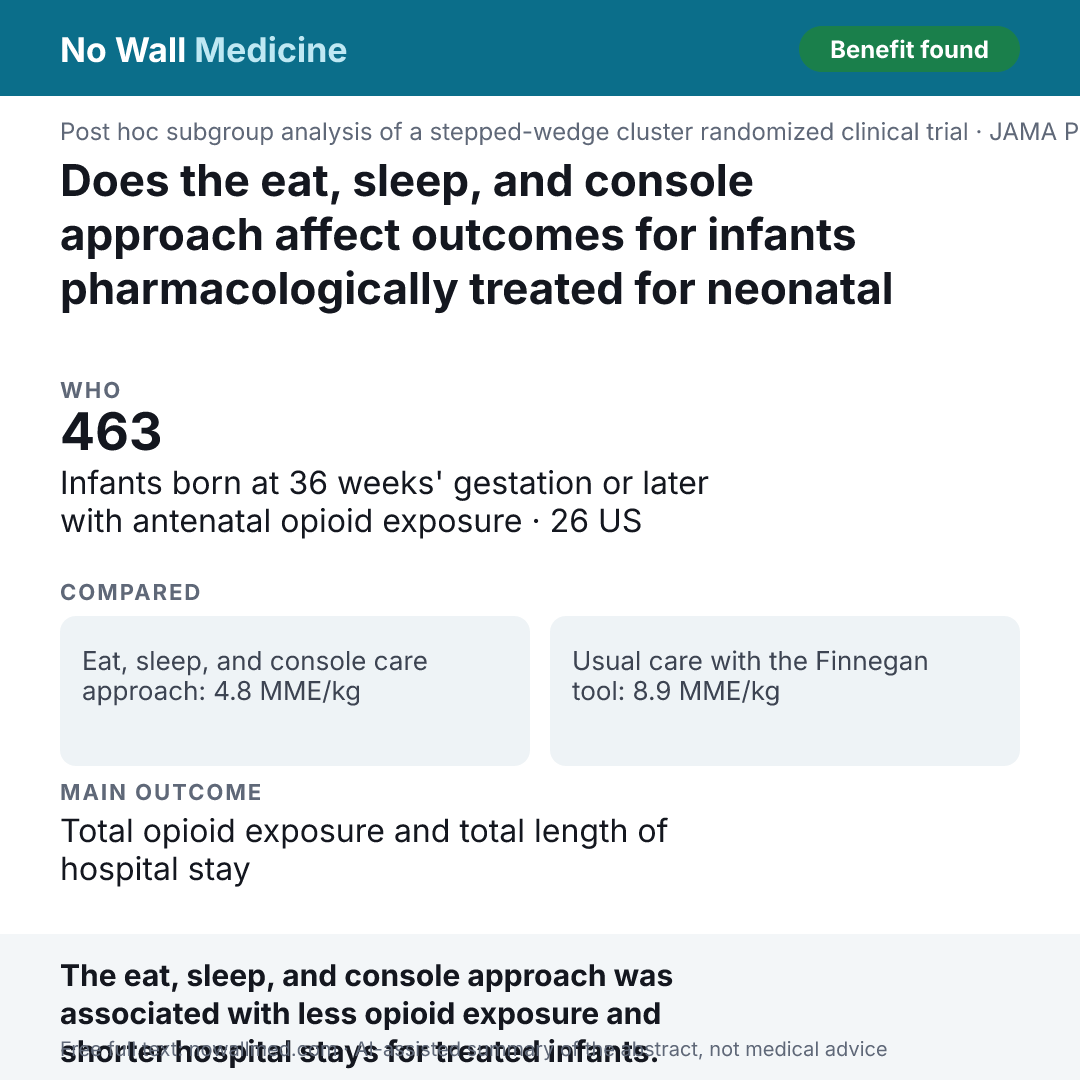
Does the eat, sleep, and console approach affect outcomes for infants pharmacologically treated for neonatal opioid withdrawal syndrome?
Who
463
Infants born at 36 weeks' gestation or later with antenatal opioid exposure · 26 US hospitals
Compared
Eat, sleep, and console care approach: 4.8 MME/kg
Usual care with the Finnegan tool: 8.9 MME/kg
Main outcome
Total opioid exposure and total length of hospital stay
Result: absolute difference of 4.1 morphine milligram equivalents per kilogram (95% CI, 1.3-7.0)
Bottom line: The eat, sleep, and console approach was associated with less opioid exposure and shorter hospital stays for treated infants.
JAMA Pediatr · 2024-04-15 · Save PNG
Same trial (NCT04057820)
Papers we list that report this registered trial, oldest first. Read a secondary analysis alongside the main results.
- Main results Benefit found
Eat, Sleep, Console approach was associated with faster hospital discharge for infants with opioid withdrawal NEJM 2023-04 - Secondary analysis Benefit found
This paper JAMA Pediatr 2024-04 - Secondary analysis Benefit found
Infants receiving Eat, Sleep, Console care were more likely to be breastfed than usual care JAMA Pediatr 2024-08 - Secondary analysis Benefit found
Eat, Sleep, Console approach associated with less medication and shorter hospital stays for infants J Pediatr 2025-10
Clinical question: Does the eat, sleep, and console approach affect outcomes for infants pharmacologically treated for neonatal opioid withdrawal syndrome?
Key points
- Researchers analyzed 463 infants receiving medication for neonatal opioid withdrawal syndrome across 26 hospitals, comparing the eat, sleep, and console approach to usual care.
- Infants in the eat, sleep, and console group had a mean total opioid exposure of 4.8 morphine milligram equivalents per kilogram compared to 8.9 morphine milligram equivalents per kilogram in usual care.
- The eat, sleep, and console approach was associated with a mean hospital stay of 16.7 days compared to 22.9 days for usual care.
Headline and key points written with AI from the paper’s abstract, with every number checked against it. Read the paper before relying on them.
Was this summary helpful?
Subject terms
Headline, design, result, key points, caveat and citation as plain text.
Cite this article
Devlin LA, Hu Z, Merhar SL, et al. Influence of Eat, Sleep, and Console on Infants Pharmacologically Treated for Opioid Withdrawal: A Post Hoc Subgroup Analysis of the ESC-NOW Randomized Clinical Trial. JAMA Pediatr. 2024;178(6):525-532. doi:10.1001/jamapediatrics.2024.0544
Spotted a mistake? Suggest a correction