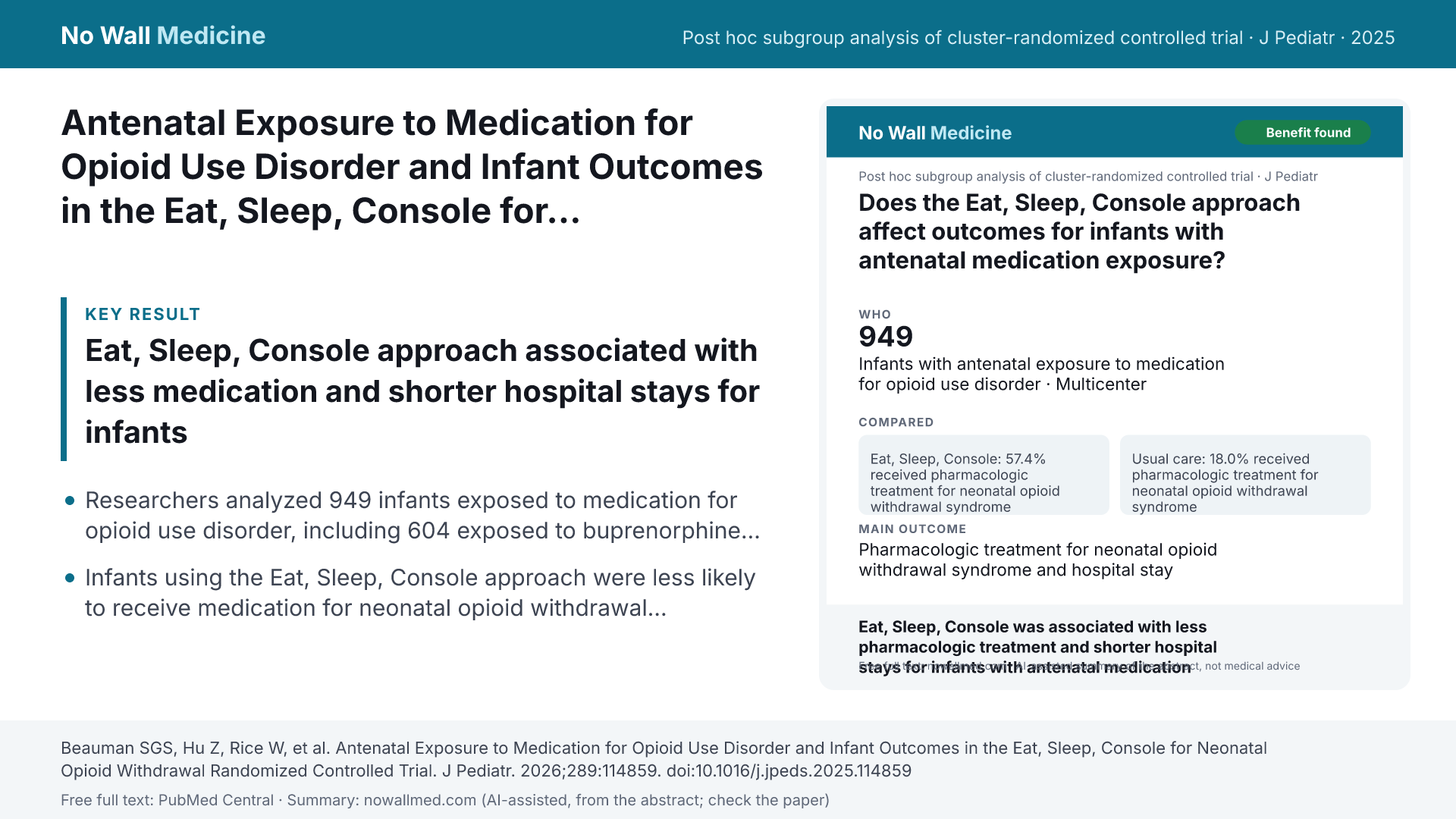
Eat, Sleep, Console approach associated with less medication and shorter hospital stays for infants
Antenatal Exposure to Medication for Opioid Use Disorder and Infant Outcomes in the Eat, Sleep, Console for Neonatal Opioid Withdrawal Randomized Controlled Trial
Post hoc subgroup analysis of cluster-randomized controlled trialBenefit found
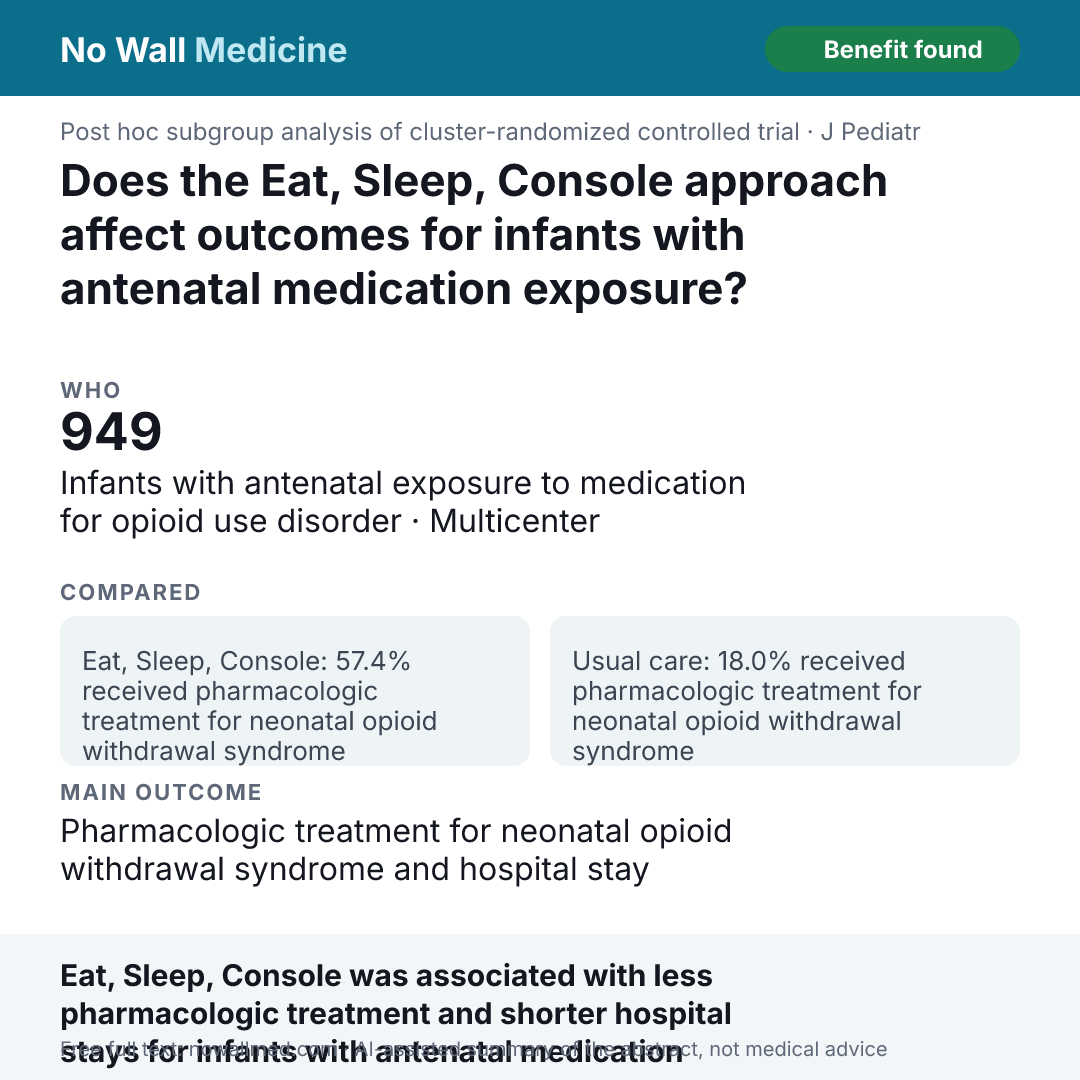
Does the Eat, Sleep, Console approach affect outcomes for infants with antenatal medication exposure?
Who
949
Infants with antenatal exposure to medication for opioid use disorder · Multicenter
Compared
Eat, Sleep, Console: 57.4% received pharmacologic treatment for neonatal opioid withdrawal syndrome
Usual care: 18.0% received pharmacologic treatment for neonatal opioid withdrawal syndrome
Main outcome
Pharmacologic treatment for neonatal opioid withdrawal syndrome and hospital stay
Result: absolute difference 39.4%; 95% CI: 30.6-48.2
Bottom line: Eat, Sleep, Console was associated with less pharmacologic treatment and shorter hospital stays for infants with antenatal medication exposure.
J Pediatr · 2025-10-17 · Save PNG
Same trial (NCT04057820)
Papers we list that report this registered trial, oldest first. Read a secondary analysis alongside the main results.
- Main results Benefit found
Eat, Sleep, Console approach was associated with faster hospital discharge for infants with opioid withdrawal NEJM 2023-04 - Secondary analysis Benefit found
Eat, sleep, and console care was associated with lower opioid exposure and shorter hospital stays JAMA Pediatr 2024-04 - Secondary analysis Benefit found
Infants receiving Eat, Sleep, Console care were more likely to be breastfed than usual care JAMA Pediatr 2024-08 - Secondary analysis Benefit found
This paper J Pediatr 2025-10
Clinical question: Does the Eat, Sleep, Console approach affect outcomes for infants with antenatal medication exposure?
In absolute numbers
Eat, Sleep, Console: 57.4% · Usual care: 18% → a difference of 39.4 percentage points, so about 3 people would need the treatment for 1 more to benefit (number needed to treat) over the trial’s follow-up.
Worked out by us from the two group results above, not reported by the authors. Check the paper for the exact outcome and timing.
Key points
- Researchers analyzed 949 infants exposed to medication for opioid use disorder, including 604 exposed to buprenorphine and 345 to methadone.
- Infants using the Eat, Sleep, Console approach were less likely to receive medication for neonatal opioid withdrawal syndrome (57.4% vs 18.0%) and had hospital stays 5.4 days shorter.
- For methadone-exposed infants, the Eat, Sleep, Console approach was associated with a 9.5 day shorter length of treatment compared to usual care.
Headline and key points written with AI from the paper’s abstract, with every number checked against it. Read the paper before relying on them.
Was this summary helpful?
Subject terms
Headline, design, result, key points, caveat and citation as plain text.
Cite this article
Beauman SGS, Hu Z, Rice W, et al. Antenatal Exposure to Medication for Opioid Use Disorder and Infant Outcomes in the Eat, Sleep, Console for Neonatal Opioid Withdrawal Randomized Controlled Trial. J Pediatr. 2026;289:114859. doi:10.1016/j.jpeds.2025.114859
Spotted a mistake? Suggest a correction