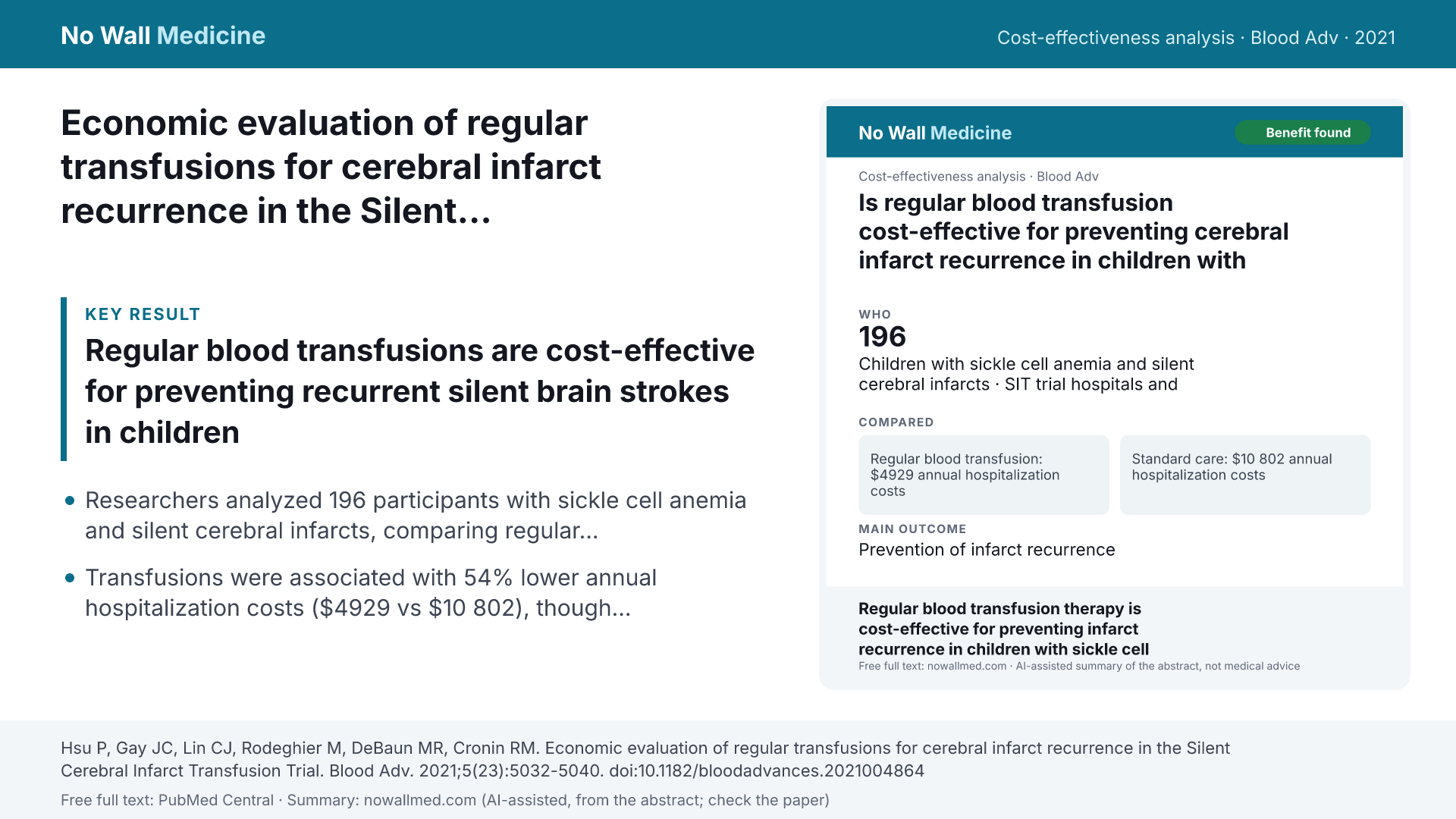
Regular blood transfusions are cost-effective for preventing recurrent silent brain strokes in children
Economic evaluation of regular transfusions for cerebral infarct recurrence in the Silent Cerebral Infarct Transfusion Trial
Cost-effectiveness analysisBenefit found
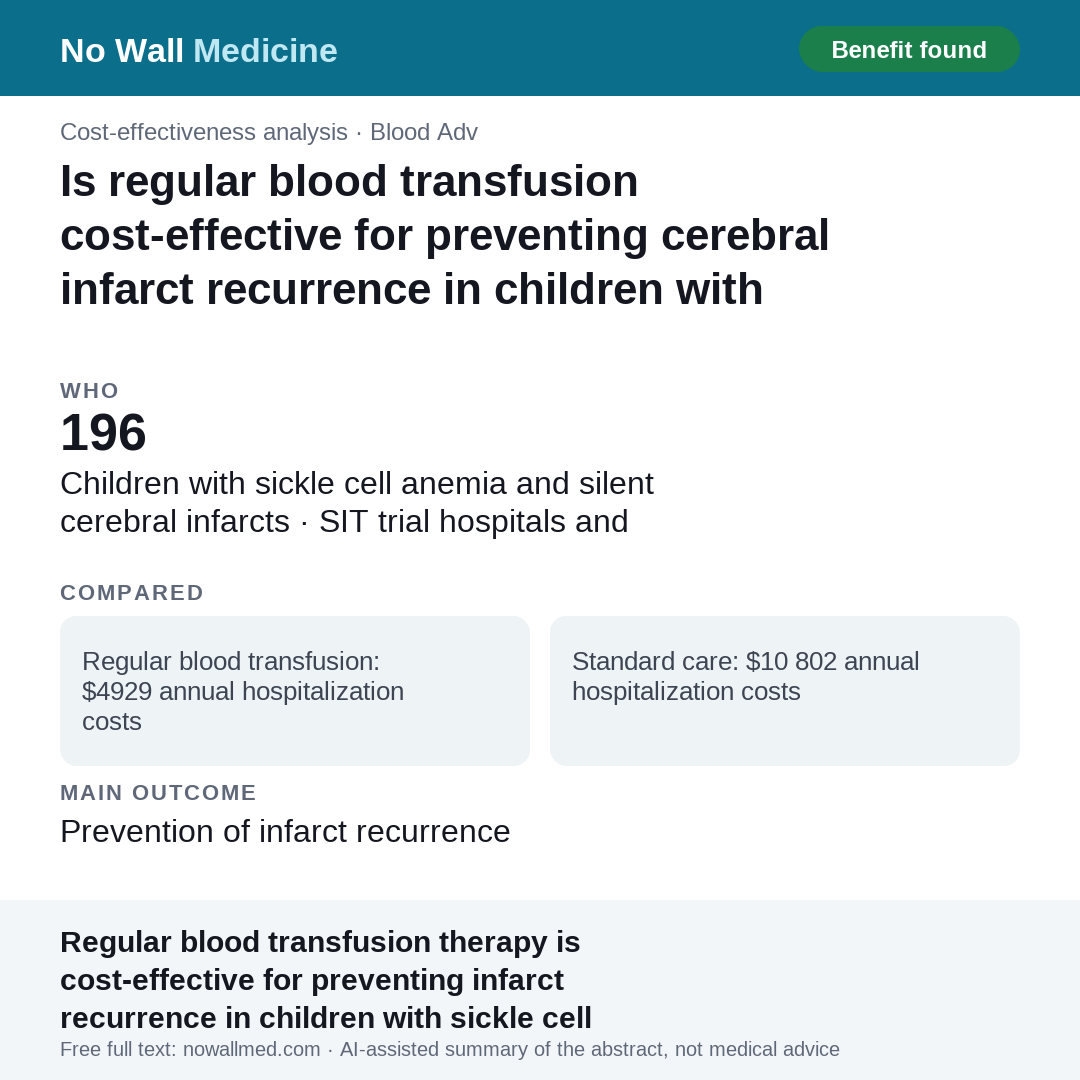
Is regular blood transfusion cost-effective for preventing cerebral infarct recurrence in children with sickle cell anemia?
Who
196
Children with sickle cell anemia and silent cerebral infarcts · SIT trial hospitals and outpatient sites
Compared
Regular blood transfusion: $4929 annual hospitalization costs
Standard care: $10 802 annual hospitalization costs
Main outcome
Prevention of infarct recurrence
Bottom line: Regular blood transfusion therapy is cost-effective for preventing infarct recurrence in children with sickle cell anemia.
Blood Adv · 2021-10-05Download image
Clinical question: Is regular blood transfusion cost-effective for preventing cerebral infarct recurrence in children with sickle cell anemia?
Key points
- Researchers analyzed 196 participants with sickle cell anemia and silent cerebral infarcts, comparing regular blood transfusions to standard care.
- Transfusions were associated with 54% lower annual hospitalization costs ($4929 vs $10 802), though outpatient costs increased by $22 454 to $137 022 per year.
- The incremental cost-effectiveness ratio for preventing one recurrent infarct was $22 025 over a 3-year period.
Headline and key points written with AI from the paper’s abstract, with every number checked against it. Read the paper before relying on them.
Was this summary helpful?
Abstract
In 2020, the American Society of Hematology published evidence-based guidelines for cerebrovascular disease in individuals with sickle cell anemia (SCA). Although the guidelines were based on National Institutes of Health-sponsored randomized controlled trials, no cost-effectiveness analysis was completed for children with SCA and silent cerebral infarcts. We conducted a cost-effectiveness analysis comparing regular blood transfusion vs standard care using SIT (Silent Cerebral Infarct Transfusion) Trial participants. This analysis included a modified societal perspective with direct costs (hospitalization, emergency department visit, transfusion, outpatient care, and iron chelation) and indirect costs (special education). Direct medical costs were estimated from hospitalizations from SIT hospitals and unlinked aggregated hospital and outpatient costs from SIT sites by using the Pediatric Health Information System. Indirect costs were estimated from published literature. Effectiveness was prevention of infarct recurrence. An incremental cost-effectiveness ratio using a 3-year time horizon (mean SIT Trial participant follow-up) compared transfusion vs standard care. A total of 196 participants received transfusions (n = 90) or standard care (n = 106), with a mean age of 10.0 years. Annual hospitalization costs were reduced by 54% for transfusions vs standard care ($4929 vs $10 802), but transfusion group outpatient costs added $22 454 to $137 022 per year. Special education cost savings were $2634 over 3 years for every infarct prevented. Transfusion therapy had an incremental cost-effectiveness ratio of $22 025 per infarct prevented. Children with preexisting silent cerebral infarcts receiving blood transfusions had lower hospitalization costs but higher outpatient costs, primarily associated with the oral iron chelator deferasirox. Regular blood transfusion therapy is cost-effective for infarct recurrence in children with SCA. This trial is registered at www.clinicaltrials.gov as #NCT00072761.
Abstract reproduced under the article’s CC BY NC ND licence.
Subject terms
Headline, design, result, key points, caveat and citation as plain text.
Cite this article
Hsu P, Gay JC, Lin CJ, Rodeghier M, DeBaun MR, Cronin RM. Economic evaluation of regular transfusions for cerebral infarct recurrence in the Silent Cerebral Infarct Transfusion Trial. Blood Adv. 2021;5(23):5032-5040. doi:10.1182/bloodadvances.2021004864
Spotted a mistake? Suggest a correction