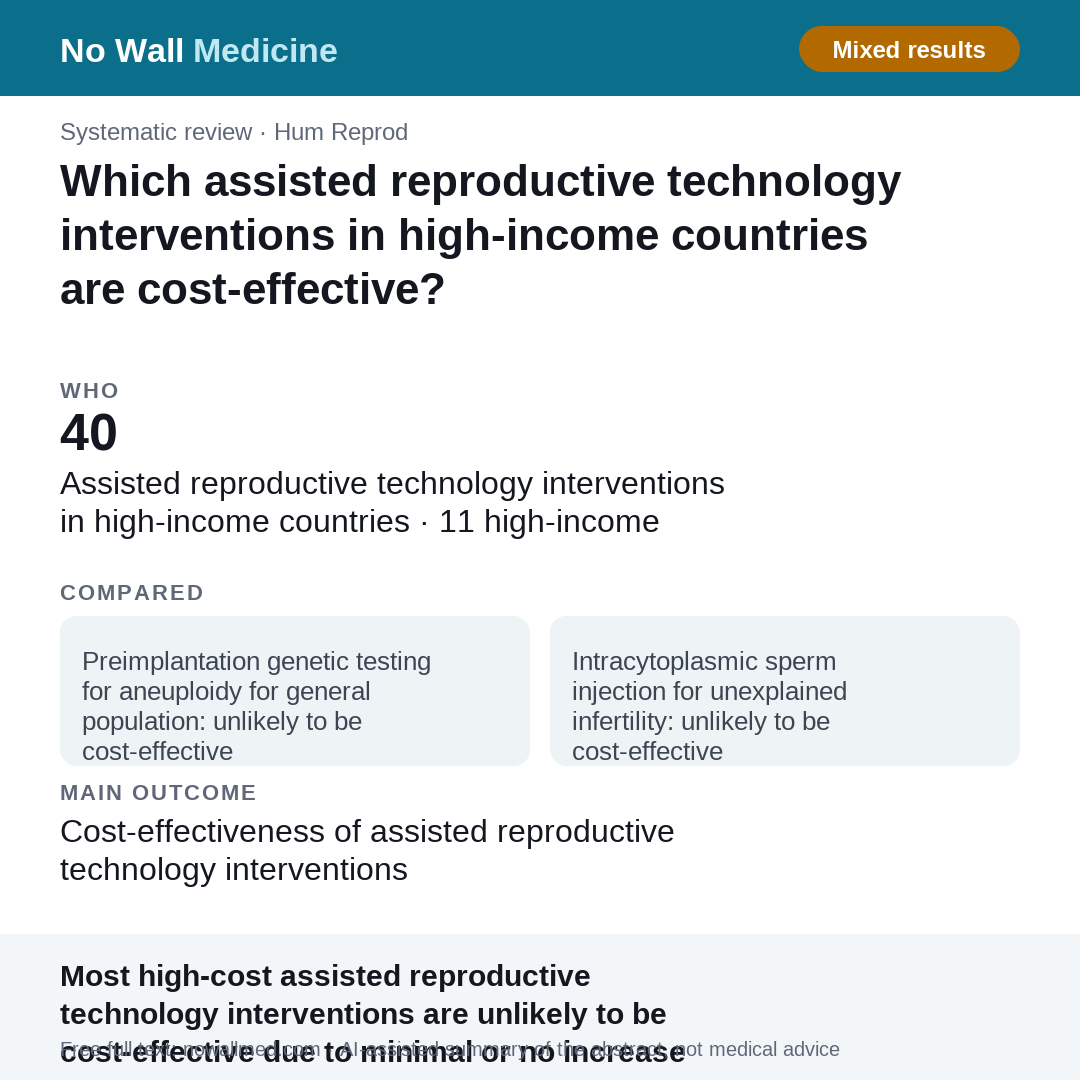
Most high-cost assisted reproductive technologies are unlikely to be cost-effective in high-income countries
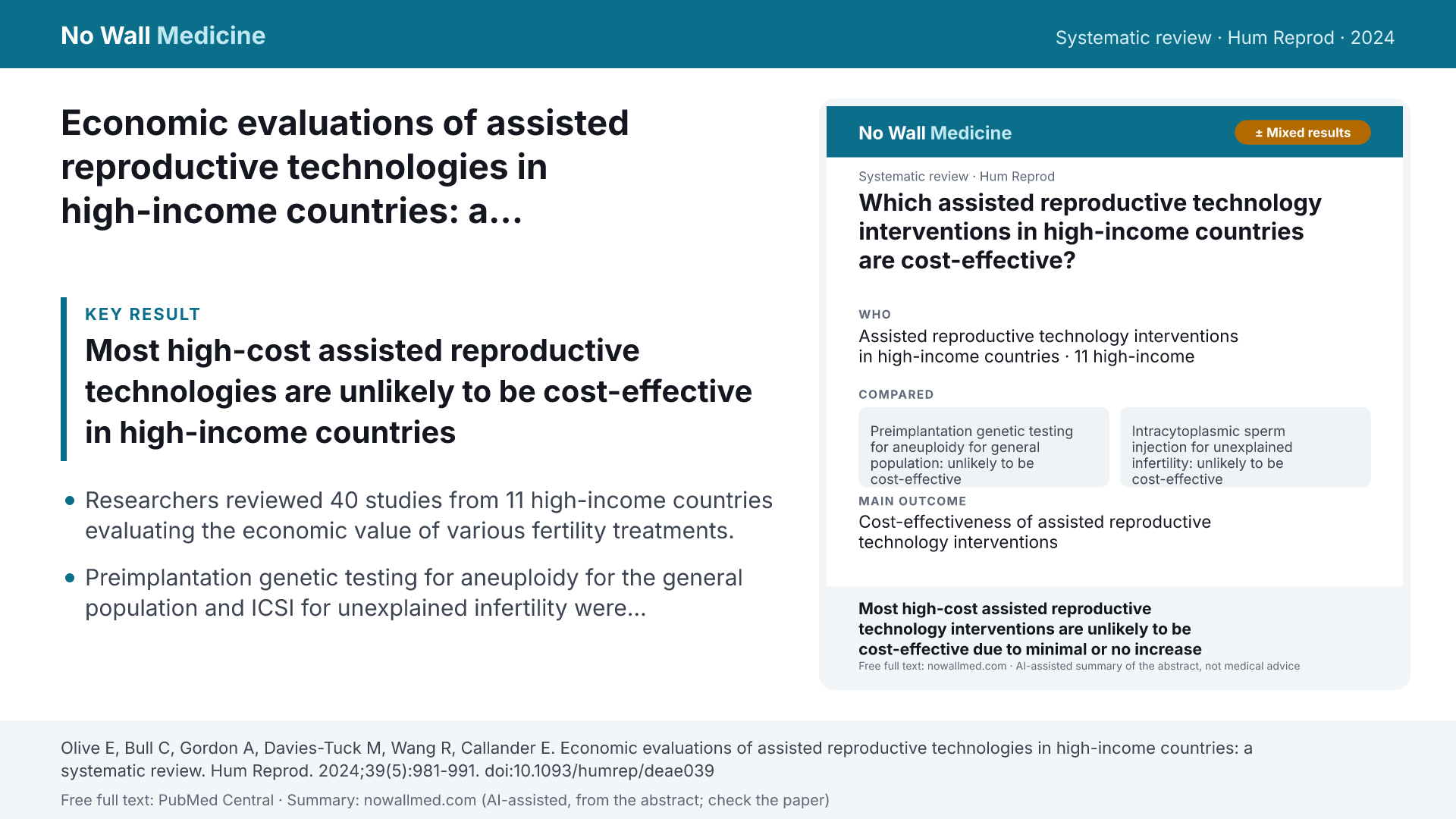
Economic evaluations of assisted reproductive technologies in high-income countries: a systematic review
Obstetrics & GynecologyAdult and pediatric
Systematic reviewMixed results
Which assisted reproductive technology interventions in high-income countries are cost-effective?
Who
40
Assisted reproductive technology interventions in high-income countries · 11 high-income countries
Compared
Preimplantation genetic testing for aneuploidy for general population: unlikely to be cost-effective
Intracytoplasmic sperm injection for unexplained infertility: unlikely to be cost-effective
Main outcome
Cost-effectiveness of assisted reproductive technology interventions
Bottom line: Most high-cost assisted reproductive technology interventions are unlikely to be cost-effective due to minimal or no increase in effectiveness.
Limitation: Lack of preference-based and standardized outcomes limits comparability across studies.
Hum Reprod · 2024-03-05Download image
Clinical question: Which assisted reproductive technology interventions in high-income countries are cost-effective?
Why it matters: It is unknown which assisted reproductive technology interventions in high-income countries are cost-effective to help funders maximize the delivery of healthy children.
Key points
- Researchers reviewed 40 studies from 11 high-income countries evaluating the economic value of various fertility treatments.
- Preimplantation genetic testing for aneuploidy for the general population and ICSI for unexplained infertility were unlikely to be cost-effective due to minimal or no increase in effectiveness.
- Using biosimilars or human menopausal gonadotropin for ovarian stimulation was cheaper but was associated with compromised clinical effectiveness.
Limitation the authors note: A lack of preference-based and standardized outcomes limits the comparability of results across studies.
Headline and key points written with AI from the paper’s abstract, with every number checked against it. Read the paper before relying on them.
Was this summary helpful?
Subject terms
Cite this article
Olive E, Bull C, Gordon A, Davies-Tuck M, Wang R, Callander E. Economic evaluations of assisted reproductive technologies in high-income countries: a systematic review. Hum Reprod. 2024. doi:10.1093/humrep/deae039
Spotted a mistake? Suggest a correction