Monitoring heparin with activated clotting time did not reduce complications during abdominal aortic aneurysm repair
Editor's Choice - Activated Clotting Time Guided Heparinisation during Open Abdominal Aortic Aneurysm Repair (ACTION-1): A Randomised, Multicentre, Single Blind, Superiority Trial
Randomised, multicentre, single blinded, superiority trialHarm found
Does activated clotting time guided heparinisation improve outcomes during open abdominal aortic aneurysm repair?
Who
294
Patients undergoing elective open abdominal aortic aneurysm repair · multicentre
Compared
Activated clotting time guided heparinisation: 34 patients (22.8%)
Single heparin bolus of 5 000 international units: 37 patients (25.5%)
Main outcome
Combined incidence of thromboembolic complications and all cause death
Result: absolute difference -2.7%, 95% confidence interval -12.5 to 7.1%
Bottom line: Activated clotting time guided heparinisation did not reduce primary efficacy outcomes and increased bleeding and mortality risks.
Eur J Vasc Endovasc Surg · 2025-07-18Download image
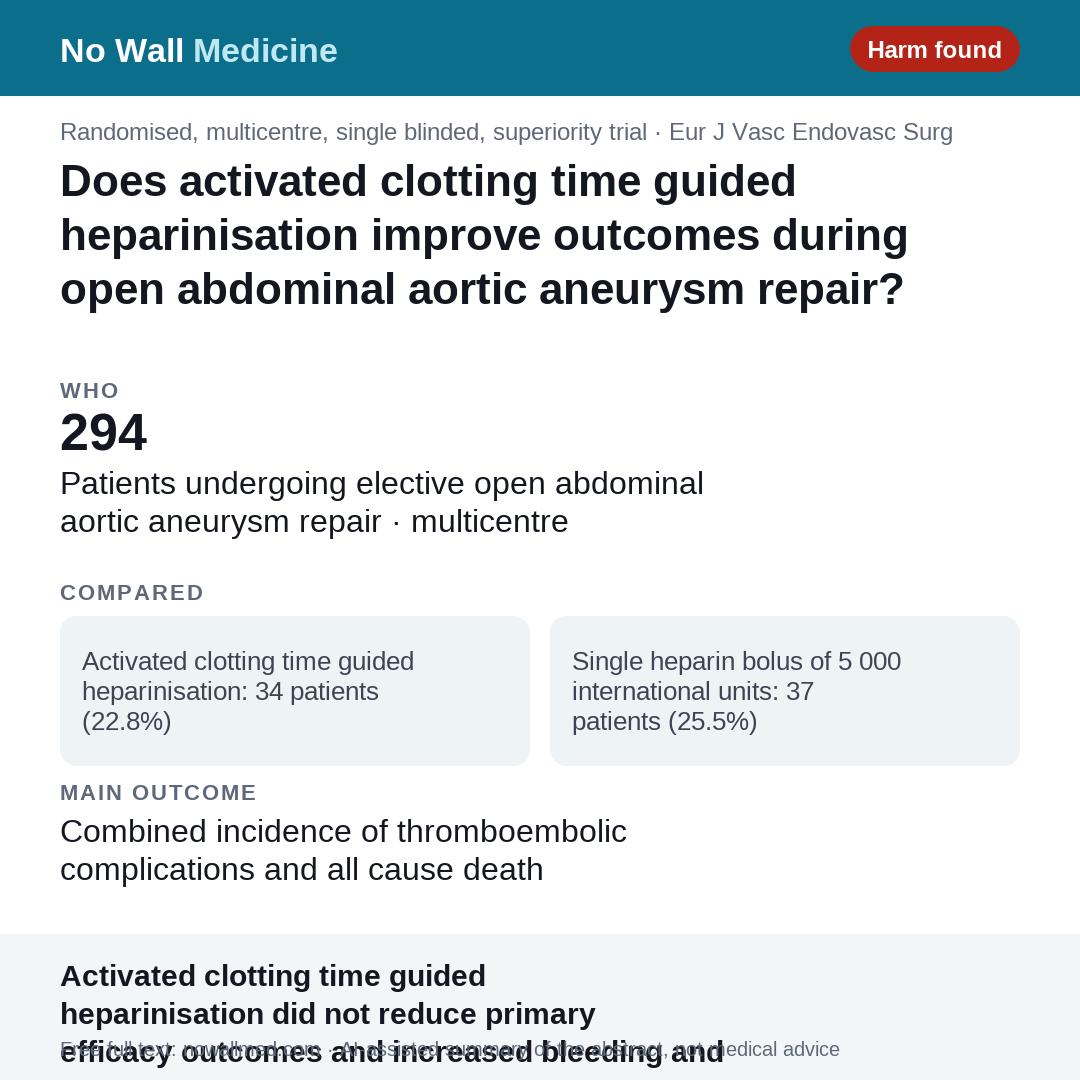
Clinical question: Does activated clotting time guided heparinisation improve outcomes during open abdominal aortic aneurysm repair?
Why it matters: The optimal dosage of intravenous unfractionated heparin and the role of monitoring its effect using activated clotting time to prevent complications are uncertain.
Key points
- Researchers studied 294 patients undergoing elective open abdominal aortic aneurysm repair, comparing activated clotting time guided heparinisation to a single 5,000 international unit dose.
- The primary outcome of thromboembolic complications and death occurred in 22.8% of the guided group versus 25.5% in the control group, showing no significant difference.
- The guided heparinisation group had higher rates of bleeding complications and deaths compared to the single dose group.
Headline and key points written with AI from the paper’s abstract, with every number checked against it. Read the paper before relying on them.
Topics
Cite this article
Jongkind V, Steunenberg TAH, Roosendaal LC, Hoebink M, Blankensteijn JD, Koelemay MJW. Editor's Choice - Activated Clotting Time Guided Heparinisation during Open Abdominal Aortic Aneurysm Repair (ACTION-1): A Randomised, Multicentre, Single Blind, Superiority Trial. Eur J Vasc Endovasc Surg. 2025. doi:10.1016/j.ejvs.2025.07.027
Spotted a mistake? Suggest a correction
Top studies every Monday
The week’s key trials and guidelines in your specialties, plus any topics you follow. By email, free.
Get the weekly digest