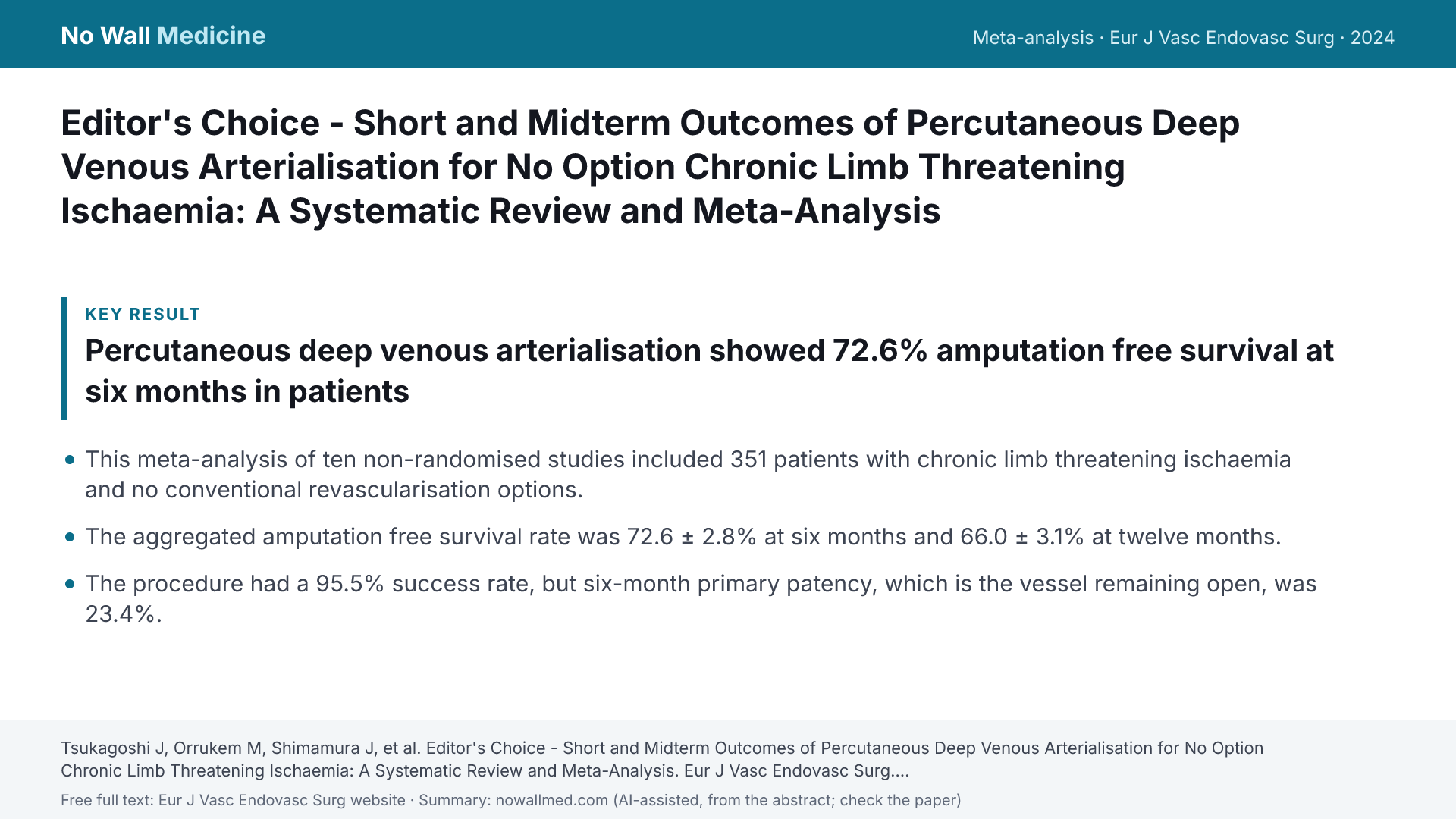
Percutaneous deep venous arterialisation showed 72.6% amputation free survival at six months in patients
Editor's Choice - Short and Midterm Outcomes of Percutaneous Deep Venous Arterialisation for No Option Chronic Limb Threatening Ischaemia: A Systematic Review and Meta-Analysis
Why it matters: Large scale data examining the clinical effectiveness of percutaneous deep venous arterialisation for patients with end stage chronic limb threatening ischaemia are limited.
Key points
- This meta-analysis of ten non-randomised studies included 351 patients with chronic limb threatening ischaemia and no conventional revascularisation options.
- The aggregated amputation free survival rate was 72.6 ± 2.8% at six months and 66.0 ± 3.1% at twelve months.
- The procedure had a 95.5% success rate, but six-month primary patency, which is the vessel remaining open, was 23.4%.
Limitation the authors note: The authors state there was an overall low certainty of evidence.
Headline and key points written with AI from the paper’s abstract, with every number checked against it. Read the paper before relying on them.
Was this summary helpful?
Subject terms
Headline, design, result, key points, caveat and citation as plain text.
Cite this article
Tsukagoshi J, Orrukem M, Shimamura J, et al. Editor's Choice - Short and Midterm Outcomes of Percutaneous Deep Venous Arterialisation for No Option Chronic Limb Threatening Ischaemia: A Systematic Review and Meta-Analysis. Eur J Vasc Endovasc Surg. 2025;69(2):284-292. doi:10.1016/j.ejvs.2024.08.001
Spotted a mistake? Suggest a correction