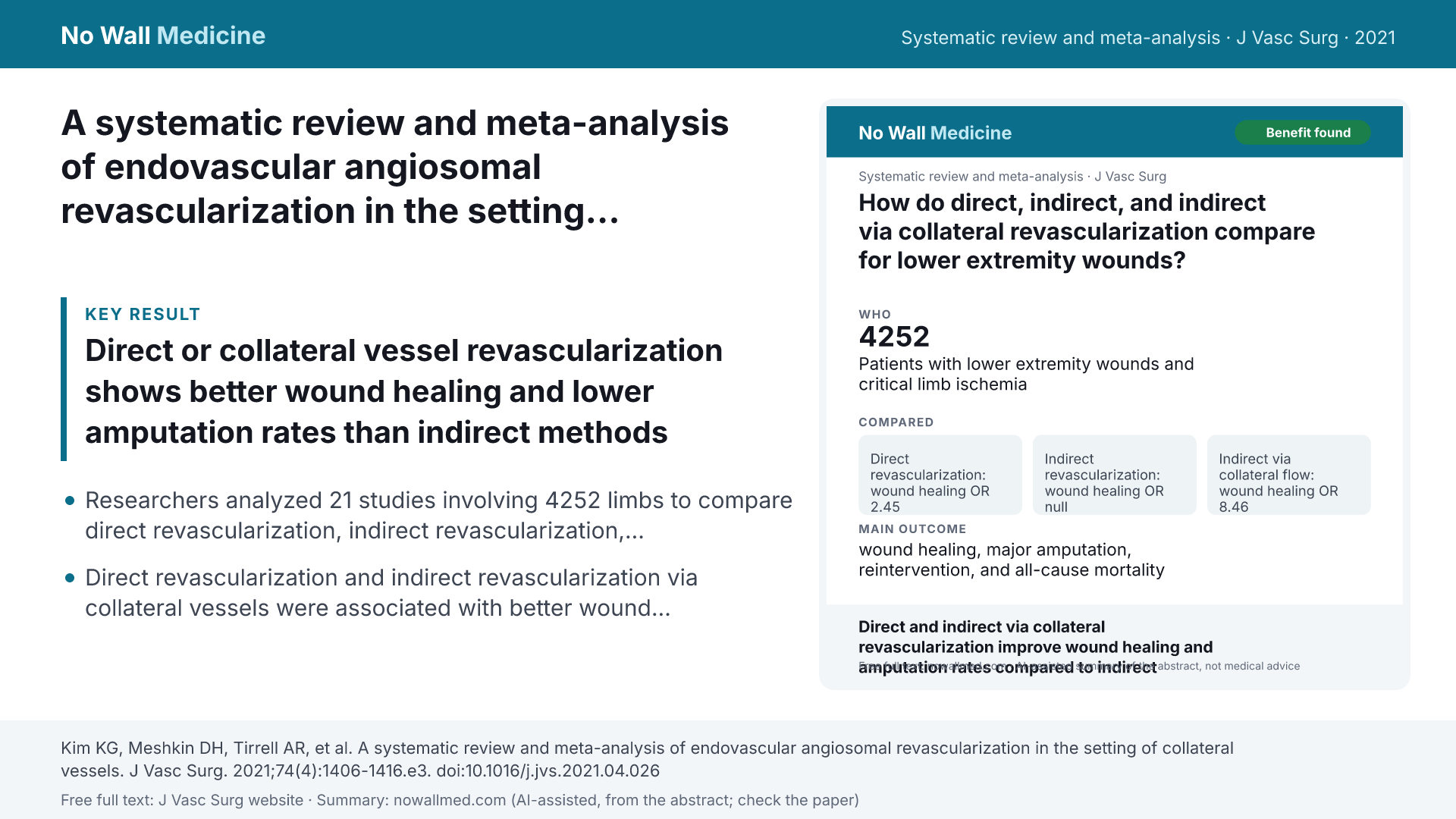
Direct or collateral vessel revascularization shows better wound healing and lower amputation rates than indirect methods
A systematic review and meta-analysis of endovascular angiosomal revascularization in the setting of collateral vessels
Systematic review and meta-analysisBenefit found
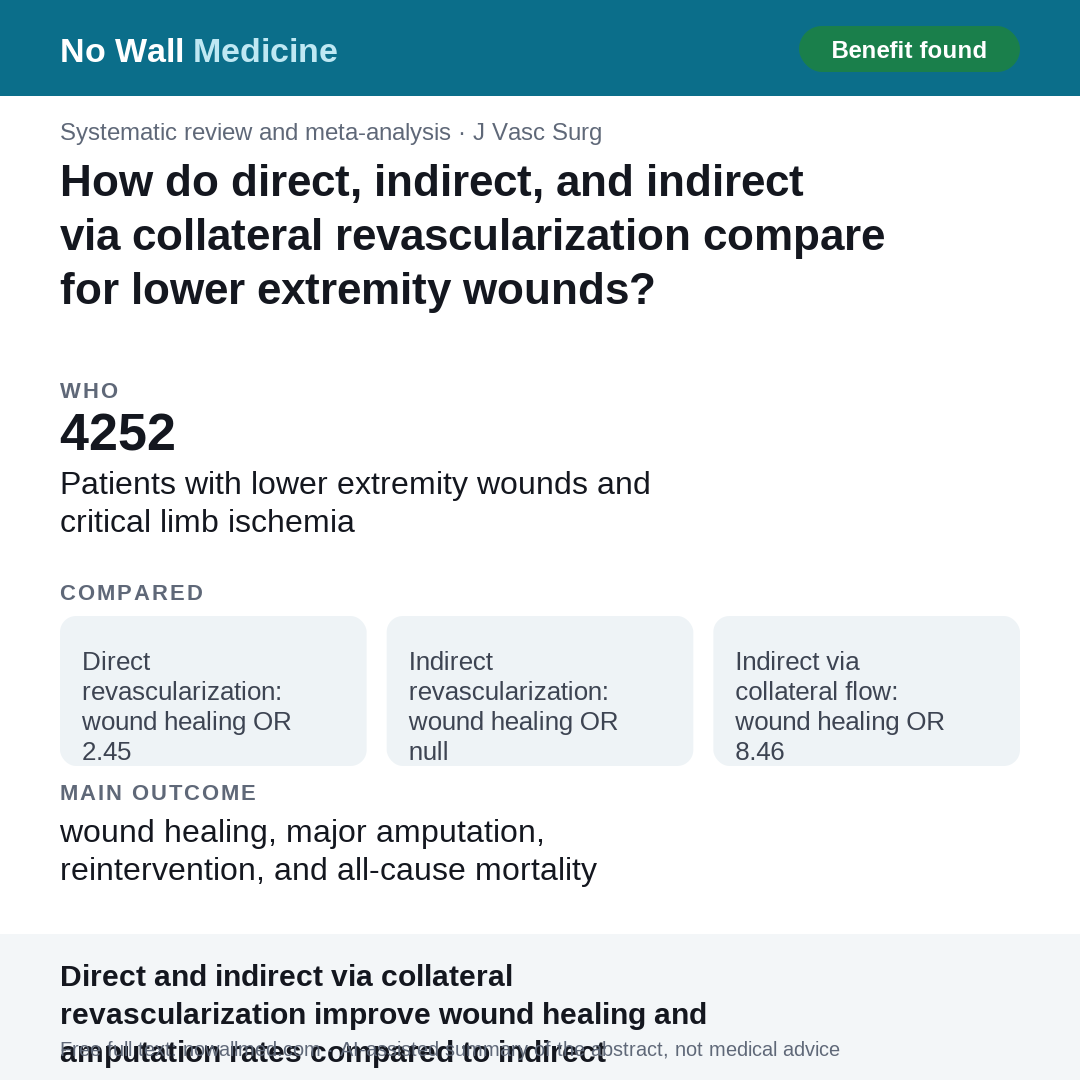
How do direct, indirect, and indirect via collateral revascularization compare for lower extremity wounds?
Who
4252
Patients with lower extremity wounds and critical limb ischemia
Compared
Direct revascularization: wound healing OR 2.45
Indirect revascularization: wound healing OR null
Indirect via collateral flow: wound healing OR 8.46
Main outcome
wound healing, major amputation, reintervention, and all-cause mortality
Result: wound healing OR 2.45 (DR vs IR) and OR 8.46 (IRc vs IR)
Bottom line: Direct and indirect via collateral revascularization improve wound healing and amputation rates compared to indirect revascularization.
Limitation: Small sample size of collateral flow limbs, retrospective studies, and variability in outcome definitions.
J Vasc Surg · 2021-04-30Download image
Clinical question: How do direct, indirect, and indirect via collateral revascularization compare for lower extremity wounds?
Why it matters: The role of collateral vessels in clinical outcomes for treating lower extremity wounds remains undefined compared to direct or indirect revascularization.
Key points
- Researchers analyzed 21 studies involving 4252 limbs to compare direct revascularization, indirect revascularization, and indirect revascularization via collateral vessels for treating lower extremity wounds.
- Direct revascularization and indirect revascularization via collateral vessels were associated with better wound healing and lower major amputation rates than indirect revascularization alone.
- No significant differences were found between the three methods regarding all-cause mortality or reintervention rates.
Limitation the authors note: The analysis was limited by a small sample size of collateral vessel limbs, a predominance of retrospective studies, and variability in outcome definitions.
Headline and key points written with AI from the paper’s abstract, with every number checked against it. Read the paper before relying on them.
Was this summary helpful?
Subject terms
Cite this article
Kim KG, Meshkin DH, Tirrell AR, et al. A systematic review and meta-analysis of endovascular angiosomal revascularization in the setting of collateral vessels. J Vasc Surg. 2021. doi:10.1016/j.jvs.2021.04.026
Spotted a mistake? Suggest a correction