Multicomponent strategy to improve rheumatoid arthritis treatment adherence showed inconclusive results in a cluster trial
EducAR: implementing a multicomponent strategy to improve therapeutic adherence in rheumatoid arthritis
Cluster randomized trialNo clear difference
Does a multicomponent strategy improve therapeutic adherence in rheumatoid arthritis?
Who
141
Consecutive patients with less than 2 years of rheumatoid arthritis
Compared
Standard of care: 48% to 67%
Intervention: 42% to 47%
Main outcome
6-month initiation and implementation adherence
Bottom line: The multicomponent intervention did not show a detected effect on treatment adherence compared to standard care.
Limitation: Low implementation due to lack of time and inadequate focus.
RMD Open · 2025-02-27Download image
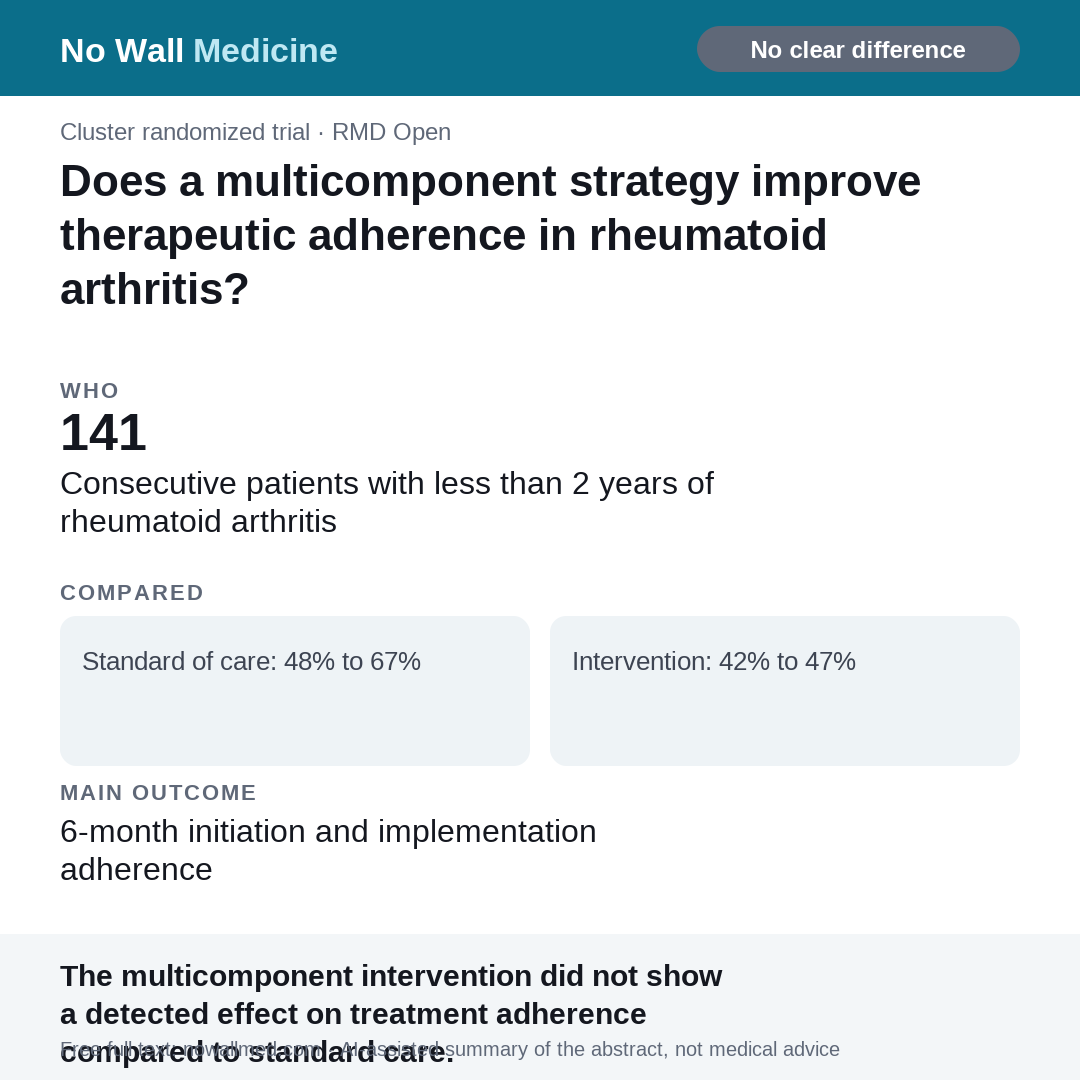
Clinical question: Does a multicomponent strategy improve therapeutic adherence in rheumatoid arthritis?
Why it matters: It was unknown if implementing a strategy based on European Alliance of Associations for Rheumatology points to consider could improve treatment adherence in rheumatoid arthritis.
Key points
- The study compared a two-sided website intervention to standard care in 141 patients with rheumatoid arthritis for less than 2 years of disease.
- Both groups increased adherence at 6 months, but the control group increased from 48% to 67% while the intervention group increased from 42% to 47%.
- Implementation of the intervention was very low due to barriers such as lack of time and the belief that standard care was adequate.
Limitation the authors note: The authors stated that the results were inconclusive due to limited implementation and the complexity of the required cultural changes.
Headline and key points written with AI from the paper’s abstract, with every number checked against it. Read the paper before relying on them.
Abstract
Introduction
The EULAR points to consider (PtC) for reducing non-adherence need implementation. Objectives
To design, implement and evaluate a strategy based on the PtC to improve treatment adherence in rheumatoid arthritis (RA). Methods
A multidisciplinary panel cocreated an intervention that was subsequently tested in a cluster trial, where centres were randomised to access the developed intervention or follow the standard of care (SOC). 6-month initiation and implementation adherence were measured in consecutive patients with <2 years of RA. The results were discussed among the centres assigned to the intervention to explore barriers and facilitators to implementation. Results
The intervention was a two-sided website. The items on the patient site mainly addressed disease and treatment education, self-management and peer support. The healthcare professional site has tutorials on communication to improve trust and adherence, plus shared decision-making aids. It was tested in 141 RA patients (67 control and 74 intervention). Both groups increased adherence at 6 months, mainly in the control group (48% to 67% vs 42% to 47% in the intervention group). Implementation had been very low in relation to barriers identified as lack of time, inadequate focus (exclusively for nurses) and consideration of the current SOC as adequate. Conclusion
Despite designing an intervention based on the best evidence, the results were inconclusive; the lack of a detected effect could be explained by the limited implementation, which was insufficient for the complexity of the changes required (change of culture). Trial register number
ClinicalTrials.gov ID NCT05425485.
Abstract reproduced under the article’s CC BY NC licence.
Topics
Cite this article
Ahijón Lana M, Sivera Mascaró F, Fernández-Nebro A, Muntadas Castelló S, Pérez M, Otón T. EducAR: implementing a multicomponent strategy to improve therapeutic adherence in rheumatoid arthritis. RMD Open. 2025. doi:10.1136/rmdopen-2024-004989
Spotted a mistake? Suggest a correction