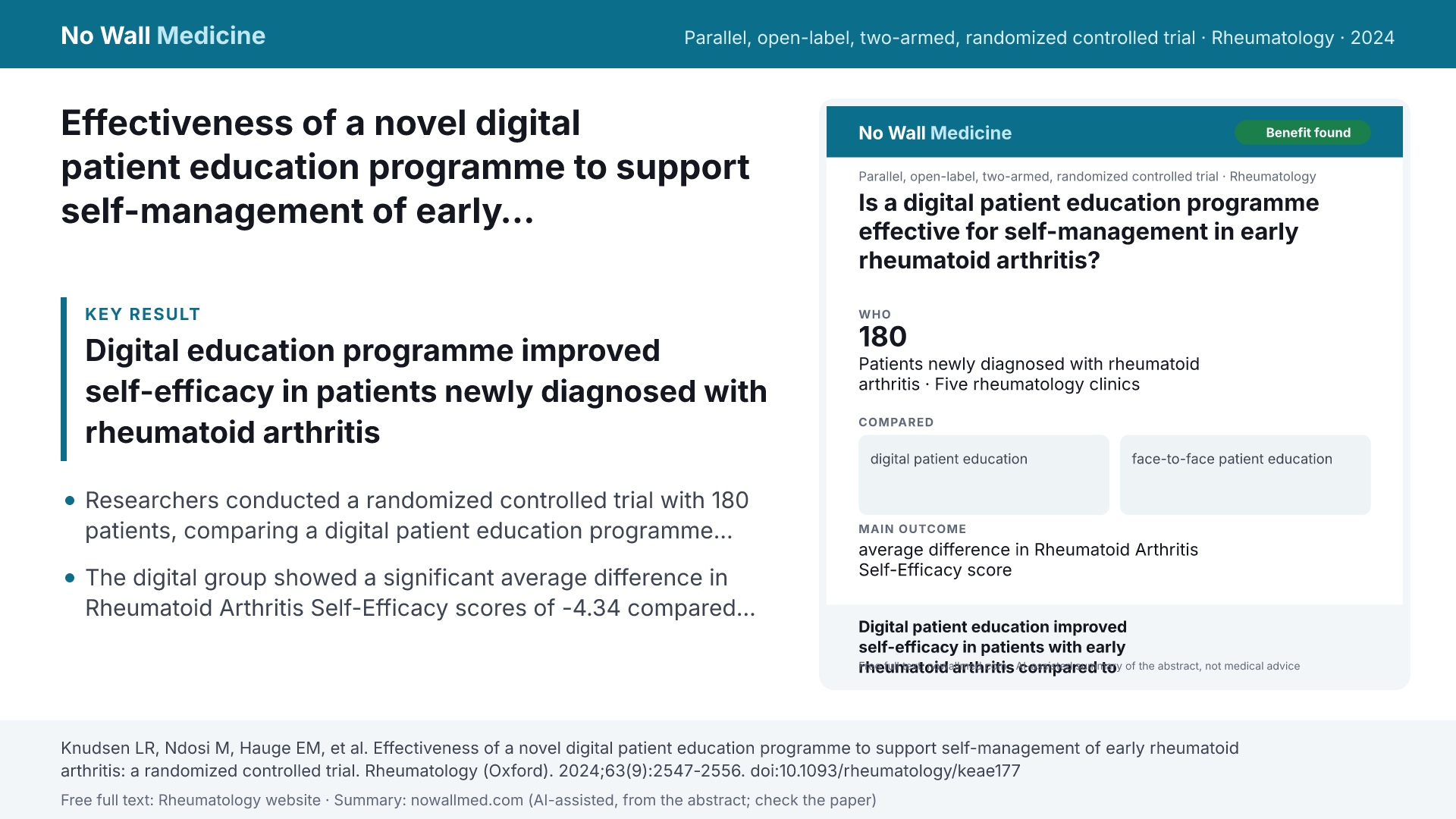
Digital education programme improved self-efficacy in patients newly diagnosed with rheumatoid arthritis
Effectiveness of a novel digital patient education programme to support self-management of early rheumatoid arthritis: a randomized controlled trial
Parallel, open-label, two-armed, randomized controlled trialBenefit found
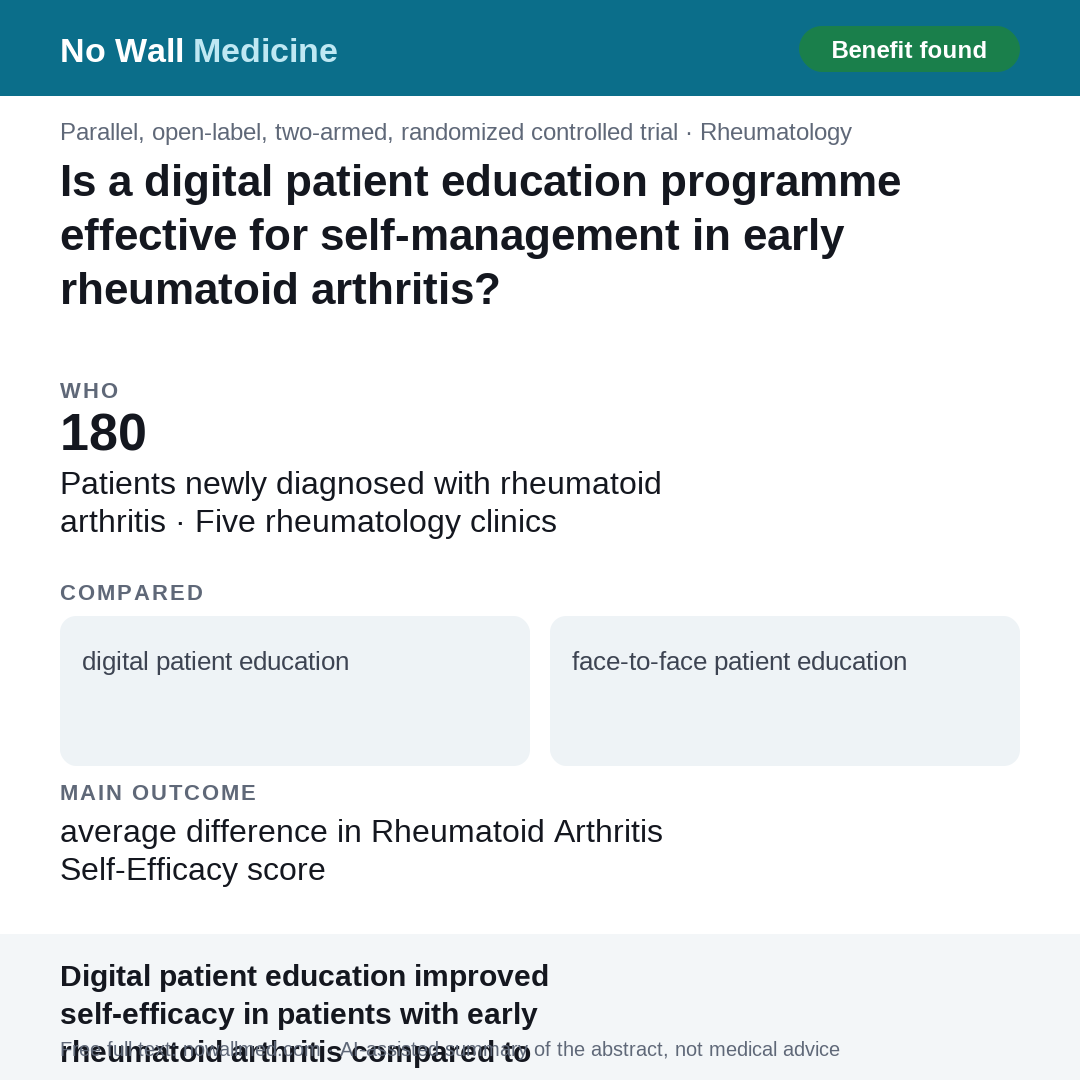
Is a digital patient education programme effective for self-management in early rheumatoid arthritis?
Who
180
Patients newly diagnosed with rheumatoid arthritis · Five rheumatology clinics
Compared
digital patient education
face-to-face patient education
Main outcome
average difference in Rheumatoid Arthritis Self-Efficacy score
Result: -4.34 difference in RASE score (95% CI: -8.17 to -0.51)
Bottom line: Digital patient education improved self-efficacy in patients with early rheumatoid arthritis compared to face-to-face education.
Rheumatology · 2024-03-19Download image
Clinical question: Is a digital patient education programme effective for self-management in early rheumatoid arthritis?
Why it matters: It was unknown if a digital patient education programme could effectively support self-management for people newly diagnosed with rheumatoid arthritis.
Key points
- Researchers conducted a randomized controlled trial with 180 patients, comparing a digital patient education programme to face-to-face education.
- The digital group showed a significant average difference in Rheumatoid Arthritis Self-Efficacy scores of -4.34 compared to the face-to-face group at 12 months.
- The digital education group was associated with fewer out-patient clinic contacts, though no significant differences were found for knowledge, health literacy, or quality of life.
Headline and key points written with AI from the paper’s abstract, with every number checked against it. Read the paper before relying on them.
Was this summary helpful?
Subject terms
Cite this article
Knudsen LR, Ndosi M, Hauge EM, et al. Effectiveness of a novel digital patient education programme to support self-management of early rheumatoid arthritis: a randomized controlled trial. Rheumatology. 2024. doi:10.1093/rheumatology/keae177
Spotted a mistake? Suggest a correction