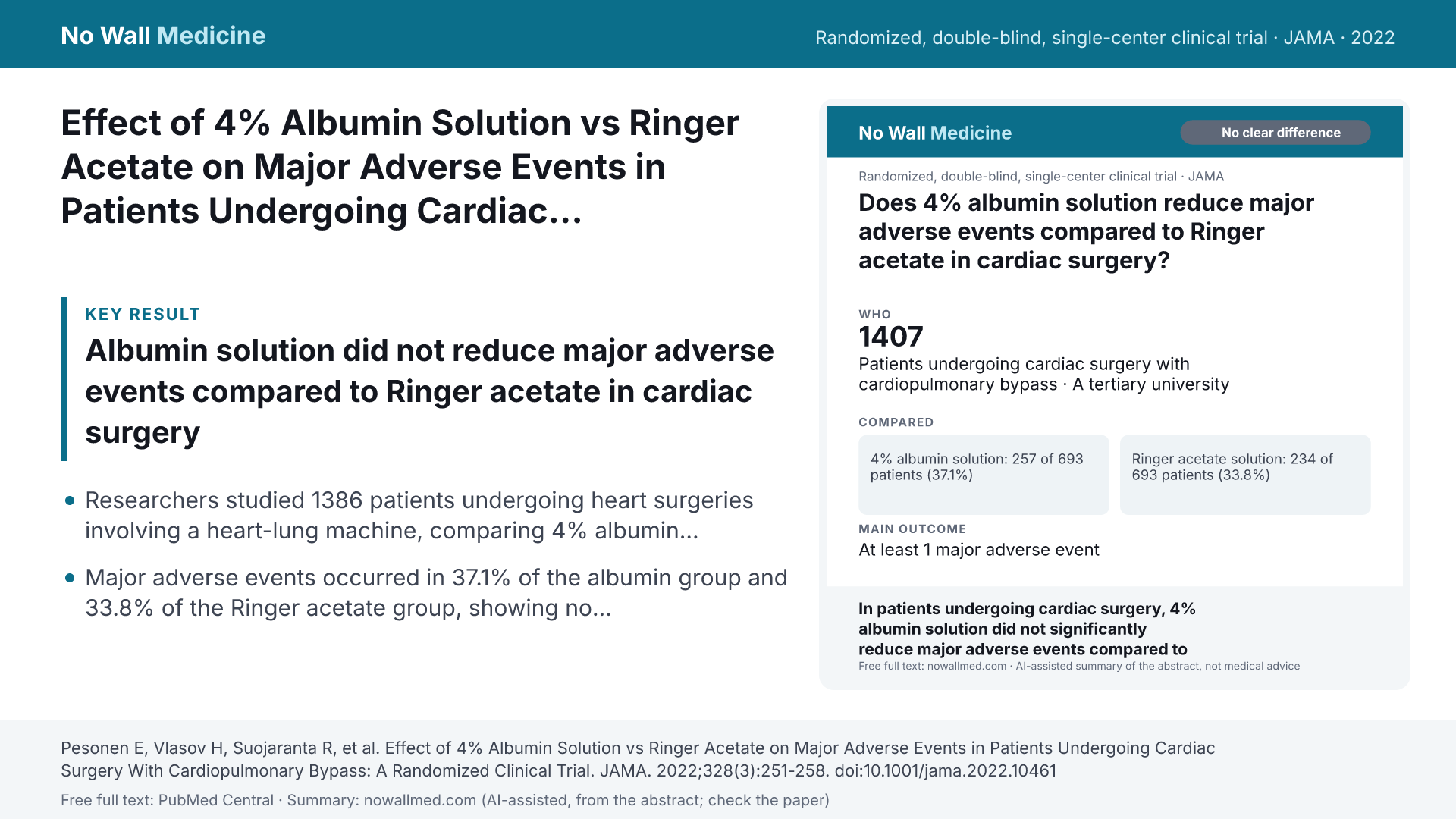
Albumin solution did not reduce major adverse events compared to Ringer acetate in cardiac surgery
Effect of 4% Albumin Solution vs Ringer Acetate on Major Adverse Events in Patients Undergoing Cardiac Surgery With Cardiopulmonary Bypass: A Randomized Clinical Trial
Randomized, double-blind, single-center clinical trialNo clear difference
Does 4% albumin solution reduce major adverse events compared to Ringer acetate in cardiac surgery?
Who
1407
Patients undergoing cardiac surgery with cardiopulmonary bypass · A tertiary university hospital
Compared
4% albumin solution: 257 of 693 patients (37.1%)
Ringer acetate solution: 234 of 693 patients (33.8%)
Main outcome
At least 1 major adverse event
Result: relative risk 1.10 (95% CI, 0.95-1.27)
Bottom line: In patients undergoing cardiac surgery, 4% albumin solution did not significantly reduce major adverse events compared to Ringer acetate.
JAMA · 2022-07-19Download image
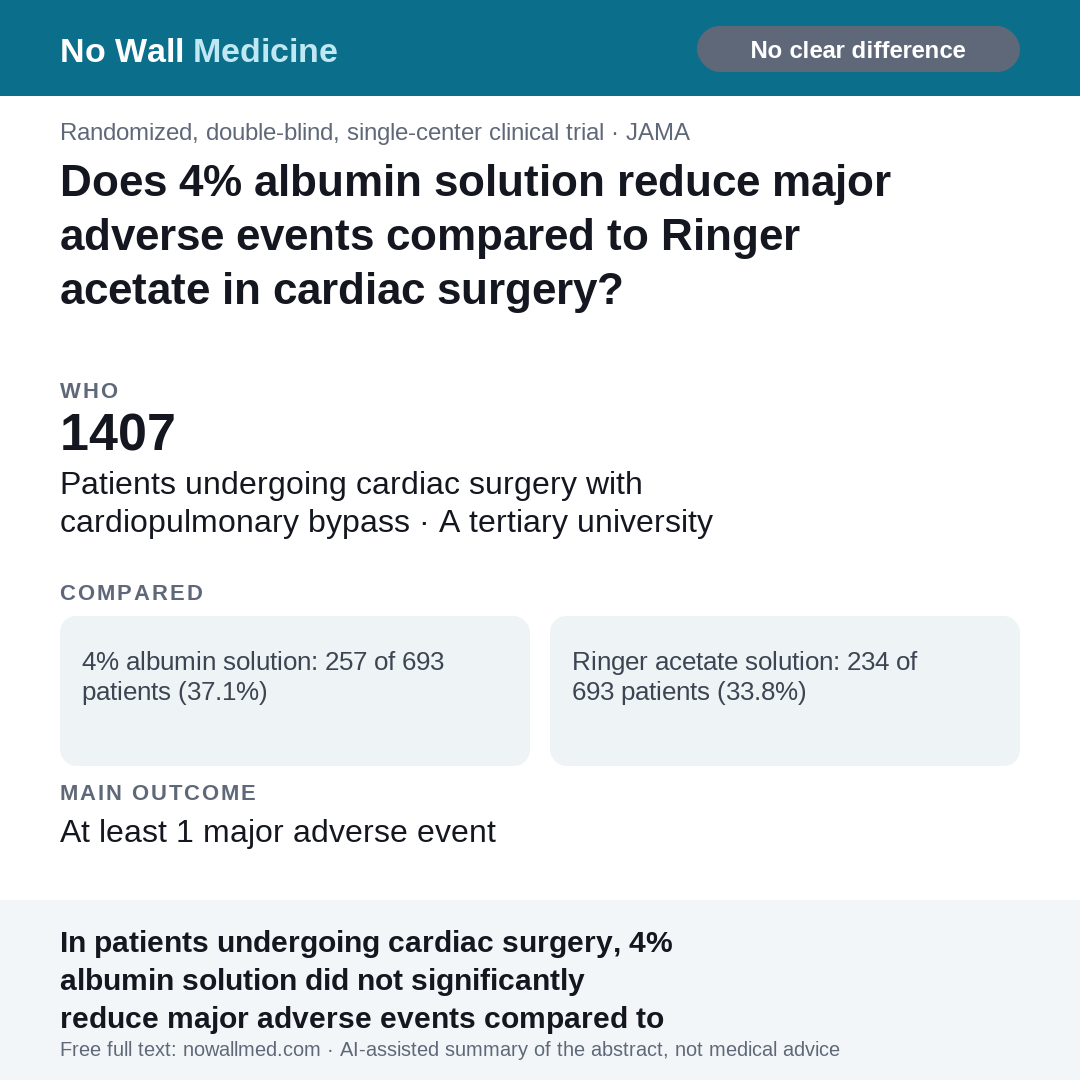
Clinical question: Does 4% albumin solution reduce major adverse events compared to Ringer acetate in cardiac surgery?
Why it matters: It was unknown if using 4% albumin solution instead of crystalloids reduces surgical complications in patients undergoing cardiac surgery with cardiopulmonary bypass.
Key points
- Researchers studied 1386 patients undergoing heart surgeries involving a heart-lung machine, comparing 4% albumin solution to Ringer acetate solution.
- Major adverse events occurred in 37.1% of the albumin group and 33.8% of the Ringer acetate group, showing no statistically significant difference.
- The most common serious adverse events included pulmonary embolus, postpericardiotomy syndrome, and pleural effusion requiring hospital readmission.
Headline and key points written with AI from the paper’s abstract, with every number checked against it. Read the paper before relying on them.
Was this summary helpful?
Subject terms
Cite this article
Pesonen E, Vlasov H, Suojaranta R, Hiippala S, Schramko A, Wilkman E. Effect of 4% Albumin Solution vs Ringer Acetate on Major Adverse Events in Patients Undergoing Cardiac Surgery With Cardiopulmonary Bypass: A Randomized Clinical Trial. JAMA. 2022. doi:10.1001/jama.2022.10461
Spotted a mistake? Suggest a correction