Restrictive or liberal oxygenation during heart surgery showed no difference in patient outcomes
Restrictive versus liberal oxygenation in patients undergoing cardiopulmonary bypass-assisted heart surgery: a randomised controlled trial
Single-centre, patient- and assessor-blinded randomised trialNo clear difference
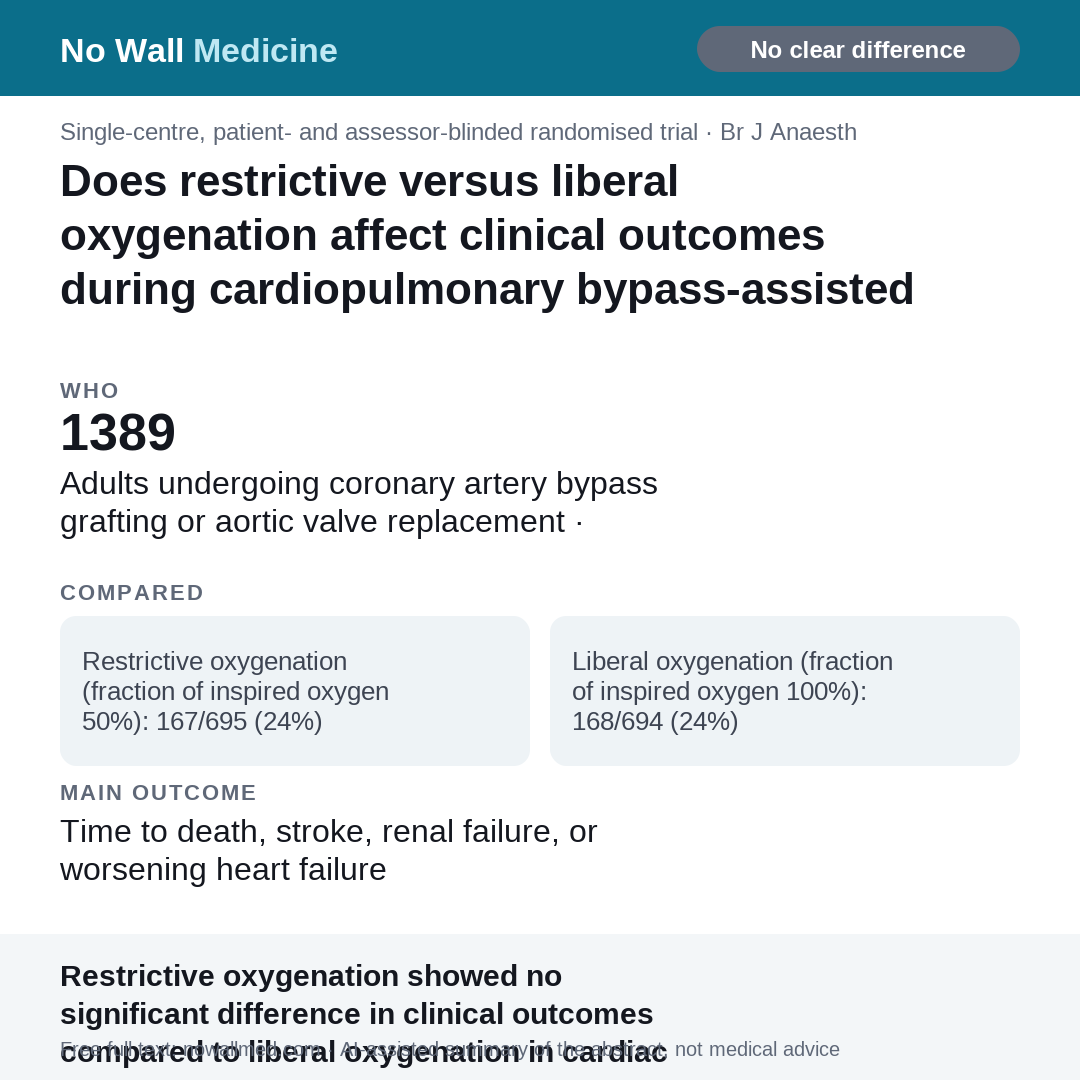
Does restrictive versus liberal oxygenation affect clinical outcomes during cardiopulmonary bypass-assisted heart surgery?
Who
1389
Adults undergoing coronary artery bypass grafting or aortic valve replacement · Single-centre
Compared
Restrictive oxygenation (fraction of inspired oxygen 50%): 167/695 (24%)
Liberal oxygenation (fraction of inspired oxygen 100%): 168/694 (24%)
Main outcome
Time to death, stroke, renal failure, or worsening heart failure
Result: hazard ratio 1.01 (95% confidence interval 0.8-1.3)
Bottom line: Restrictive oxygenation showed no significant difference in clinical outcomes compared to liberal oxygenation in cardiac surgery patients.
Br J Anaesth · 2025-09-19Download image
Clinical question: Does restrictive versus liberal oxygenation affect clinical outcomes during cardiopulmonary bypass-assisted heart surgery?
Why it matters: It is unclear if maintaining high oxygen levels during heart-lung machine use causes organ injury compared to more restrictive oxygen levels.
Key points
- Researchers studied 1389 adults undergoing heart surgery assisted by a heart-lung machine, comparing 50% oxygen therapy to 100% oxygen therapy.
- During a median follow-up of 5.9 yr, 24% of participants in the restrictive group and 24% in the liberal group met the primary composite endpoint.
- The study found no significant differences in death, stroke, kidney failure requiring dialysis, or new or worsening heart failure between the two groups.
Headline and key points written with AI from the paper’s abstract, with every number checked against it. Read the paper before relying on them.
Topics
Cite this article
Wiberg S, Møller CH, Kjaergaard J, Mikkelsen AD, Sørensen HM, Kunkel JB. Restrictive versus liberal oxygenation in patients undergoing cardiopulmonary bypass-assisted heart surgery: a randomised controlled trial. Br J Anaesth. 2025. doi:10.1016/j.bja.2025.08.005
Spotted a mistake? Suggest a correction
Top studies every Monday
The week’s key trials and guidelines in your specialties, by email. Free.
Get the weekly digest