Clinical decision support system reduced new vascular events in patients with acute ischaemic stroke
Effect of a clinical decision support system on stroke care quality and outcomes in patients with acute ischaemic stroke (GOLDEN BRIDGE II): cluster randomised clinical trial
Multicentre, cluster randomised clinical trialBenefit found
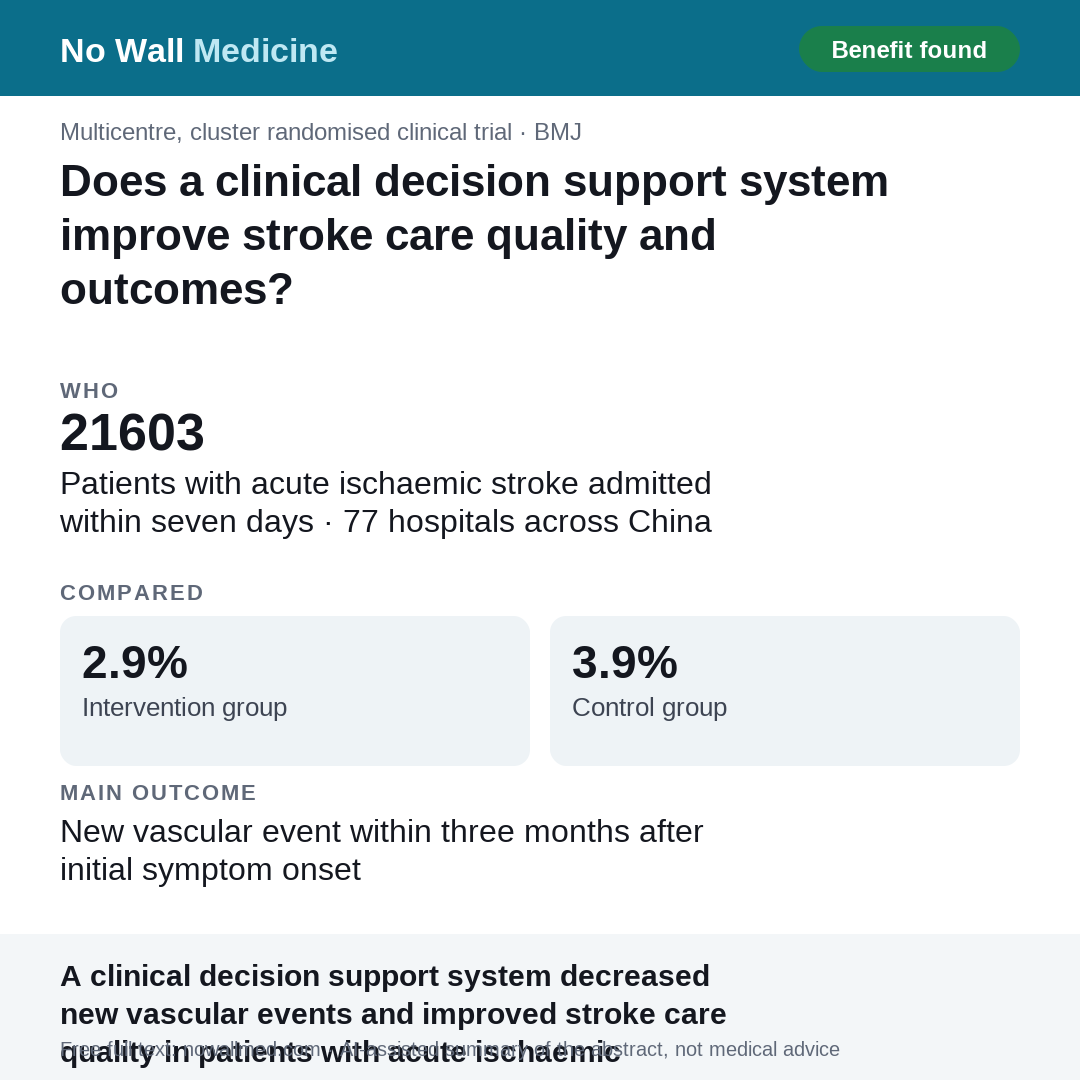
Does a clinical decision support system improve stroke care quality and outcomes?
Who
21603
Patients with acute ischaemic stroke admitted within seven days · 77 hospitals across China
Compared
2.9%Intervention group (320/11054)
3.9%Control group (416/10549)
Main outcome
New vascular event within three months after initial symptom onset
Result: adjusted hazard ratio 0.74 (95% CI 0.58 to 0.93)
Bottom line: A clinical decision support system decreased new vascular events and improved stroke care quality in patients with acute ischaemic stroke.
BMJ · 2026-03-20Download image
Clinical question: Does a clinical decision support system improve stroke care quality and outcomes?
Why it matters: It is unclear how a clinical decision support system, including artificial intelligence assisted imaging analysis, affects care quality and outcomes for acute ischaemic stroke.
Key points
- Researchers studied 21,603 patients across 77 hospitals in China to compare a clinical decision support system with usual care.
- New vascular events at three months occurred in 2.9% of the intervention group compared to 3.9% in the control group.
- The intervention group showed higher evidence-based care quality, while no significant differences were found in disability or all-cause mortality.
Headline and key points written with AI from the paper’s abstract, with every number checked against it. Read the paper before relying on them.
Abstract
Objective
To evaluate the efficacy of a clinical decision support system (CDSS) on stroke care quality and clinical outcomes among patients with acute ischaemic stroke. Design
Multicentre, cluster randomised clinical trial. Setting
77 hospitals across China. Participants
77 hospitals (38 randomised to intervention group, 39 to control group) enrolled 21 603 patients with acute ischaemic stroke admitted to hospital within seven days after symptom onset. Interventions
Hospitals in the intervention group received stroke CDSS support including artificial intelligence assisted imaging analysis, classification of stroke causes, and evidence based treatment recommendations. Hospitals in the control group provided usual care. Main outcomes measures
The primary outcome was a new vascular event (composite of ischaemic stroke, haemorrhagic stroke, myocardial infarction, and vascular death) within three months after initial symptom onset. Secondary outcomes included the composite measure and all-or-none measure of evidence based performance measures for acute ischaemic stroke care quality, a new vascular event at six and 12 months, and disability (modified Rankin Scale score 3-6) and all cause mortality at three, six, and 12 months. Safety outcomes were moderate or severe bleeding events and all bleeding events at three, six, and 12 months. Results
11 054 patients in the intervention group and 10 549 patients in the control group were enrolled from January 2021 to June 2023. New vascular events at three months occurred in 2.9% (320/11 054) in the intervention group compared with 3.9% (416/10 549) in the control group (adjusted hazard ratio 0.74, 95% confidence interval (CI) 0.58 to 0.93, P=0.01). The CDSS intervention effect remained significant in the cluster level analysis (-0.01, -0.02 to -0.004, P=0.003). Patients in the intervention group were more likely to have a higher composite measure (91.4% (77 049/84 276) v 89.8% (70 794/78 834), adjusted odds ratio 1.21, 95% CI 1.17 to 1.26, P<0.001). New vascular events were significantly lower in the intervention group at 12 months (4.0% (440/11 054) v 5.5% (576/10 549), adjusted hazard ratio 0.73, 95% CI 0.56 to 0.95, P=0.02). No significant differences were found in disability and all cause mortality. Moderate or severe bleeding, and all bleeding did not differ significantly between the two groups. Conclusions
Use of the stroke CDSS in patients with acute ischaemic stroke in China led to a significant decrease in new vascular events at three months. The stroke CDSS intervention was also effective in improving stroke care quality and decreasing long term vascular events. Trial registration
ClinicalTrials.gov NCT04524624.
Abstract reproduced under the article’s CC BY NC licence.
Topics
Cite this article
Zhang X, Ding L, Jing J, Wang C, Gu H, Jiang Y. Effect of a clinical decision support system on stroke care quality and outcomes in patients with acute ischaemic stroke (GOLDEN BRIDGE II): cluster randomised clinical trial. BMJ. 2026. doi:10.1136/bmj-2025-085810
Spotted a mistake? Suggest a correction