Digital training package improved contact testing and HIV self-test kit provision in Malawi
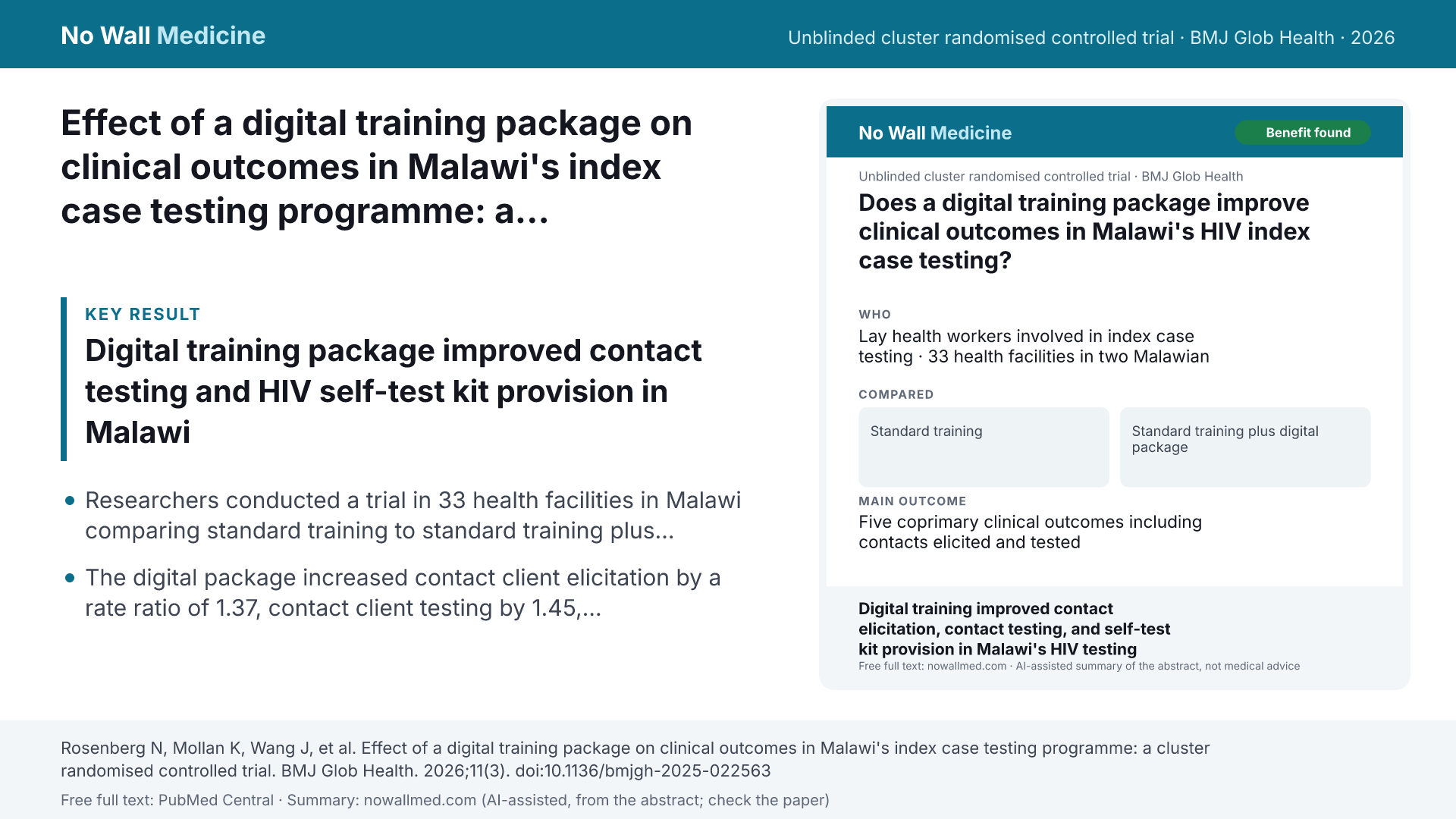
Effect of a digital training package on clinical outcomes in Malawi's index case testing programme: a cluster randomised controlled trial
Unblinded cluster randomised controlled trialBenefit found
Does a digital training package improve clinical outcomes in Malawi's HIV index case testing?
Who
Lay health workers involved in index case testing · 33 health facilities in two Malawian districts
Compared
Standard training
Standard training plus digital package
Main outcome
Five coprimary clinical outcomes including contacts elicited and tested
Result: contact client elicitation RR=1.37 (95% CI 1.10 to 1.71)
Bottom line: Digital training improved contact elicitation, contact testing, and self-test kit provision in Malawi's HIV testing programme.
BMJ Glob Health · 2026-03-13 · Save PNG
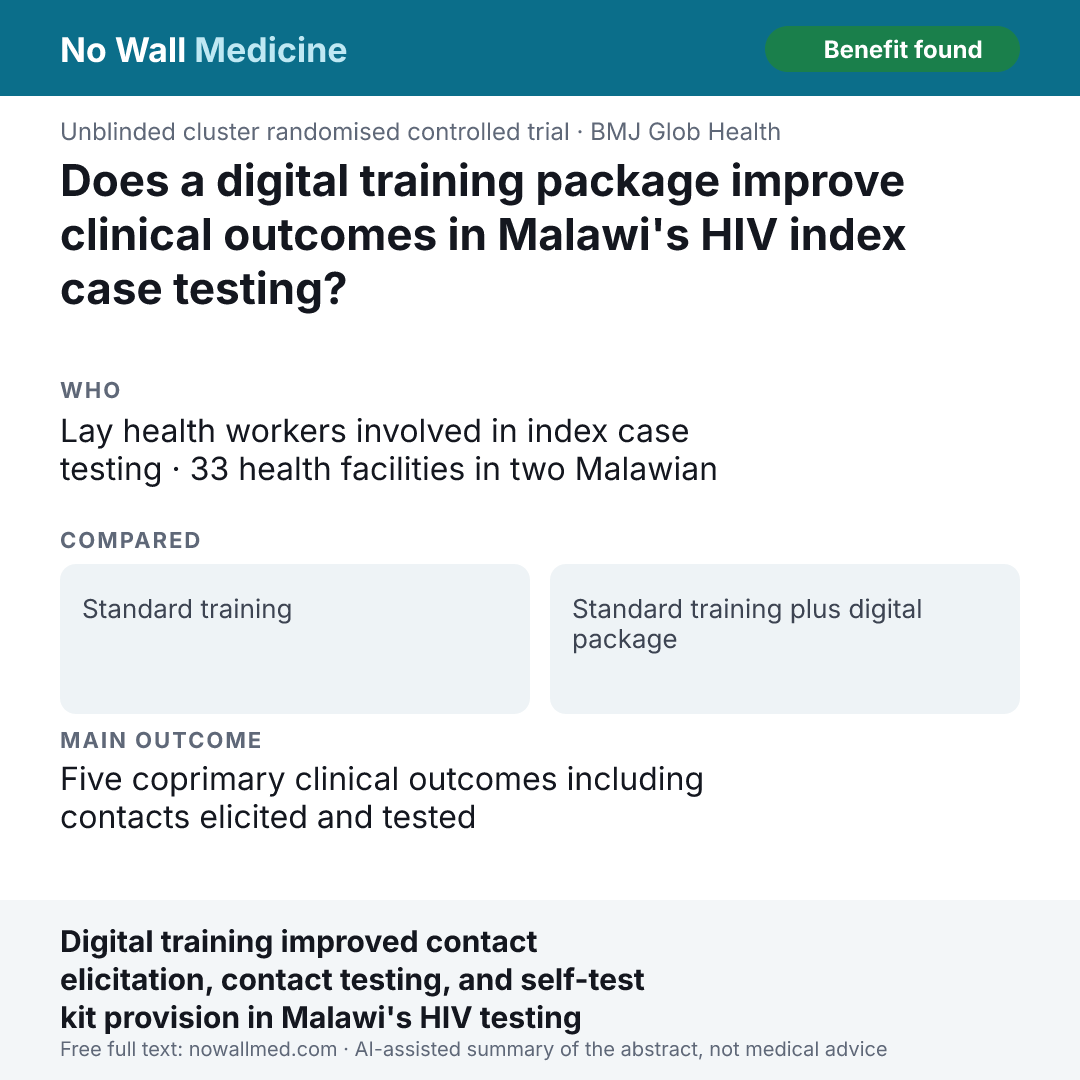
Clinical question: Does a digital training package improve clinical outcomes in Malawi's HIV index case testing?
Why it matters: Clinical outcomes are rarely evaluated when using digital training to reach health workers in low-income settings.
Key points
- Researchers conducted a trial in 33 health facilities in Malawi comparing standard training to standard training plus a digital-based package for lay health workers.
- The digital package increased contact client elicitation by a rate ratio of 1.37, contact client testing by 1.45, and self-test kit provision by 2.29.
- The digital training showed positive but non-significant effects on index client participation and new HIV diagnoses.
Headline and key points written with AI from the paper’s abstract, with every number checked against it. Read the paper before relying on them.
Was this summary helpful?
Abstract
Introduction
Training health workers is a common implementation strategy to expand evidence-based interventions. Digital training is a promising way of reaching more health workers, minimising clinical interruptions and lowering costs, but clinical outcomes are rarely evaluated in low-income settings. Clinical outcomes were evaluated in Malawi's HIV index case testing programme through the Package of Resources for Assisted Contact Tracing: Implementation, Costs, and Effectiveness study. Methods
An unblinded cluster randomised controlled trial was conducted in 33 health facilities in two Malawian districts (2022-2023). Facilities were stratified by district and size and randomly assigned 2:1 to receive standard training or standard training plus a digital-based package. The package included asynchronous role-modelling, small-group practice, one-on-one feedback and tablet-guided quality improvement. Participants were lay health workers involved in index case testing. Index clients were people diagnosed with HIV. Contact clients were their partners, children and household members. Five coprimary outcomes, abstracted from programme registers over 1 year, were assessed at the cluster level: index client participation, contacts elicited, contacts tested, new HIV diagnoses and self-test kit provision. Impacts were estimated using negative binomial mixed-effects models (α=0.05). Results
Clusters were randomly assigned to enhanced (n=11) or standard (n=22) arms and analysed in four 3-month increments (calendar-quarters) over a 1-year period. In each calendar quarter, clusters had a median of 281 potential index clients (IQR 220-427). Significant effects were observed for three primary outcomes: contact client elicitation (RR=1.37, 95% CI 1.10 to 1.71, p=0.006), contact client testing (RR=1.45, CI 1.10 to 1.92, p=0.01) and self-test kit provision (RR=2.29, 95% CI 1.19 to 4.40, p=0.01). Positive, but non-significant effects were observed for index client participation (RR=1.22, CI 0.93 to 1.60, p=0.1) and new HIV diagnoses (RR: 1.28, CI 0.94 to 1.76, p=0.1). No study-related adverse events occurred. Conclusions
Enhanced digital training positively impacted meaningful clinical outcomes and could be replicated for expansion to other evidence-based interventions. Trial registration number
NCT05343390.
Abstract reproduced under the article’s CC BY licence.
Subject terms
Headline, design, result, key points, caveat and citation as plain text.
Cite this article
Rosenberg N, Mollan K, Wang J, et al. Effect of a digital training package on clinical outcomes in Malawi's index case testing programme: a cluster randomised controlled trial. BMJ Glob Health. 2026;11(3). doi:10.1136/bmjgh-2025-022563
Spotted a mistake? Suggest a correction