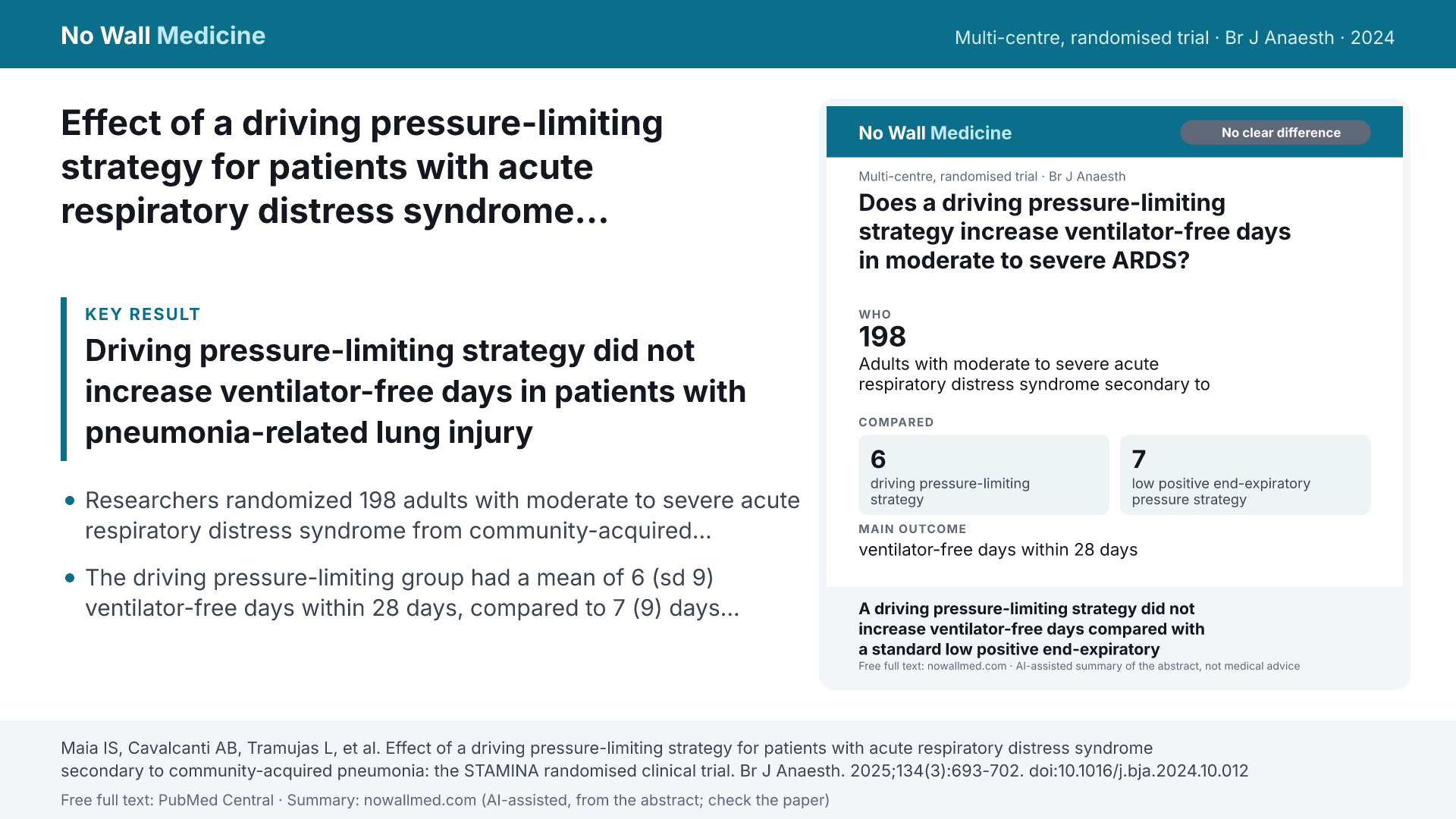
Driving pressure-limiting strategy did not increase ventilator-free days in patients with pneumonia-related lung injury
Effect of a driving pressure-limiting strategy for patients with acute respiratory distress syndrome secondary to community-acquired pneumonia: the STAMINA randomised clinical trial
Multi-centre, randomised trialNo clear difference
Does a driving pressure-limiting strategy increase ventilator-free days in moderate to severe ARDS?
Who
198
Adults with moderate to severe acute respiratory distress syndrome secondary to community-acquired pneumonia · multi-centre
Compared
6driving pressure-limiting strategy (sd 9)
7low positive end-expiratory pressure strategy (9)
Main outcome
ventilator-free days within 28 days
Result: proportional odds ratio 0.72 (95% confidence interval 0.39-1.32)
Bottom line: A driving pressure-limiting strategy did not increase ventilator-free days compared with a standard low positive end-expiratory pressure strategy.
Br J Anaesth · 2024-11-26Download image
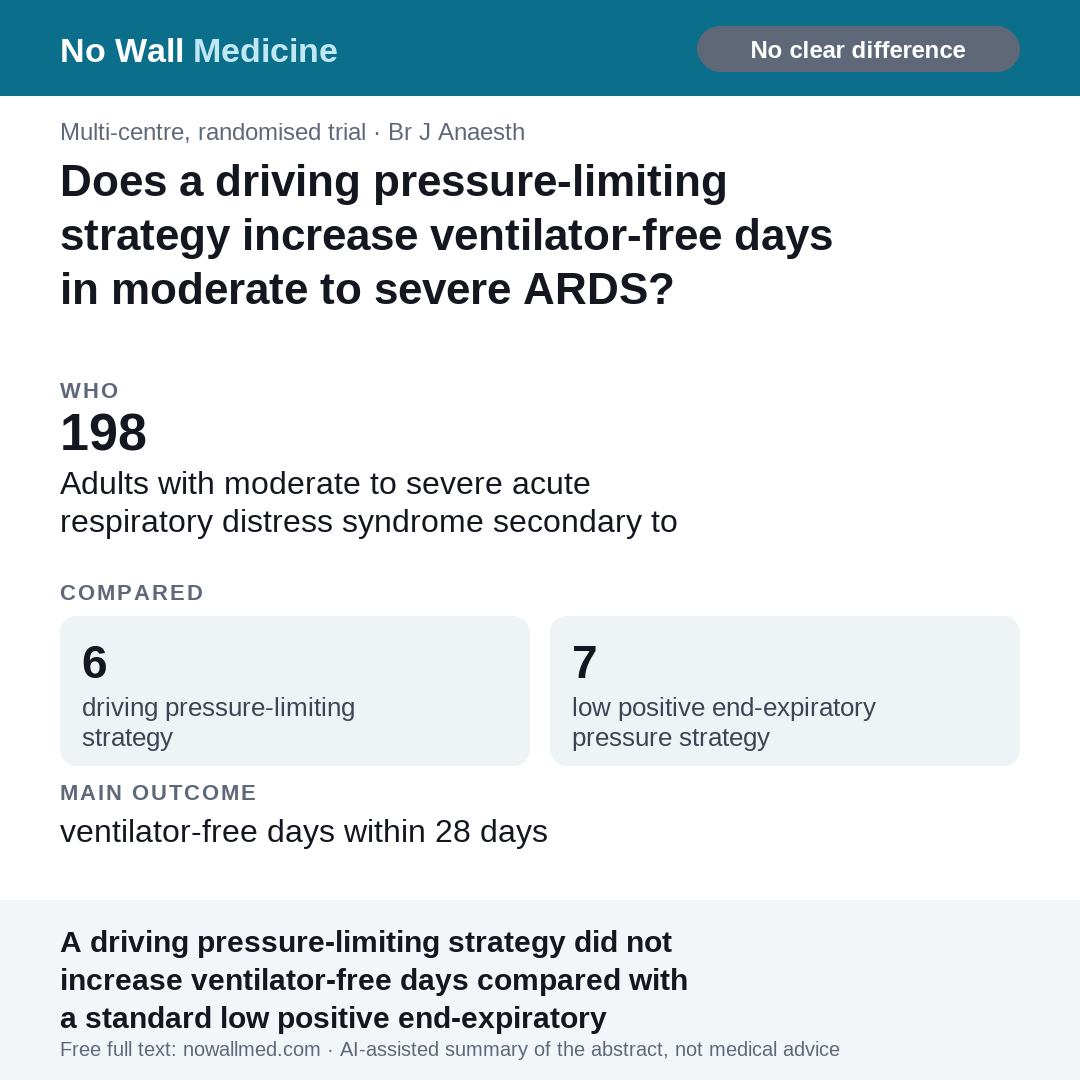
Clinical question: Does a driving pressure-limiting strategy increase ventilator-free days in moderate to severe ARDS?
Why it matters: It was unknown if adjusting tidal volume and positive end-expiratory pressure to limit driving pressure would increase ventilator-free days in patients with pneumonia-related lung injury.
Key points
- Researchers randomized 198 adults with moderate to severe acute respiratory distress syndrome from community-acquired pneumonia to either a driving pressure-limiting strategy or a low positive end-expiratory pressure strategy.
- The driving pressure-limiting group had a mean of 6 (sd 9) ventilator-free days within 28 days, compared to 7 (9) days in the control group.
- There were no significant differences between the two groups regarding in-hospital or intensive care unit mortality at 90 days.
Headline and key points written with AI from the paper’s abstract, with every number checked against it. Read the paper before relying on them.
Was this summary helpful?
Subject terms
Cite this article
Maia IS, Cavalcanti AB, Tramujas L, et al. Effect of a driving pressure-limiting strategy for patients with acute respiratory distress syndrome secondary to community-acquired pneumonia: the STAMINA randomised clinical trial. Br J Anaesth. 2024. doi:10.1016/j.bja.2024.10.012
Spotted a mistake? Suggest a correction