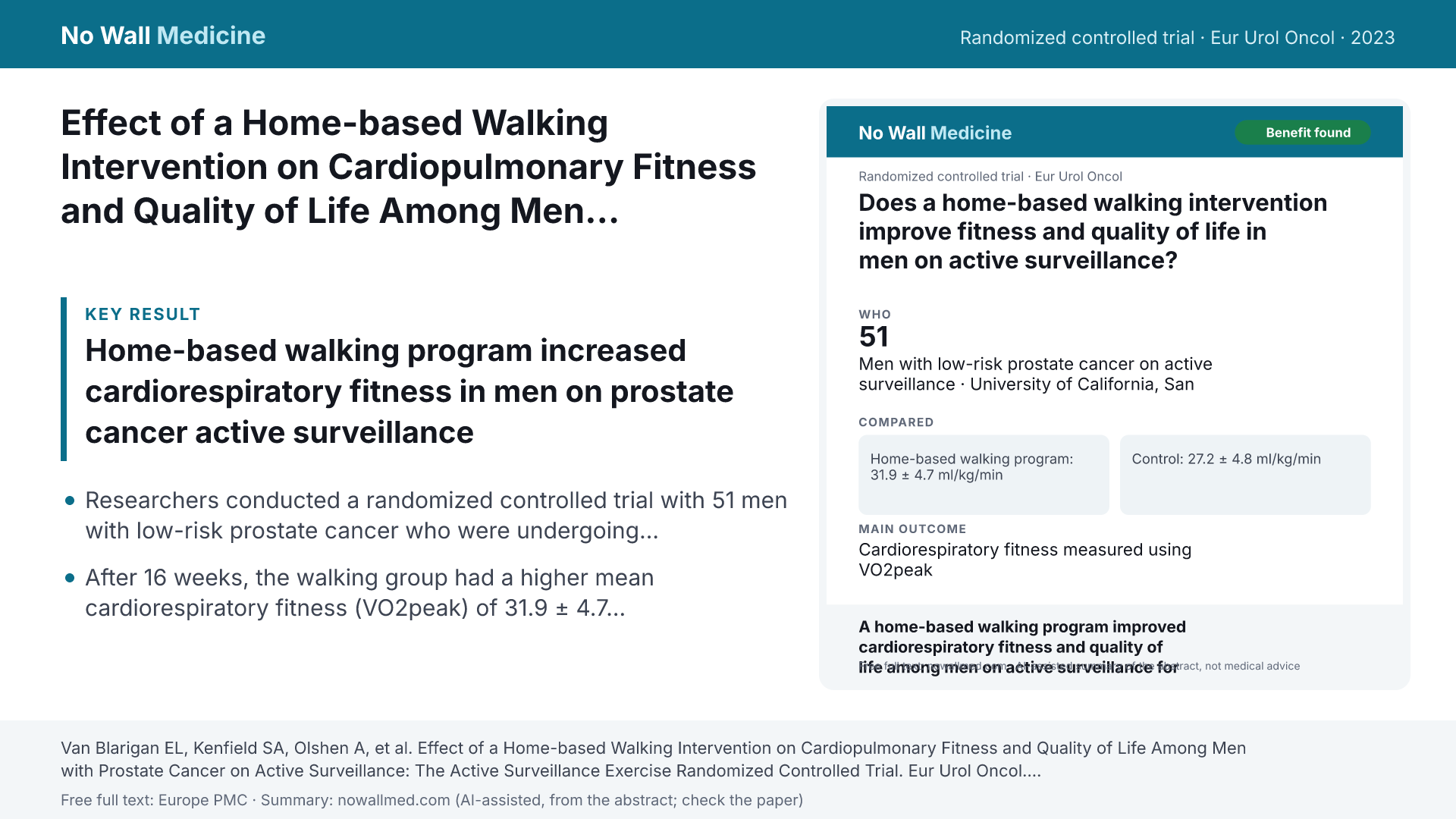
Home-based walking program increased cardiorespiratory fitness in men on prostate cancer active surveillance
Effect of a Home-based Walking Intervention on Cardiopulmonary Fitness and Quality of Life Among Men with Prostate Cancer on Active Surveillance: The Active Surveillance Exercise Randomized Controlled Trial
Randomized controlled trialBenefit found
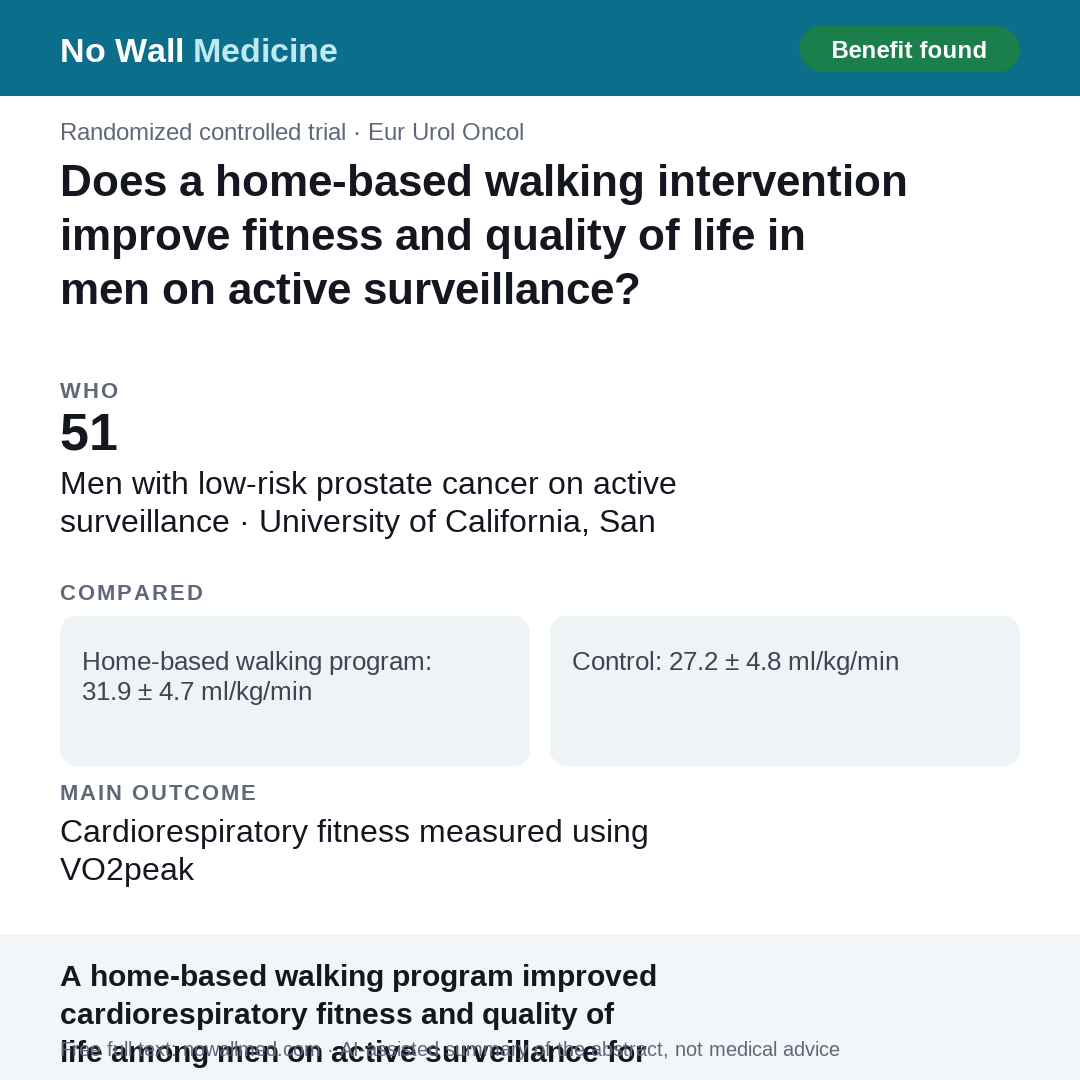
Does a home-based walking intervention improve fitness and quality of life in men on active surveillance?
Who
51
Men with low-risk prostate cancer on active surveillance · University of California, San Francisco
Compared
Home-based walking program: 31.9 ± 4.7 ml/kg/min
Control: 27.2 ± 4.8 ml/kg/min
Main outcome
Cardiorespiratory fitness measured using VO2peak
Bottom line: A home-based walking program improved cardiorespiratory fitness and quality of life among men on active surveillance for prostate cancer.
Eur Urol Oncol · 2023-10-29Download image
Clinical question: Does a home-based walking intervention improve fitness and quality of life in men on active surveillance?
Why it matters: Interventions to lower the risk of cancer progression and fear of recurrence are needed for men on active surveillance for prostate cancer.
Key points
- Researchers conducted a randomized controlled trial with 51 men with low-risk prostate cancer who were undergoing active surveillance.
- After 16 weeks, the walking group had a higher mean cardiorespiratory fitness (VO2peak) of 31.9 ± 4.7 ml/kg/min compared to 27.2 ± 4.8 ml/kg/min in the control group.
- The walking intervention was also associated with reduced urinary obstruction/irritation and reduced fear of cancer recurrence.
Headline and key points written with AI from the paper’s abstract, with every number checked against it. Read the paper before relying on them.
Was this summary helpful?
Abstract
Background
Active surveillance (AS) is standard care for most men with low-risk prostate cancer (PC); yet, many men on AS eventually undergo curative therapy. Interventions to lower the risk of cancer progression and fear of recurrence among men on AS for PC are needed.Objective
To determine the effect of aerobic exercise on cardiorespiratory fitness, body size, and quality of life (QOL) among men on AS for PC.Design, setting, and participants
We conducted a 1:1 randomized controlled trial among 51 men with low-risk PC who elected AS. Participants were enrolled at the University of California, San Francisco.Intervention
The 16-wk intervention included a home-based walking program with a nonlinear exercise prescription tailored to baseline fitness level, heart rate monitor, and weekly phone call with an exercise physiologist. Controls received printed materials.Outcome measurements and statistical analysis
Cardiorespiratory fitness was measured using VO2peak; secondary outcomes included change in body size, anxiety, and QOL. Analyses were based on intention to treat.Results and limitations
Between 2016 and 2021, we randomized 51 men to intervention (n = 26) or control (n = 25). Follow-up was 88% (45/51), 85% (22/26) in the intervention and 92% (23/25) in the control group. At 16 wk, the intervention group had a higher mean VO2peak than the control group (31.9 ± 4.7 vs 27.2 ± 4.8 ml/kg/min; group × time effect p value: Conclusions
A home-based walking program improved VO2peak and reduced urinary obstruction/irritation and fear of recurrence among men on AS for PC.Patient summary
Moderate to vigorous aerobic exercise improves fitness and quality of life among men on active surveillance for prostate cancer.
Abstract reproduced under the article’s CC BY-NC-ND licence.
Subject terms
Cite this article
Van Blarigan EL, Kenfield SA, Olshen A, et al. Effect of a Home-based Walking Intervention on Cardiopulmonary Fitness and Quality of Life Among Men with Prostate Cancer on Active Surveillance: The Active Surveillance Exercise Randomized Controlled Trial. Eur Urol Oncol. 2023. doi:10.1016/j.euo.2023.10.012
Spotted a mistake? Suggest a correction