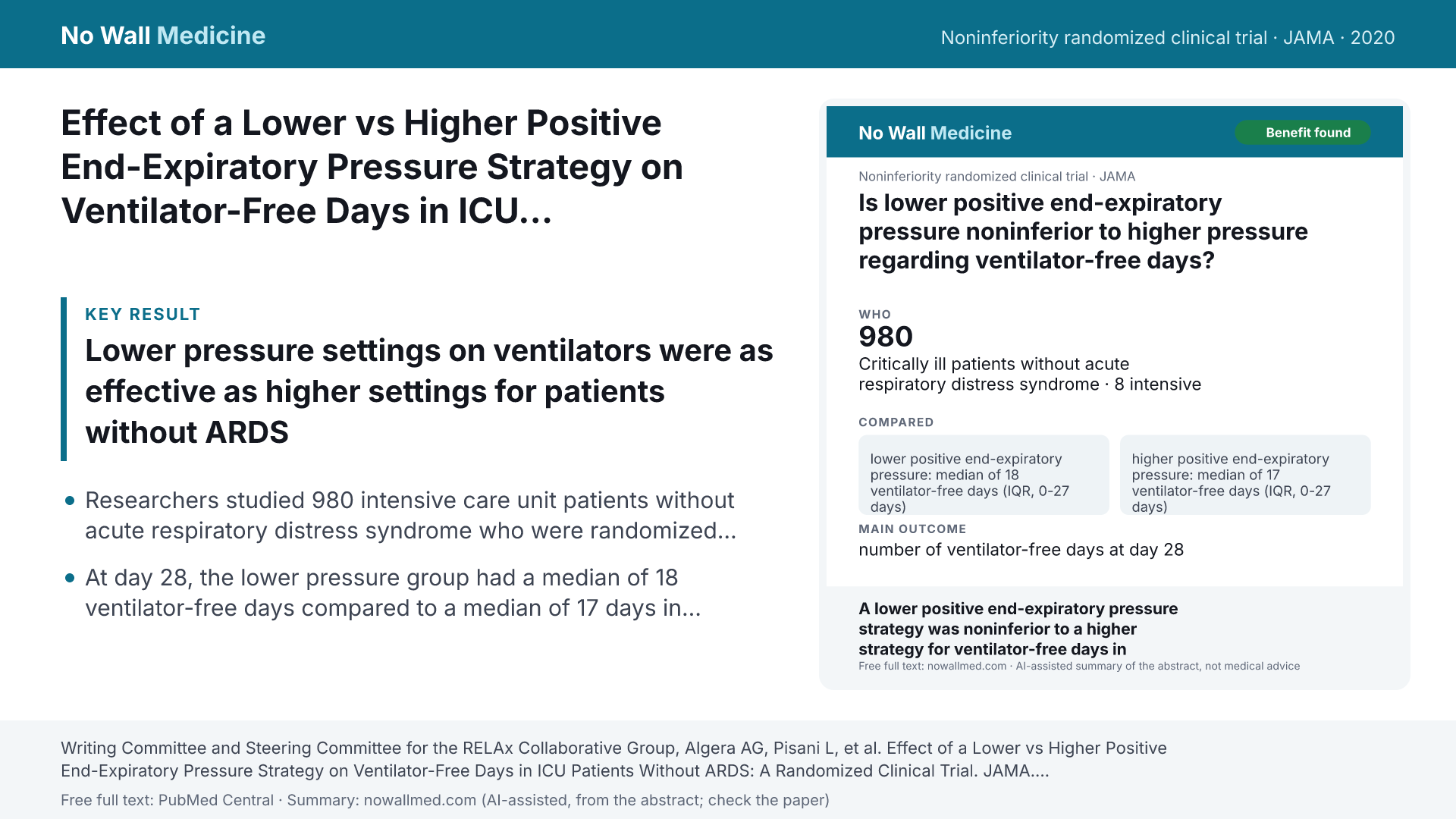
Lower pressure settings on ventilators were as effective as higher settings for patients without ARDS
Effect of a Lower vs Higher Positive End-Expiratory Pressure Strategy on Ventilator-Free Days in ICU Patients Without ARDS: A Randomized Clinical Trial
Noninferiority randomized clinical trialBenefit found
Is lower positive end-expiratory pressure noninferior to higher pressure regarding ventilator-free days?
Who
980
Critically ill patients without acute respiratory distress syndrome · 8 intensive care units in the Netherlands
Compared
lower positive end-expiratory pressure: median of 18 ventilator-free days (IQR, 0-27 days)
higher positive end-expiratory pressure: median of 17 ventilator-free days (IQR, 0-27 days)
Main outcome
number of ventilator-free days at day 28
Result: mean ratio, 1.04; 95% CI, 0.95-∞
Bottom line: A lower positive end-expiratory pressure strategy was noninferior to a higher strategy for ventilator-free days in patients without acute respiratory distress syndrome.
JAMA · 2020-12-10 · Save PNG
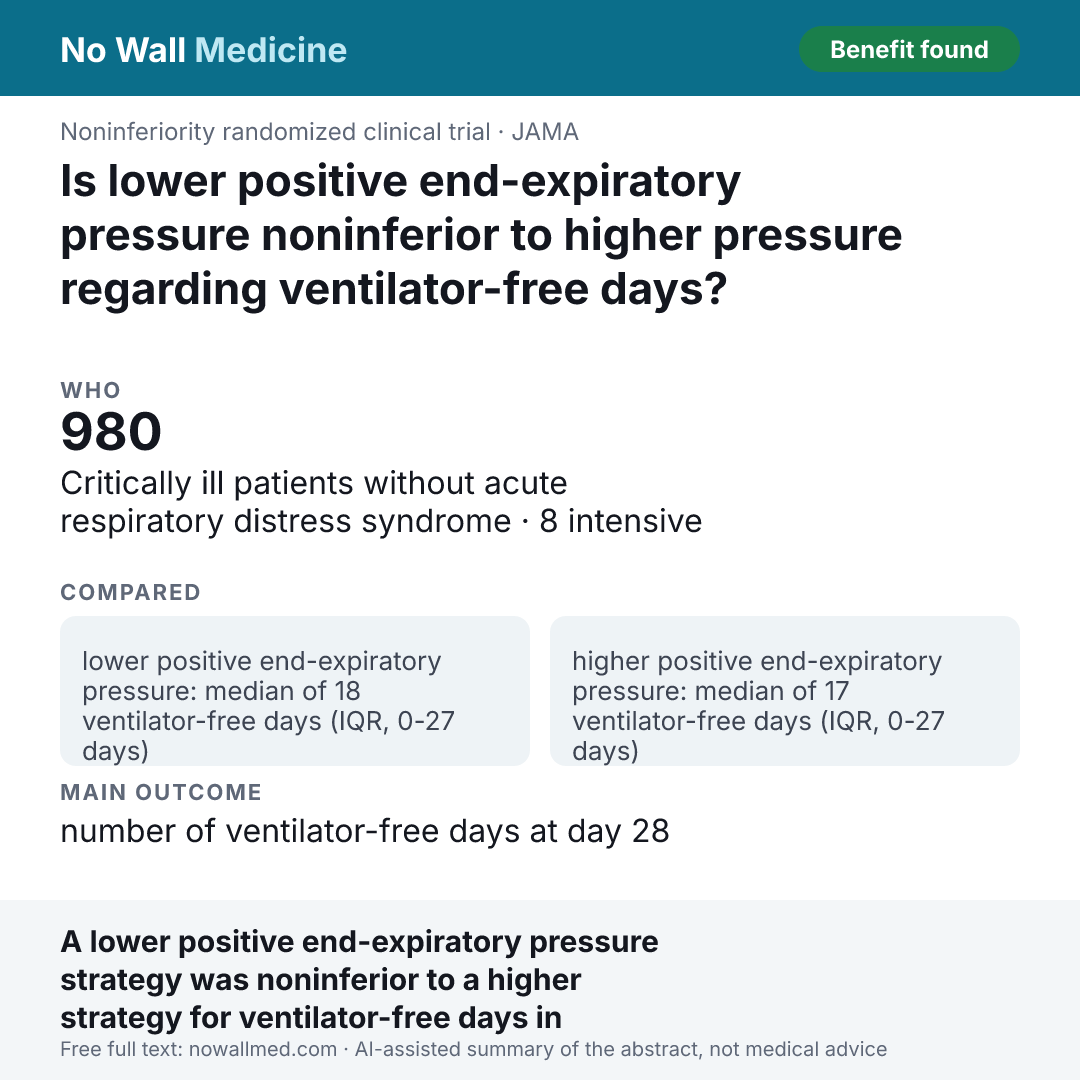
Clinical question: Is lower positive end-expiratory pressure noninferior to higher pressure regarding ventilator-free days?
Key points
- Researchers studied 980 intensive care unit patients without acute respiratory distress syndrome who were randomized to receive either lower or higher positive end-expiratory pressure.
- At day 28, the lower pressure group had a median of 18 ventilator-free days compared to a median of 17 days in the higher pressure group.
- There were no statistically significant differences in 28-day mortality, which was 38.4% in the lower pressure group and 42.0% in the higher pressure group.
Headline and key points written with AI from the paper’s abstract, with every number checked against it. Read the paper before relying on them.
Was this summary helpful?
Subject terms
Headline, design, result, key points, caveat and citation as plain text.
Cite this article
Writing Committee and Steering Committee for the RELAx Collaborative Group, Algera AG, Pisani L, et al. Effect of a Lower vs Higher Positive End-Expiratory Pressure Strategy on Ventilator-Free Days in ICU Patients Without ARDS: A Randomized Clinical Trial. JAMA. 2020;324(24):2509-2520. doi:10.1001/jama.2020.23517
Spotted a mistake? Suggest a correction