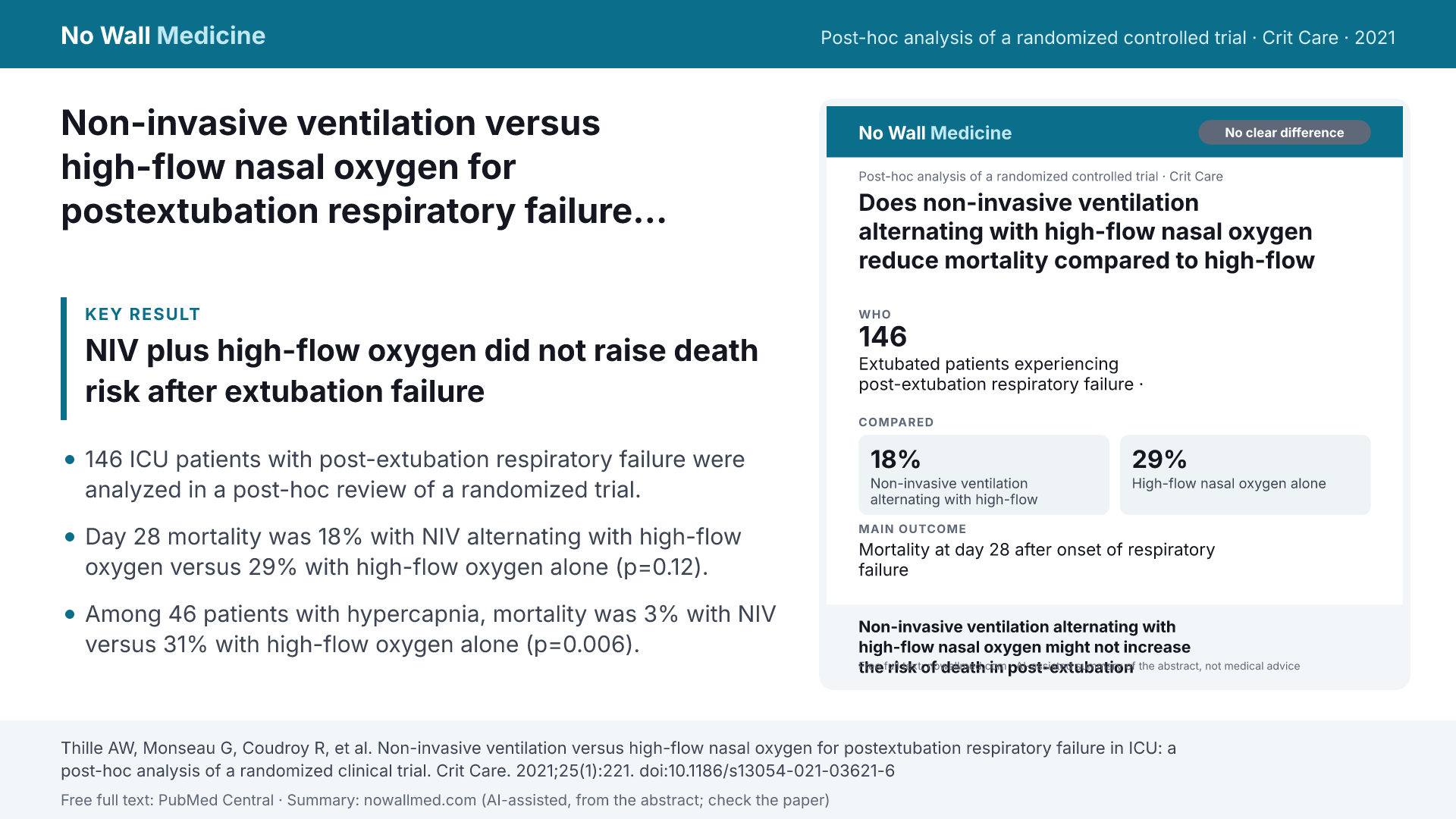
NIV plus high-flow oxygen did not raise death risk after extubation failure
Non-invasive ventilation versus high-flow nasal oxygen for postextubation respiratory failure in ICU: a post-hoc analysis of a randomized clinical trial
Post-hoc analysis of a randomized controlled trialNo clear difference
Does non-invasive ventilation alternating with high-flow nasal oxygen reduce mortality compared to high-flow nasal oxygen alone?
Who
146
Extubated patients experiencing post-extubation respiratory failure · Multicenter
Compared
18%Non-invasive ventilation alternating with high-flow nasal oxygen (15/84)
29%High-flow nasal oxygen alone (18/62)
Main outcome
Mortality at day 28 after onset of respiratory failure
Result: difference, -11% (95% CI, -25 to 2)
Bottom line: Non-invasive ventilation alternating with high-flow nasal oxygen might not increase the risk of death in post-extubation respiratory failure.
Crit Care · 2021-06-28Download image
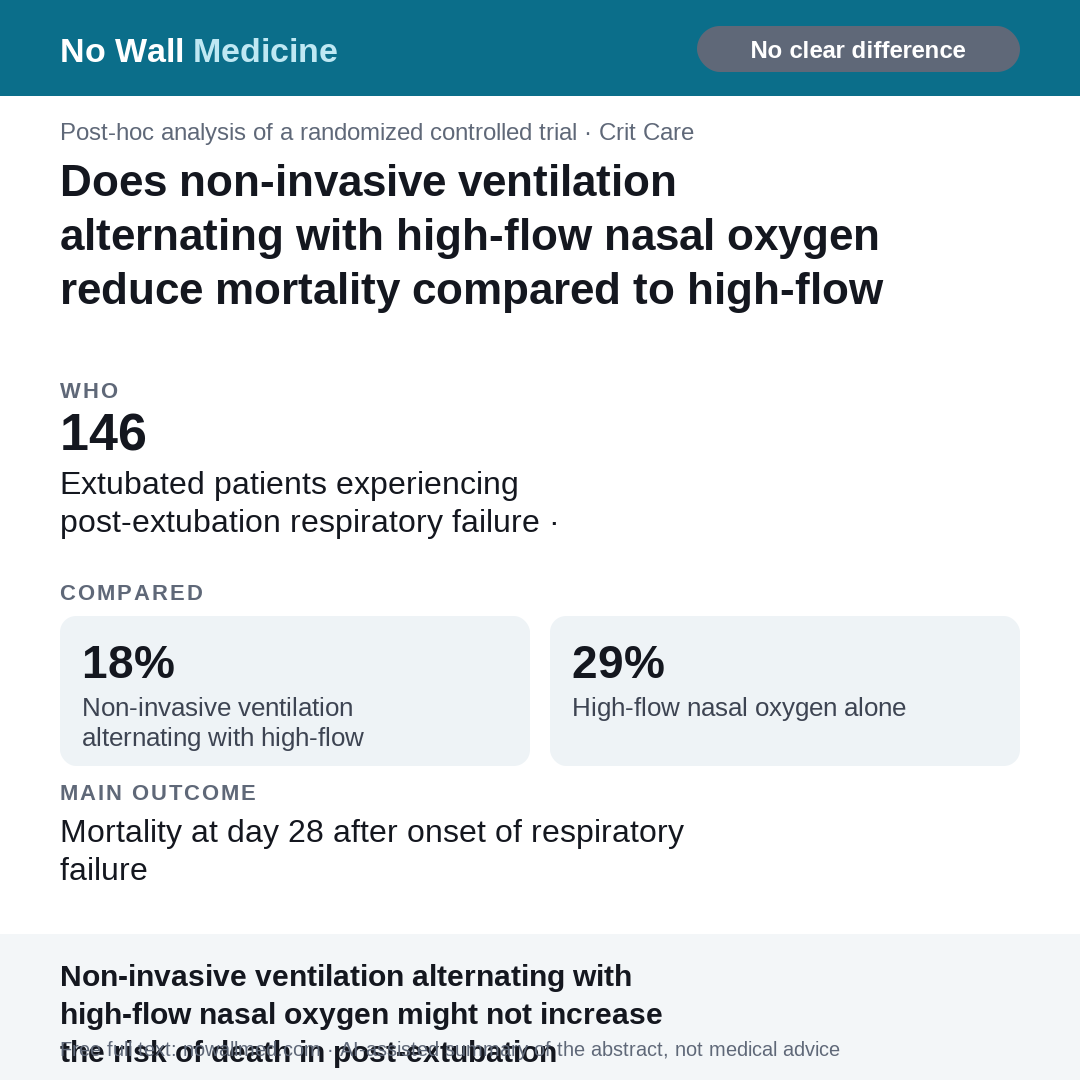
Clinical question: Does non-invasive ventilation alternating with high-flow nasal oxygen reduce mortality compared to high-flow nasal oxygen alone?
Key points
- 146 ICU patients with post-extubation respiratory failure were analyzed in a post-hoc review of a randomized trial.
- Day 28 mortality was 18% with NIV alternating with high-flow oxygen versus 29% with high-flow oxygen alone (p=0.12).
- Among 46 patients with hypercapnia, mortality was 3% with NIV versus 31% with high-flow oxygen alone (p=0.006).
Headline and key points written with AI from the paper’s abstract, with every number checked against it. Read the paper before relying on them.
Was this summary helpful?
Abstract
Background
In intensive care units (ICUs), patients experiencing post-extubation respiratory failure have poor outcomes. The use of noninvasive ventilation (NIV) to treat post-extubation respiratory failure may increase the risk of death. This study aims at comparing mortality between patients treated with NIV alternating with high-flow nasal oxygen or high-flow nasal oxygen alone. Methods
Post-hoc analysis of a multicenter, randomized, controlled trial focusing on patients who experienced post-extubation respiratory failure within the 7 days following extubation. Patients were classified in the NIV group or the high-flow nasal oxygen group according to oxygenation strategy used after the onset of post-extubation respiratory failure. Patients reintubated within the first hour after extubation and those promptly reintubated without prior treatment were excluded. The primary outcome was mortality at day 28 after the onset of post-extubation respiratory failure. Results
Among 651 extubated patients, 158 (25%) experienced respiratory failure and 146 were included in the analysis. Mortality at day 28 was 18% (15/84) using NIV alternating with high-flow nasal oxygen and 29% (18/62) with high flow nasal oxygen alone (difference, - 11% [95% CI, - 25 to 2]; p = 0.12). Among the 46 patients with hypercapnia at the onset of respiratory failure, mortality at day 28 was 3% (1/33) with NIV and 31% (4/13) with high-flow nasal oxygen alone (difference, - 28% [95% CI, - 54 to - 6]; p = 0.006). The proportion of patients reintubated 48 h after the onset of post-extubation respiratory failure was 44% (37/84) with NIV and 52% (32/62) with high-flow nasal oxygen alone (p = 0.21). Conclusions
In patients with post-extubation respiratory failure, NIV alternating with high-flow nasal oxygen might not increase the risk of death. Trial registration number The trial was registered at http://www.clinicaltrials.gov with the registration number NCT03121482 the 20th April 2017.
Abstract reproduced under the article’s CC BY licence.
Subject terms
Headline, design, result, key points, caveat and citation as plain text.
Cite this article
Thille AW, Monseau G, Coudroy R, et al. Non-invasive ventilation versus high-flow nasal oxygen for postextubation respiratory failure in ICU: a post-hoc analysis of a randomized clinical trial. Crit Care. 2021. doi:10.1186/s13054-021-03621-6
Spotted a mistake? Suggest a correction