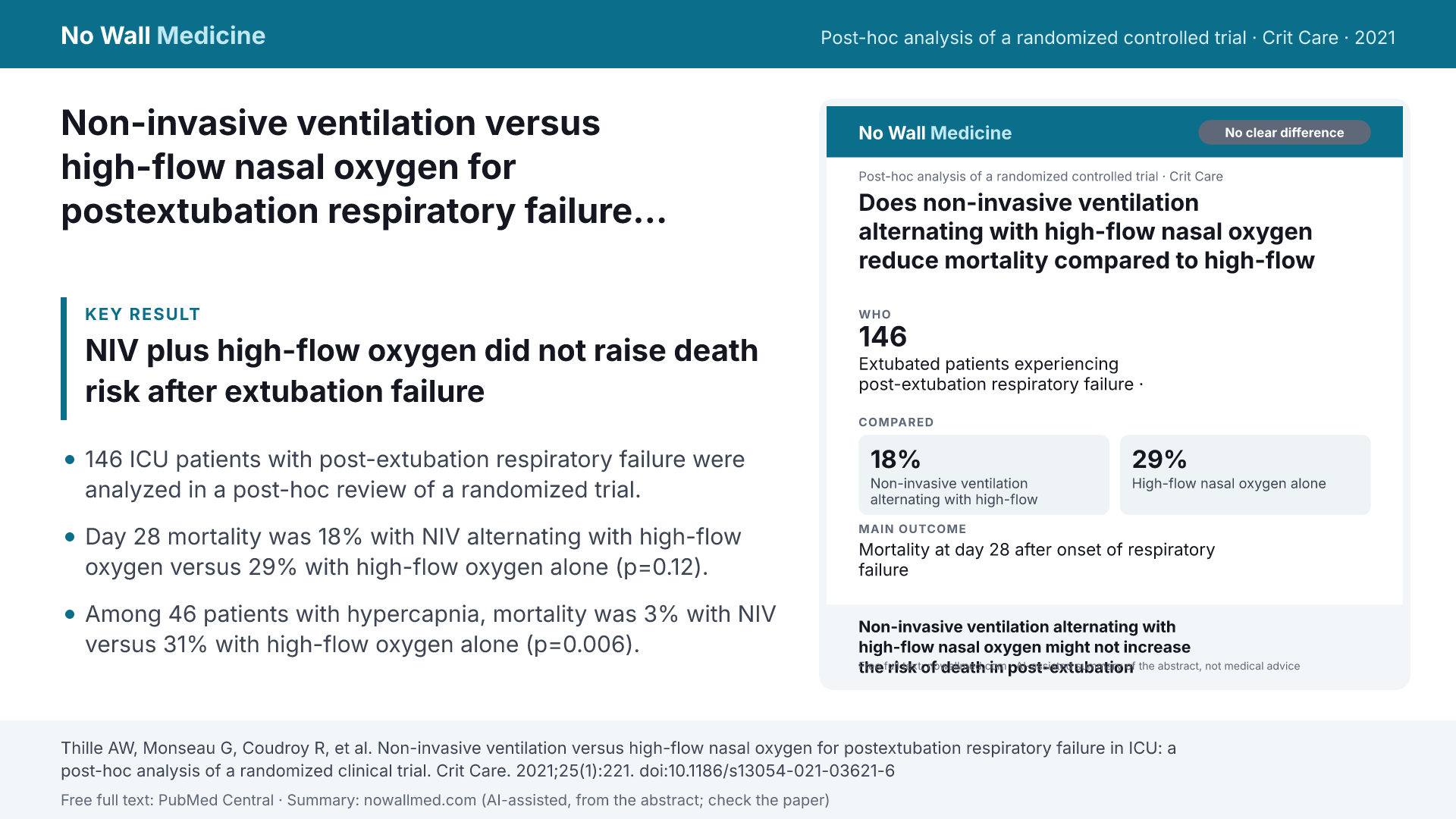
Non-invasive ventilation versus high-flow nasal oxygen for postextubation respiratory failure in ICU: a post-hoc analysis of a randomized clinical trial
Key result: NIV plus high-flow oxygen did not raise death risk after extubation failure
Post-hoc analysis of a randomized controlled trialNo clear difference
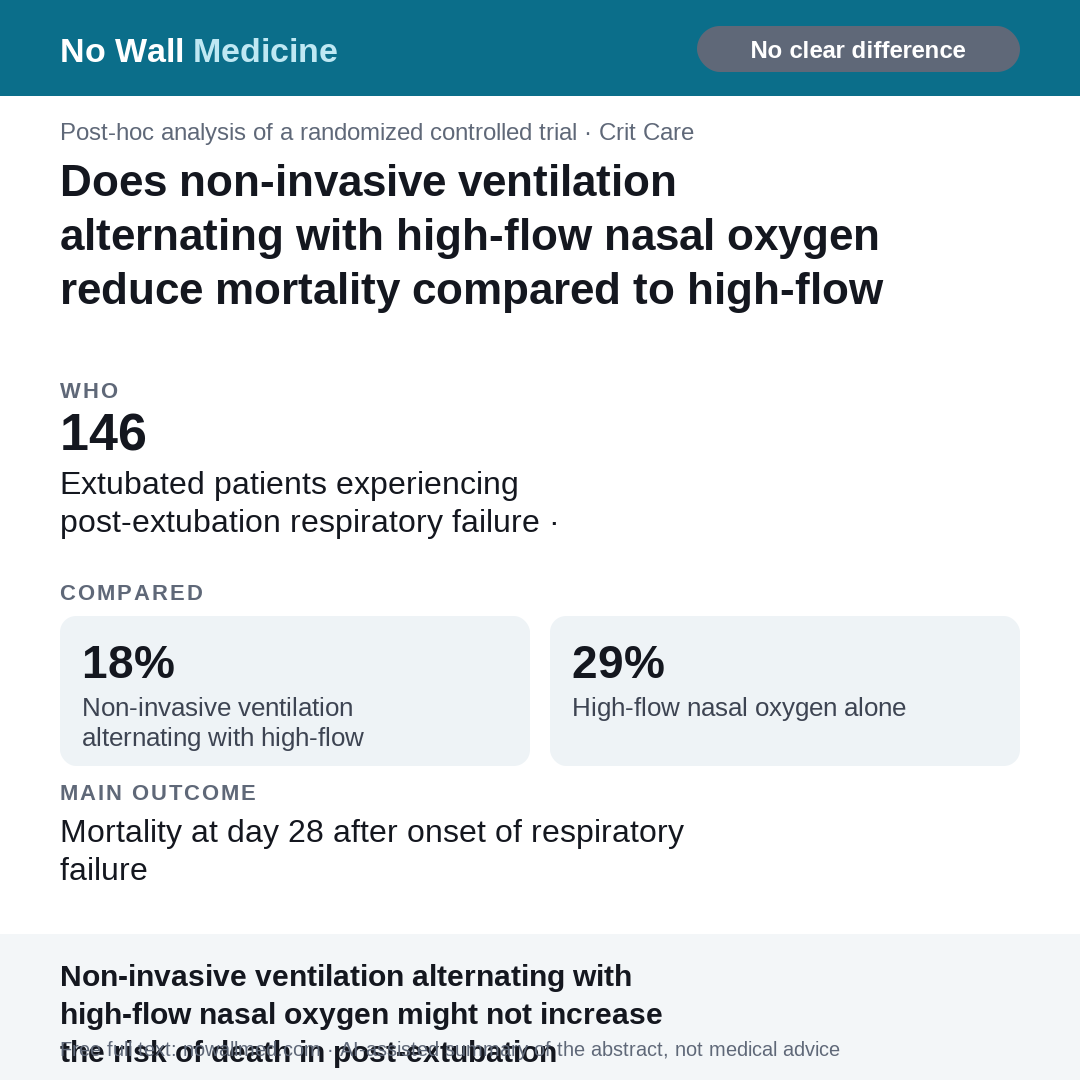
Does non-invasive ventilation alternating with high-flow nasal oxygen reduce mortality compared to high-flow nasal oxygen alone?
Who
146
Extubated patients experiencing post-extubation respiratory failure · Multicenter
Compared
18%Non-invasive ventilation alternating with high-flow nasal oxygen (15/84)
29%High-flow nasal oxygen alone (18/62)
Main outcome
Mortality at day 28 after onset of respiratory failure
Result: difference, -11% (95% CI, -25 to 2)
Bottom line: Non-invasive ventilation alternating with high-flow nasal oxygen might not increase the risk of death in post-extubation respiratory failure.
Crit Care · 2021-06-28Download image
Key points
- 146 ICU patients with post-extubation respiratory failure were analyzed in a post-hoc review of a randomized trial.
- Day 28 mortality was 18% with NIV alternating with high-flow oxygen versus 29% with high-flow oxygen alone (p=0.12).
- Among 46 patients with hypercapnia, mortality was 3% with NIV versus 31% with high-flow oxygen alone (p=0.006).
Discussion prompts
- Would these patients look like yours? Who was left out?
- Is the main outcome one that matters to patients?
- Is the difference large enough to change what you do?
Cite: Thille AW, Monseau G, Coudroy R, et al. Non-invasive ventilation versus high-flow nasal oxygen for postextubation respiratory failure in ICU: a post-hoc analysis of a randomized clinical trial. Crit Care. 2021. doi:10.1186/s13054-021-03621-6
Free full text: PubMed Central · Summary and visual abstract: nowallmed.com/a/non-invasive-ventilation-versus-high-flow-nasal-oxygen-for-nxc8wz/ (AI-assisted from the abstract; check the paper before relying on it).