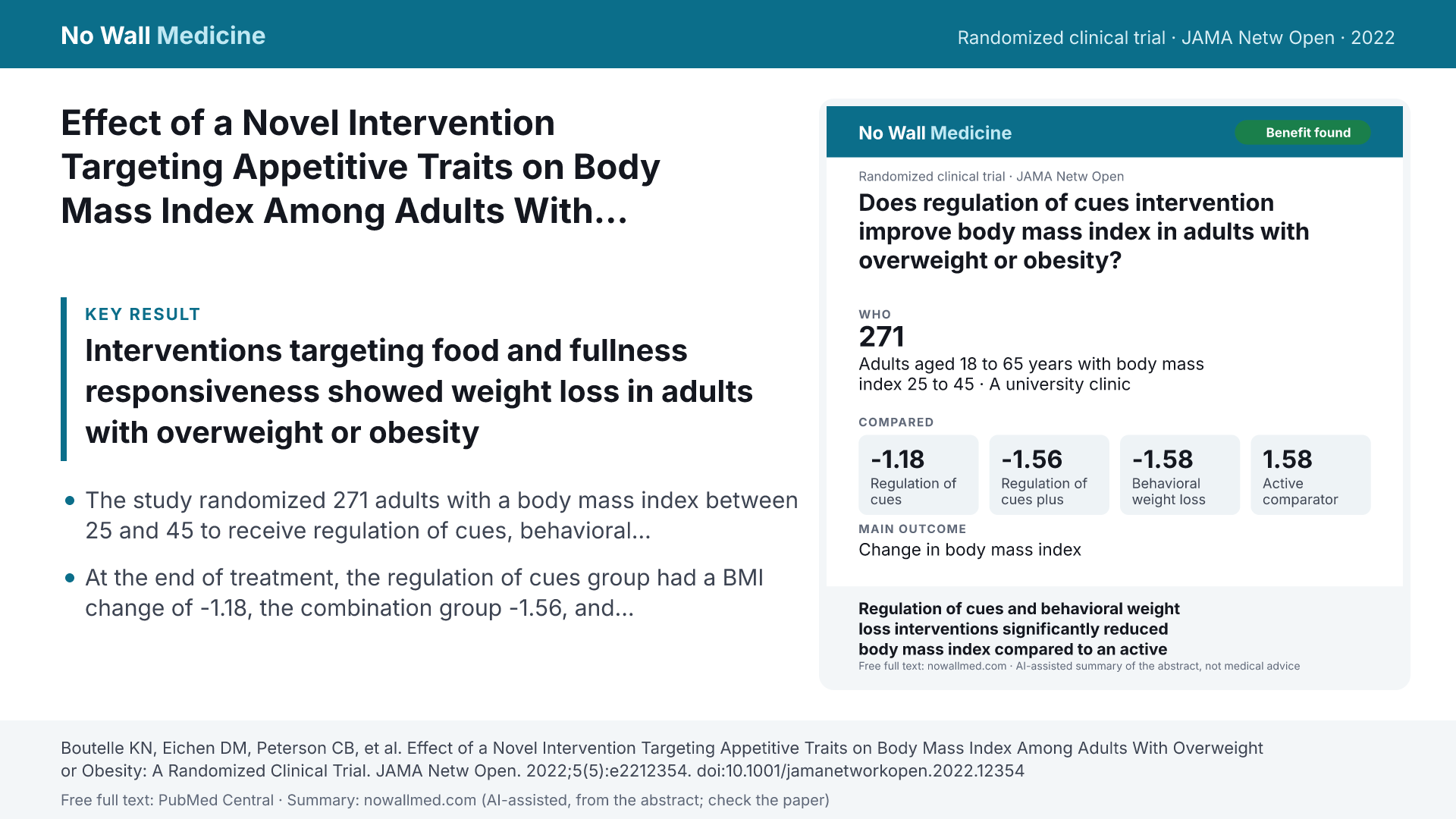
Interventions targeting food and fullness responsiveness showed weight loss in adults with overweight or obesity
Effect of a Novel Intervention Targeting Appetitive Traits on Body Mass Index Among Adults With Overweight or Obesity: A Randomized Clinical Trial
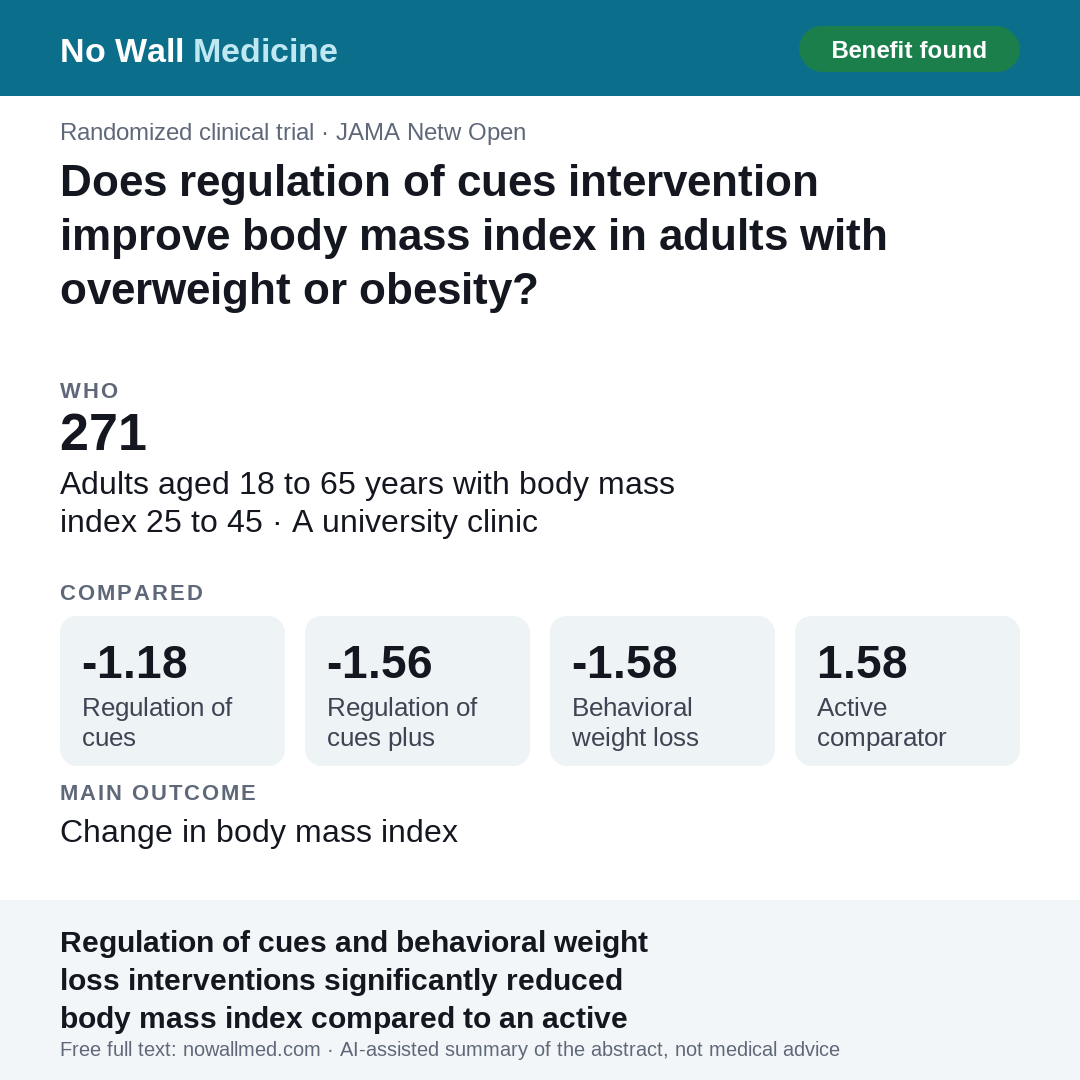
Randomized clinical trialBenefit found
Does regulation of cues intervention improve body mass index in adults with overweight or obesity?
Who
271
Adults aged 18 to 65 years with body mass index 25 to 45 · A university clinic
Compared
-1.18Regulation of cues (95% CI, -2.10 to -0.35)
-1.56Regulation of cues plus behavioral weight loss (95% CI, -2.43 to -0.67)
-1.58Behavioral weight loss (95% CI, -2.45 to -0.71)
1.58Active comparator (95% CI, 0.72 to 2.45)
Main outcome
Change in body mass index
Bottom line: Regulation of cues and behavioral weight loss interventions significantly reduced body mass index compared to an active comparator.
JAMA Netw Open · 2022-05-02Download image
Clinical question: Does regulation of cues intervention improve body mass index in adults with overweight or obesity?
Why it matters: Most individuals regain weight after behavioral weight loss programs, and it is unknown if targeting genetically determined appetitive traits like food and satiety responsiveness can improve outcomes.
Key points
- The study randomized 271 adults with a body mass index between 25 and 45 to receive regulation of cues, behavioral weight loss, a combination, or an active comparator.
- At the end of treatment, the regulation of cues group had a BMI change of -1.18, the combination group -1.56, and the behavioral weight loss group -1.58.
- The BMI of the active comparator group was 1.58 higher than the other groups at the end of treatment, and BMI reductions at 24 months were similar across the three main interventions.
Headline and key points written with AI from the paper’s abstract, with every number checked against it. Read the paper before relying on them.
Was this summary helpful?
Subject terms
Cite this article
Boutelle KN, Eichen DM, Peterson CB, et al. Effect of a Novel Intervention Targeting Appetitive Traits on Body Mass Index Among Adults With Overweight or Obesity: A Randomized Clinical Trial. JAMA Netw Open. 2022. doi:10.1001/jamanetworkopen.2022.12354
Spotted a mistake? Suggest a correction