Pay-it-forward strategy increased human papillomavirus vaccine uptake among teenage girls in China
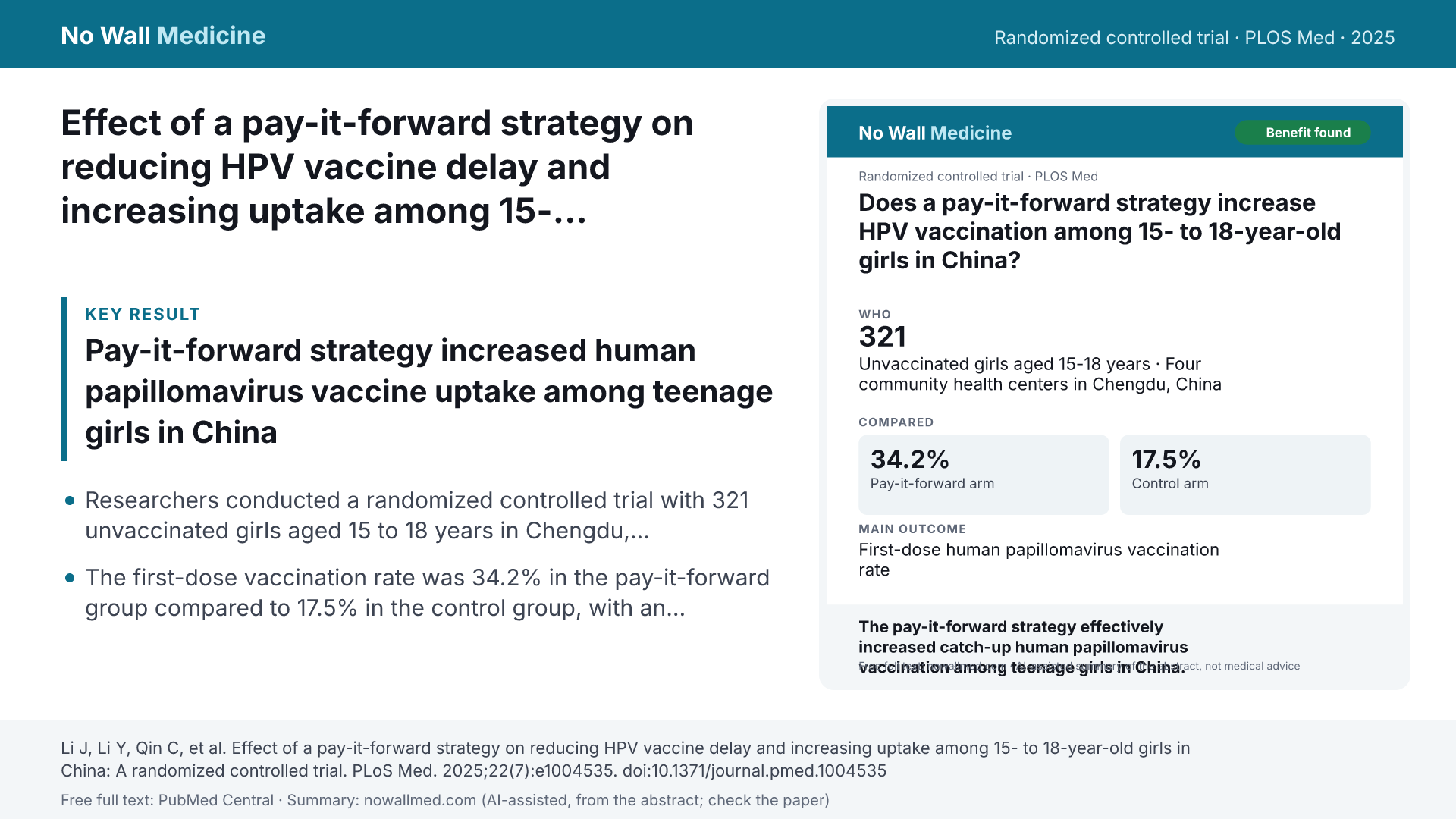
Effect of a pay-it-forward strategy on reducing HPV vaccine delay and increasing uptake among 15- to 18-year-old girls in China: A randomized controlled trial
Randomized controlled trialBenefit found
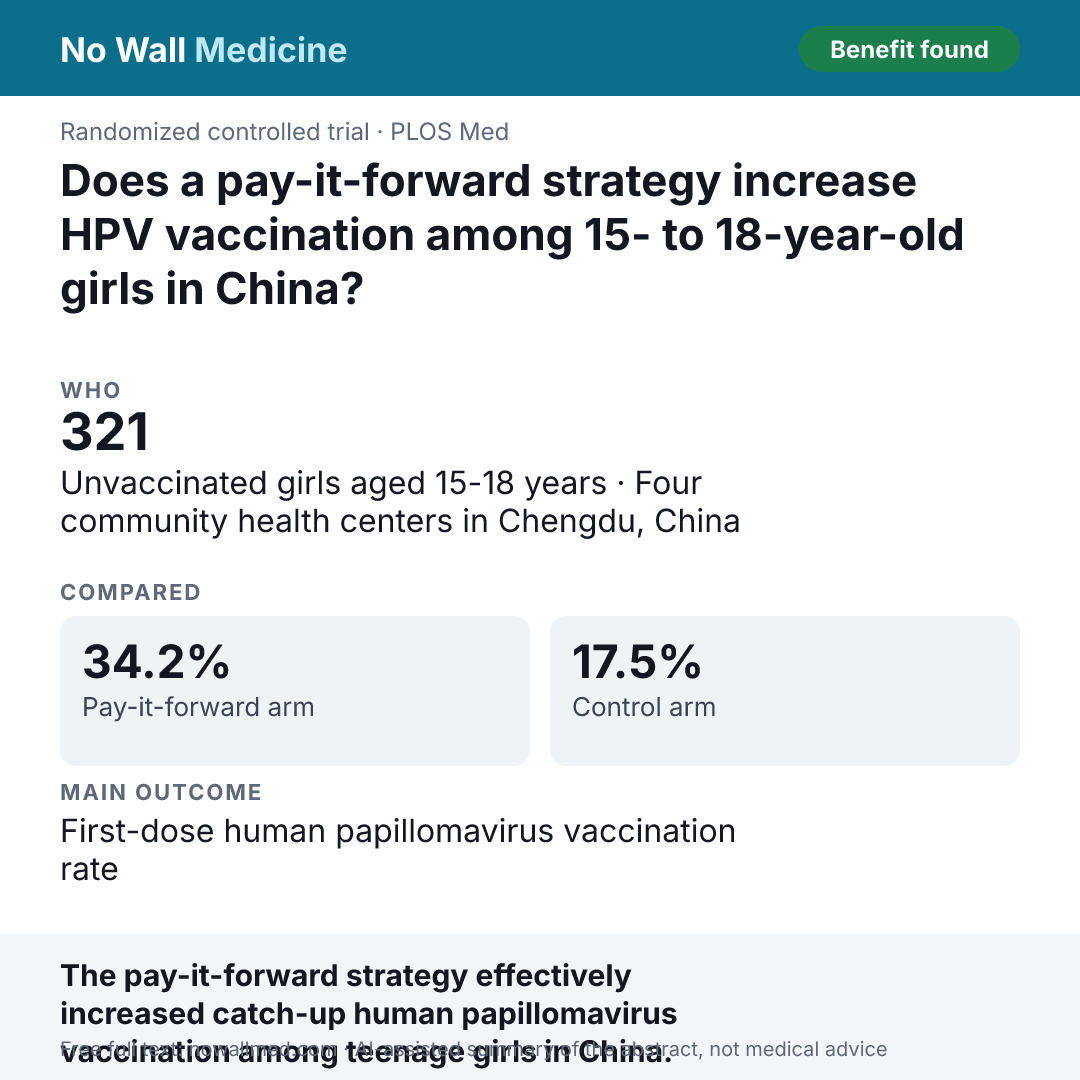
Does a pay-it-forward strategy increase HPV vaccination among 15- to 18-year-old girls in China?
Who
321
Unvaccinated girls aged 15-18 years · Four community health centers in Chengdu, China
Compared
34.2%Pay-it-forward arm
17.5%Control arm
Main outcome
First-dose human papillomavirus vaccination rate
Result: adjusted proportion difference = 17.9%, (95% CI [8.7%, 27.0%]; P < 0.001)
Bottom line: The pay-it-forward strategy effectively increased catch-up human papillomavirus vaccination among teenage girls in China.
Limitation: The trial had a 54% clinic attendance rate and was conducted in a single western province.
PLOS Med · 2025-07-31 · Save PNG
Clinical question: Does a pay-it-forward strategy increase HPV vaccination among 15- to 18-year-old girls in China?
Why it matters: Catch-up human papillomavirus vaccination is challenging in many low- and middle-income countries.
In absolute numbers
Pay-it-forward arm: 34.2% · Control arm: 17.5% → a difference of 16.7 percentage points, so about 6 people would need the treatment for 1 more to benefit (number needed to treat) over the trial’s follow-up.
Worked out by us from the two group results above, not reported by the authors. Check the paper for the exact outcome and timing.
Key points
- Researchers conducted a randomized controlled trial with 321 unvaccinated girls aged 15 to 18 years in Chengdu, China, comparing a subsidized pay-it-forward model to self-paid vaccination.
- The first-dose vaccination rate was 34.2% in the pay-it-forward group compared to 17.5% in the control group, with an adjusted proportion difference of 17.9%.
- The financial cost per person vaccinated was $230 in the pay-it-forward arm and $294 in the control arm.
Headline and key points written with AI from the paper’s abstract, with every number checked against it. Read the paper before relying on them.
Was this summary helpful?
Subject terms
Headline, design, result, key points, caveat and citation as plain text.
Cite this article
Li J, Li Y, Qin C, et al. Effect of a pay-it-forward strategy on reducing HPV vaccine delay and increasing uptake among 15- to 18-year-old girls in China: A randomized controlled trial. PLoS Med. 2025;22(7):e1004535. doi:10.1371/journal.pmed.1004535
Spotted a mistake? Suggest a correction