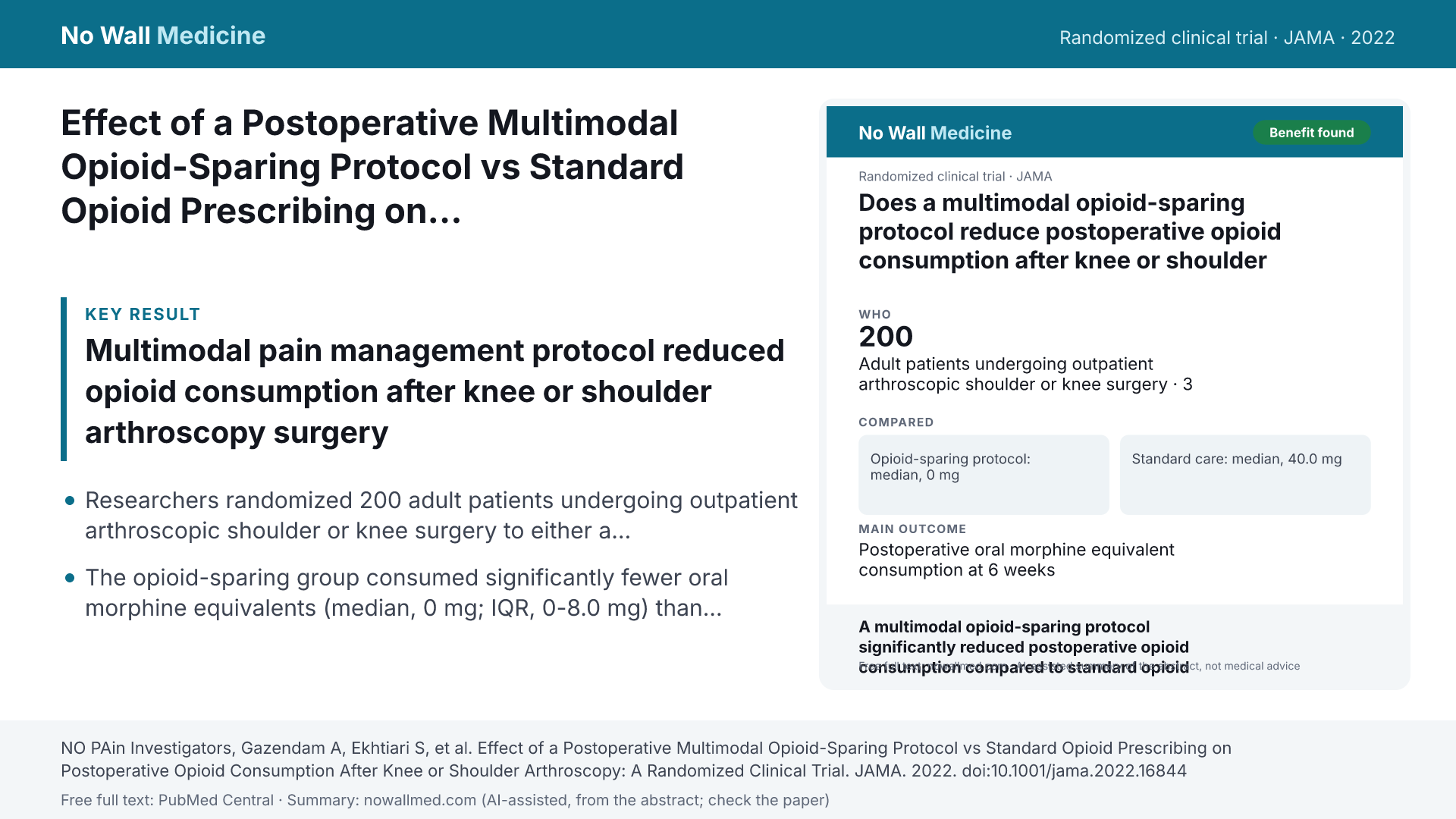
Multimodal pain management protocol reduced opioid consumption after knee or shoulder arthroscopy surgery
Effect of a Postoperative Multimodal Opioid-Sparing Protocol vs Standard Opioid Prescribing on Postoperative Opioid Consumption After Knee or Shoulder Arthroscopy: A Randomized Clinical Trial
Randomized clinical trialBenefit found
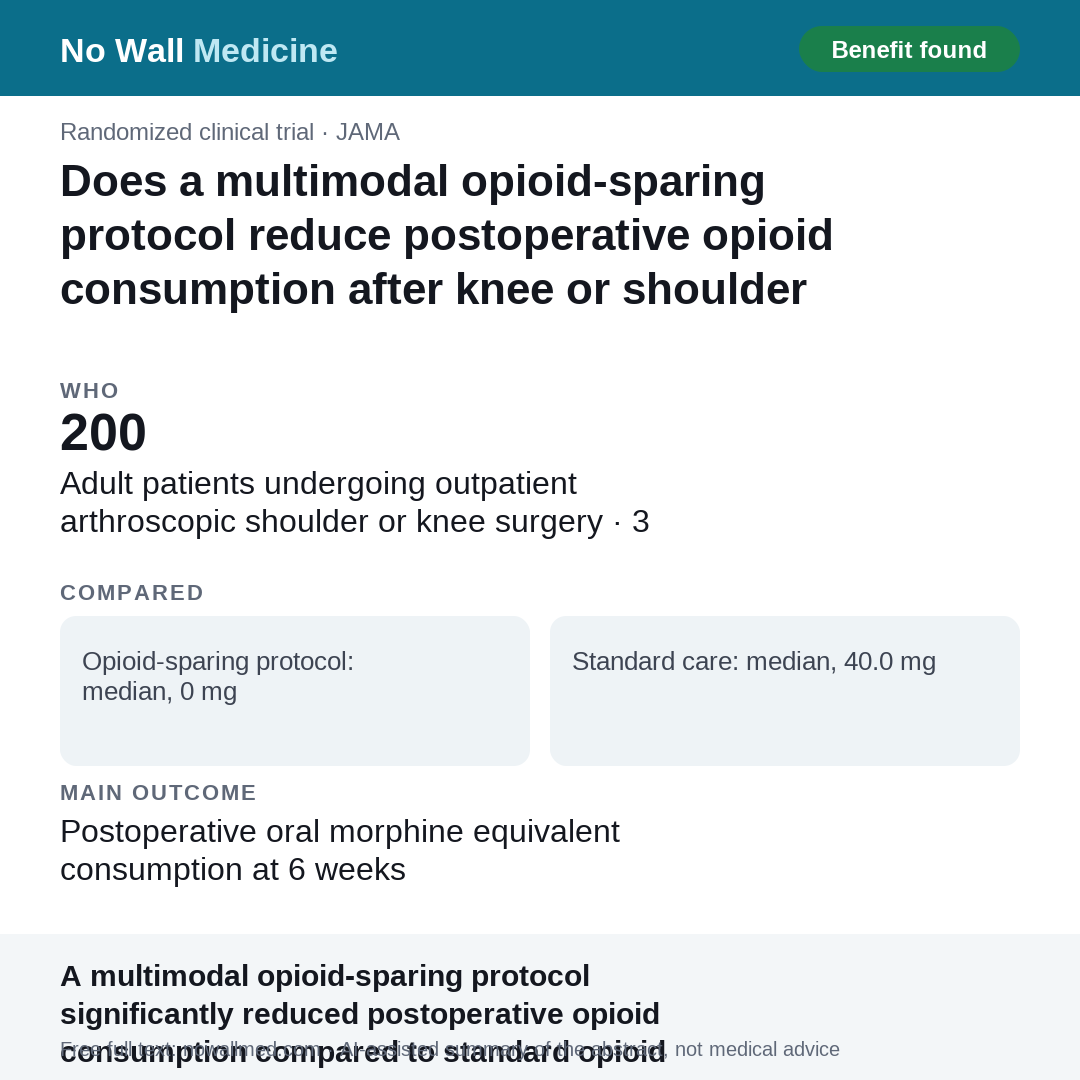
Does a multimodal opioid-sparing protocol reduce postoperative opioid consumption after knee or shoulder arthroscopy?
Who
200
Adult patients undergoing outpatient arthroscopic shoulder or knee surgery · 3 clinical sites in Ontario, Canada
Compared
Opioid-sparing protocol: median, 0 mg
Standard care: median, 40.0 mg
Main outcome
Postoperative oral morphine equivalent consumption at 6 weeks
Result: mean difference, 300.8 mg; 95% CI, 269.4-332.3
Bottom line: A multimodal opioid-sparing protocol significantly reduced postoperative opioid consumption compared to standard opioid prescribing after arthroscopic surgery.
JAMA · 2022-10-04Download image
Clinical question: Does a multimodal opioid-sparing protocol reduce postoperative opioid consumption after knee or shoulder arthroscopy?
Why it matters: Prospective, comparative trials evaluating the effectiveness of opioid-sparing protocols versus standard care for patients undergoing arthroscopic shoulder or knee surgery are lacking.
Key points
- Researchers randomized 200 adult patients undergoing outpatient arthroscopic shoulder or knee surgery to either a multimodal opioid-sparing protocol or standard opioid prescribing.
- The opioid-sparing group consumed significantly fewer oral morphine equivalents (median, 0 mg; IQR, 0-8.0 mg) than the control group (median, 40.0 mg; IQR, 7.5-105.0).
- The mean amount of oral morphine equivalents prescribed was 40.4 mg in the opioid-sparing group compared to 341.2 mg in the standard care group.
Headline and key points written with AI from the paper’s abstract, with every number checked against it. Read the paper before relying on them.
Was this summary helpful?
Subject terms
Cite this article
NO PAin Investigators, Gazendam A, Ekhtiari S, et al. Effect of a Postoperative Multimodal Opioid-Sparing Protocol vs Standard Opioid Prescribing on Postoperative Opioid Consumption After Knee or Shoulder Arthroscopy: A Randomized Clinical Trial. JAMA. 2022. doi:10.1001/jama.2022.16844
Spotted a mistake? Suggest a correction