Standardized family participation program in intensive care units did not change relative mental health symptoms
Effect of a Standardized Family Participation Program in the ICU: A Multicenter Stepped-Wedge Cluster Randomized Controlled Trial
Multicenter stepped-wedge cluster randomized controlled trialNo clear difference
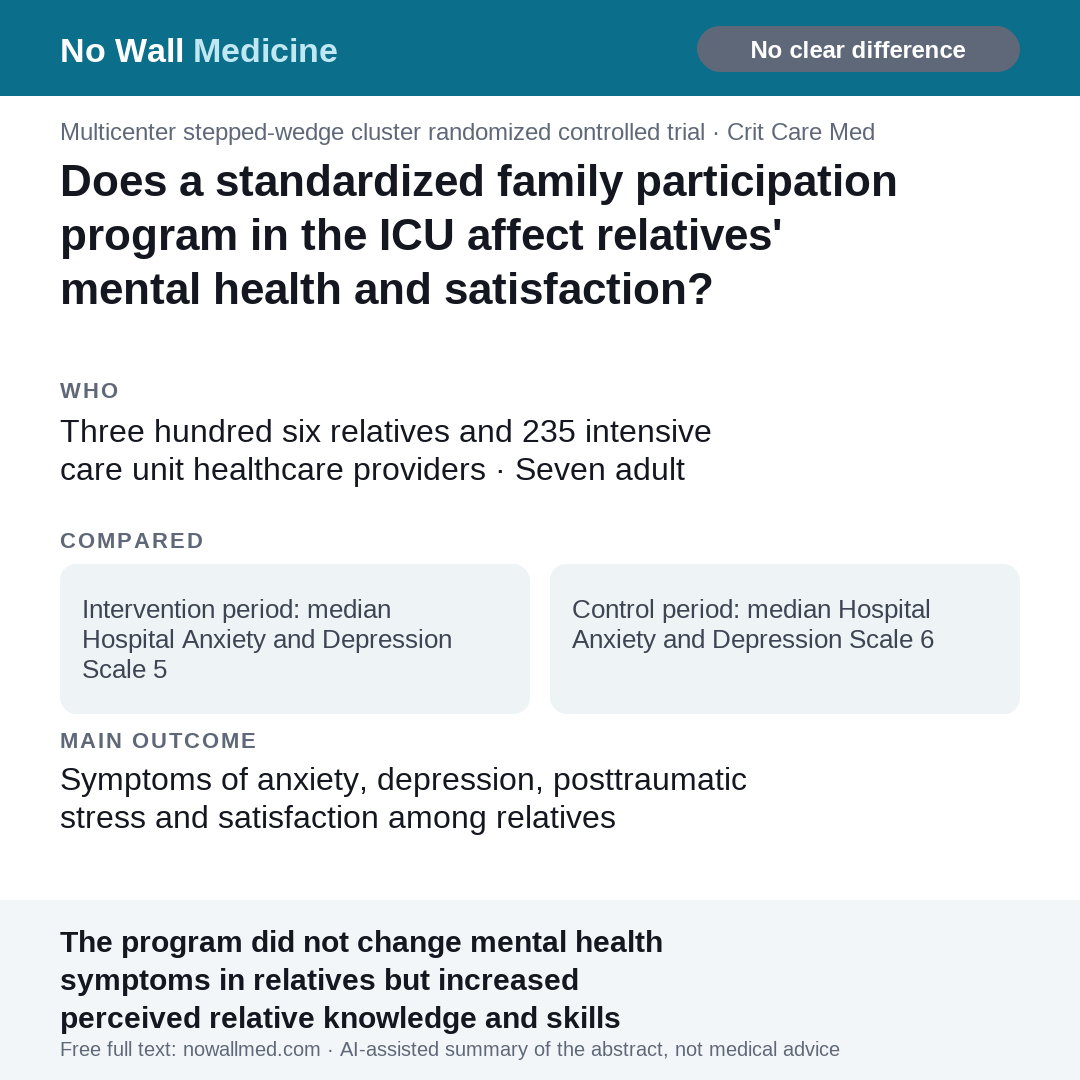
Does a standardized family participation program in the ICU affect relatives' mental health and satisfaction?
Who
Three hundred six relatives and 235 intensive care unit healthcare providers · Seven adult intensive care units in seven hospitals
Compared
Intervention period: median Hospital Anxiety and Depression Scale 5
Control period: median Hospital Anxiety and Depression Scale 6
Main outcome
Symptoms of anxiety, depression, posttraumatic stress and satisfaction among relatives
Result: median ratio 0.72 (95% CI, 0.46-1.13)
Bottom line: The program did not change mental health symptoms in relatives but increased perceived relative knowledge and skills among healthcare providers.
Crit Care Med · 2023-11-07Download image
Clinical question: Does a standardized family participation program in the ICU affect relatives' mental health and satisfaction?
Why it matters: It is unknown if a standardized program for family participation in essential care activities affects the mental health of relatives or the perceptions of healthcare providers.
Key points
- Researchers studied 306 relatives and 235 intensive care unit healthcare providers across seven hospitals using a stepped-wedge cluster randomized controlled trial.
- The program was not associated with significant changes in anxiety, depression, or posttraumatic stress symptoms among relatives 3 months after discharge.
- Healthcare providers reported that 47% of relatives knew how to participate during the intervention period compared to 22% during the control period.
Headline and key points written with AI from the paper’s abstract, with every number checked against it. Read the paper before relying on them.
Was this summary helpful?
Subject terms
Cite this article
Dijkstra BM, Rood PJT, Teerenstra S, et al. Effect of a Standardized Family Participation Program in the ICU: A Multicenter Stepped-Wedge Cluster Randomized Controlled Trial. Crit Care Med. 2023. doi:10.1097/CCM.0000000000006093
Spotted a mistake? Suggest a correction