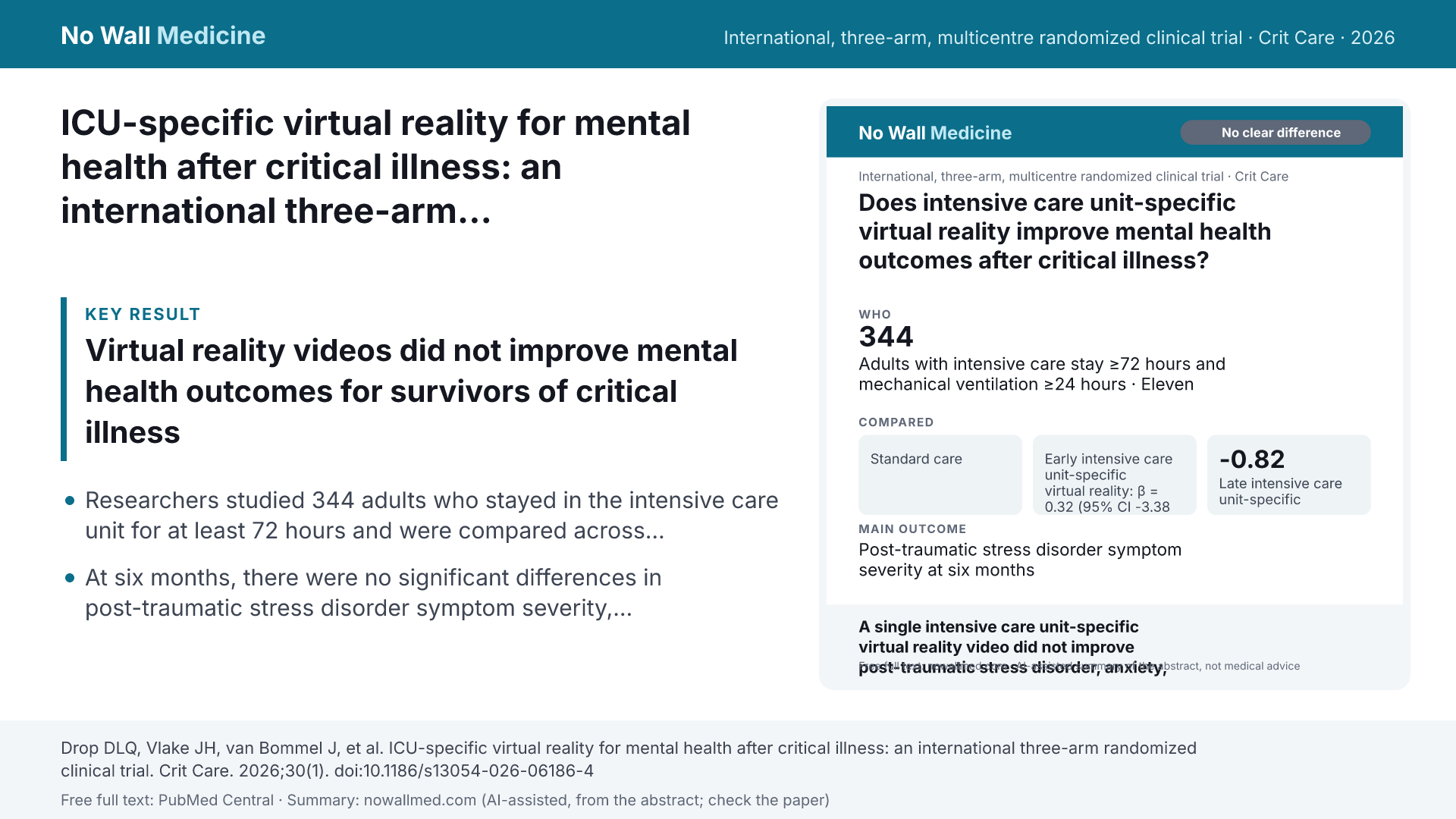
Virtual reality videos did not improve mental health outcomes for survivors of critical illness
ICU-specific virtual reality for mental health after critical illness: an international three-arm randomized clinical trial
International, three-arm, multicentre randomized clinical trialNo clear difference
Does intensive care unit-specific virtual reality improve mental health outcomes after critical illness?
Who
344
Adults with intensive care stay ≥72 hours and mechanical ventilation ≥24 hours · Eleven hospitals
Compared
Standard care
Early intensive care unit-specific virtual reality: β = 0.32 (95% CI -3.38 to 4.02)
-0.82Late intensive care unit-specific virtual reality (95% CI -4.62 to 2.97)
Main outcome
Post-traumatic stress disorder symptom severity at six months
Result: β = 0.32 (95% CI -3.38 to 4.02) for early vs control
Bottom line: A single intensive care unit-specific virtual reality video did not improve post-traumatic stress disorder, anxiety, depression, or quality of life.
Limitation: Findings should not be generalized to multi-session, therapist-guided, or personalized virtual reality interventions.
Crit Care · 2026-07-24 · Save PNG
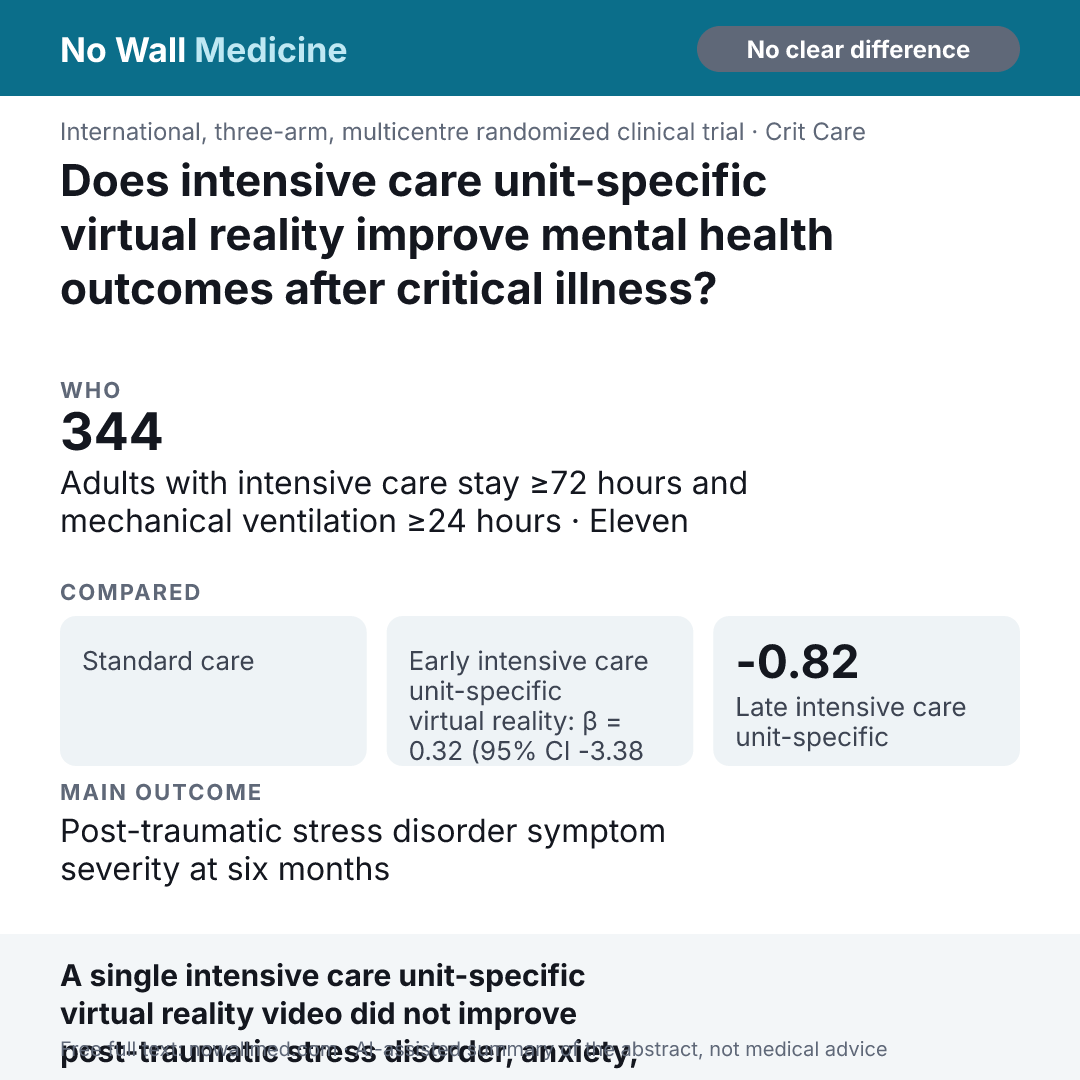
Clinical question: Does intensive care unit-specific virtual reality improve mental health outcomes after critical illness?
Why it matters: Survivors of critical illness often experience post-intensive care syndrome, which includes symptoms like post-traumatic stress disorder, anxiety, and depression.
Key points
- Researchers studied 344 adults who stayed in the intensive care unit for at least 72 hours and were compared across standard care, early virtual reality, and late virtual reality.
- At six months, there were no significant differences in post-traumatic stress disorder symptom severity, anxiety, depression, or health-related quality of life between the groups.
- Patients gave the virtual reality experience a median rating of 8/10 for satisfaction and for helping them understand their intensive care unit experience.
Limitation the authors note: The findings should not be generalized to multi-session, therapist-guided, or personalized virtual reality interventions.
Headline and key points written with AI from the paper’s abstract, with every number checked against it. Read the paper before relying on them.
Was this summary helpful?
Subject terms
Headline, design, result, key points, caveat and citation as plain text.
Cite this article
Drop DLQ, Vlake JH, van Bommel J, et al. ICU-specific virtual reality for mental health after critical illness: an international three-arm randomized clinical trial. Crit Care. 2026;30(1). doi:10.1186/s13054-026-06186-4
Spotted a mistake? Suggest a correction