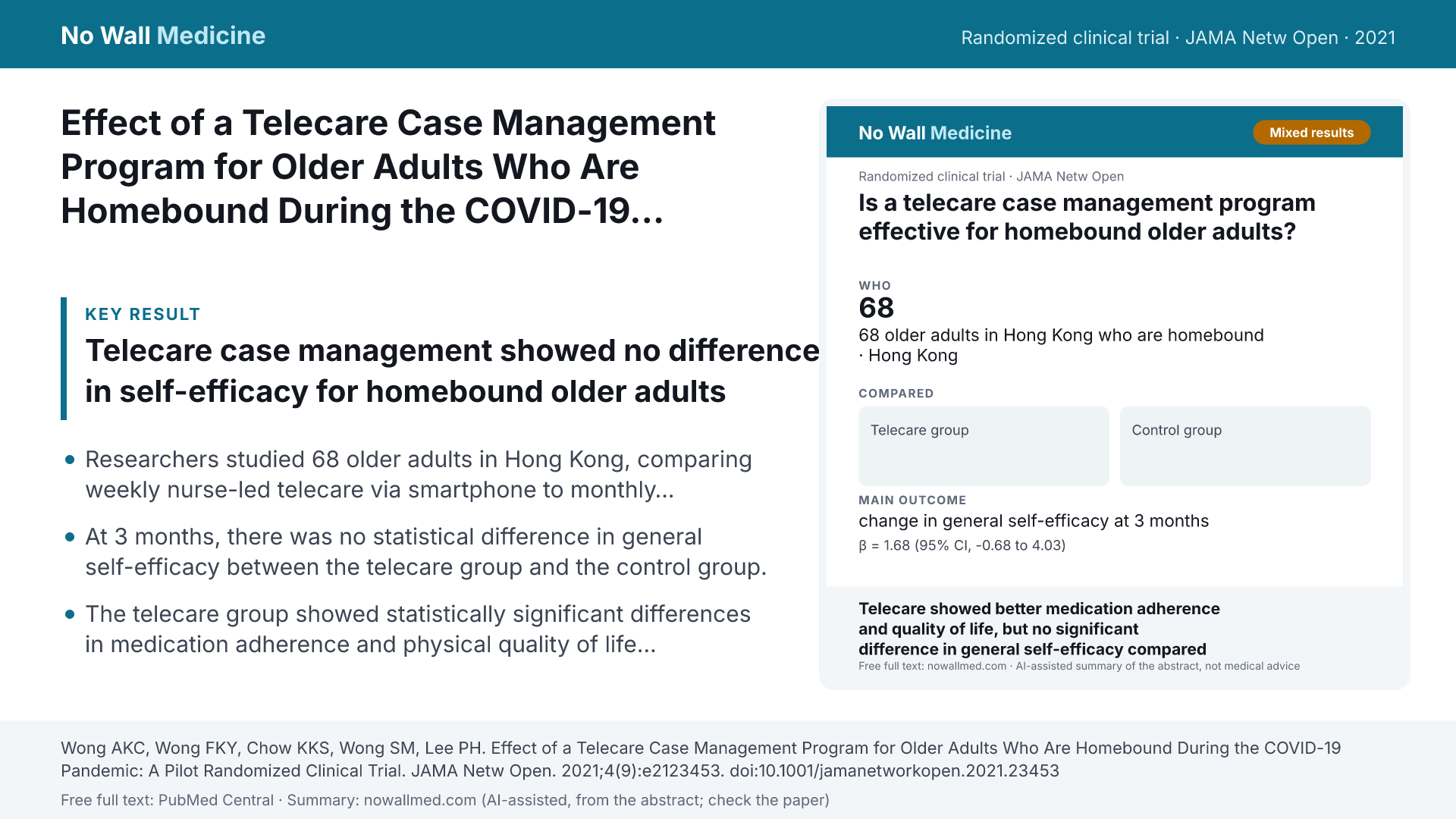
Effect of a Telecare Case Management Program for Older Adults Who Are Homebound During the COVID-19 Pandemic: A Pilot Randomized Clinical Trial
Key result: Telecare case management showed no difference in self-efficacy for homebound older adults
Key points
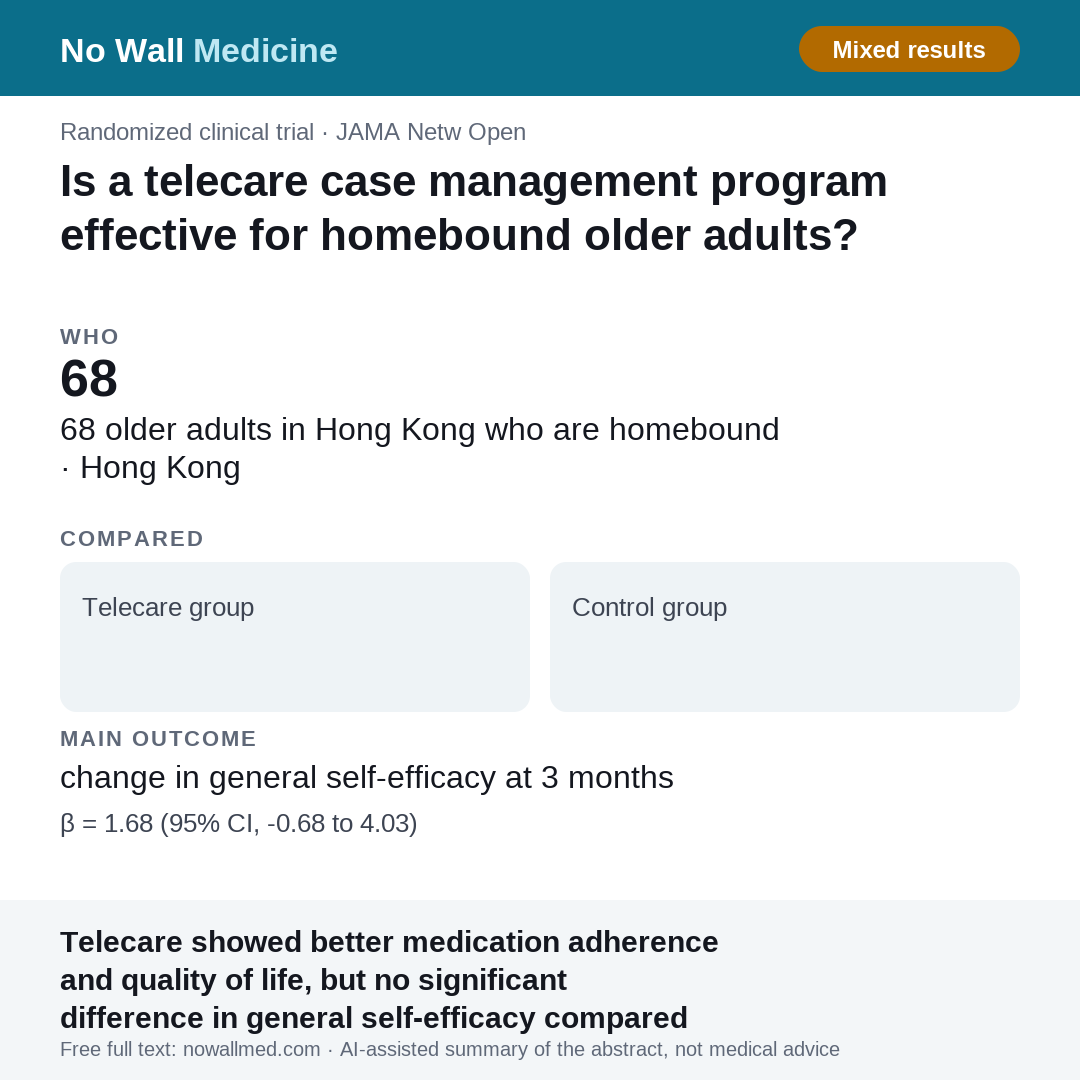
- Researchers studied 68 older adults in Hong Kong, comparing weekly nurse-led telecare via smartphone to monthly social telephone calls.
- At 3 months, there was no statistical difference in general self-efficacy between the telecare group and the control group.
- The telecare group showed statistically significant differences in medication adherence and physical quality of life compared to the control group.
Why it matters: It was unknown if a telecare case management program could effectively support the health needs of homebound older adults during the COVID-19 pandemic.
Limitation the authors note: The small sample size may limit generalizability.
Discussion prompts
- Would these patients look like yours? Who was left out?
- Is the main outcome one that matters to patients?
- Is the difference large enough to change what you do?
Cite: Wong AKC, Wong FKY, Chow KKS, Wong SM, Lee PH. Effect of a Telecare Case Management Program for Older Adults Who Are Homebound During the COVID-19 Pandemic: A Pilot Randomized Clinical Trial. JAMA Netw Open. 2021. doi:10.1001/jamanetworkopen.2021.23453
Free full text: PubMed Central · Summary and visual abstract: nowallmed.com/a/effect-of-a-telecare-case-management-program-for-older-adults-who-are-sprvb2/ (AI-assisted from the abstract; check the paper before relying on it).