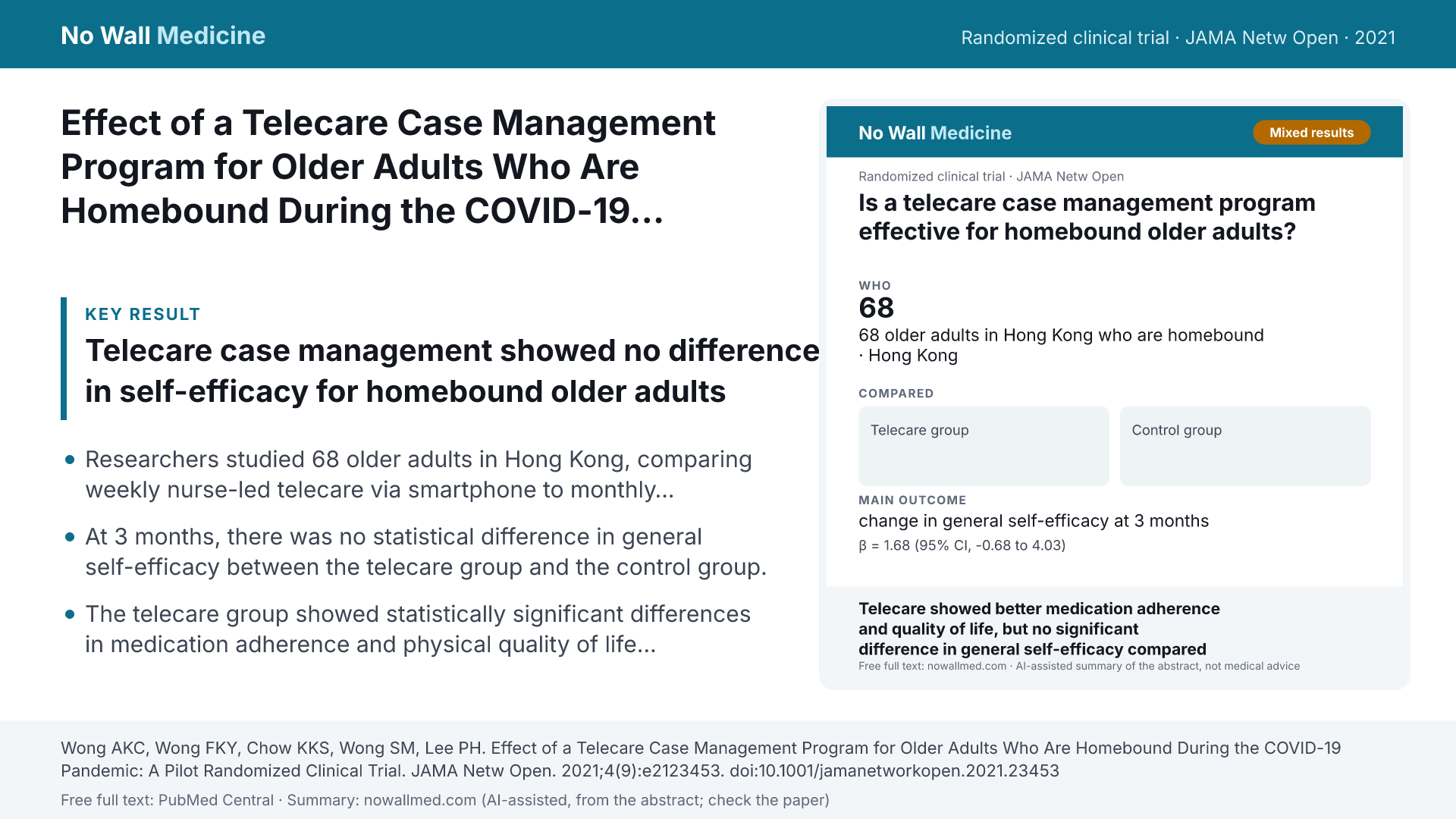
Telecare case management showed no difference in self-efficacy for homebound older adults
Effect of a Telecare Case Management Program for Older Adults Who Are Homebound During the COVID-19 Pandemic: A Pilot Randomized Clinical Trial
Randomized clinical trialMixed results
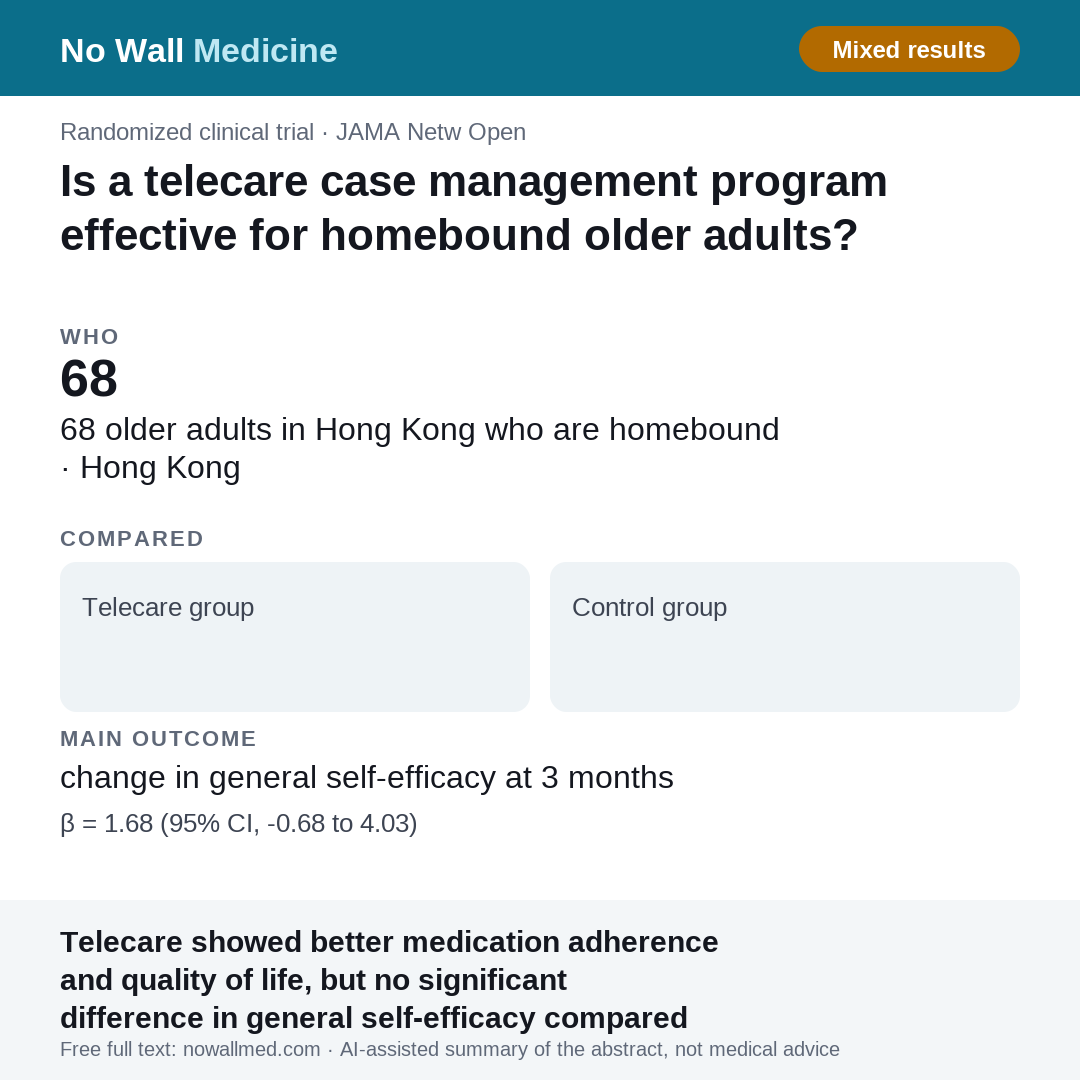
Is a telecare case management program effective for homebound older adults?
Who
68
68 older adults in Hong Kong who are homebound · Hong Kong
Compared
Telecare group
Control group
Main outcome
change in general self-efficacy at 3 months
Result: β = 1.68 (95% CI, -0.68 to 4.03)
Bottom line: Telecare showed better medication adherence and quality of life, but no significant difference in general self-efficacy compared to control.
Limitation: the small sample size may limit generalizability
JAMA Netw Open · 2021-09-01Download image
Clinical question: Is a telecare case management program effective for homebound older adults?
Why it matters: It was unknown if a telecare case management program could effectively support the health needs of homebound older adults during the COVID-19 pandemic.
Key points
- Researchers studied 68 older adults in Hong Kong, comparing weekly nurse-led telecare via smartphone to monthly social telephone calls.
- At 3 months, there was no statistical difference in general self-efficacy between the telecare group and the control group.
- The telecare group showed statistically significant differences in medication adherence and physical quality of life compared to the control group.
Limitation the authors note: The small sample size may limit generalizability.
Headline and key points written with AI from the paper’s abstract, with every number checked against it. Read the paper before relying on them.
Was this summary helpful?
Subject terms
Cite this article
Wong AKC, Wong FKY, Chow KKS, Wong SM, Lee PH. Effect of a Telecare Case Management Program for Older Adults Who Are Homebound During the COVID-19 Pandemic: A Pilot Randomized Clinical Trial. JAMA Netw Open. 2021. doi:10.1001/jamanetworkopen.2021.23453
Spotted a mistake? Suggest a correction
Top studies every Monday
The week’s key trials and guidelines in your specialties, plus any topics you follow. By email, free.
Get the weekly digest