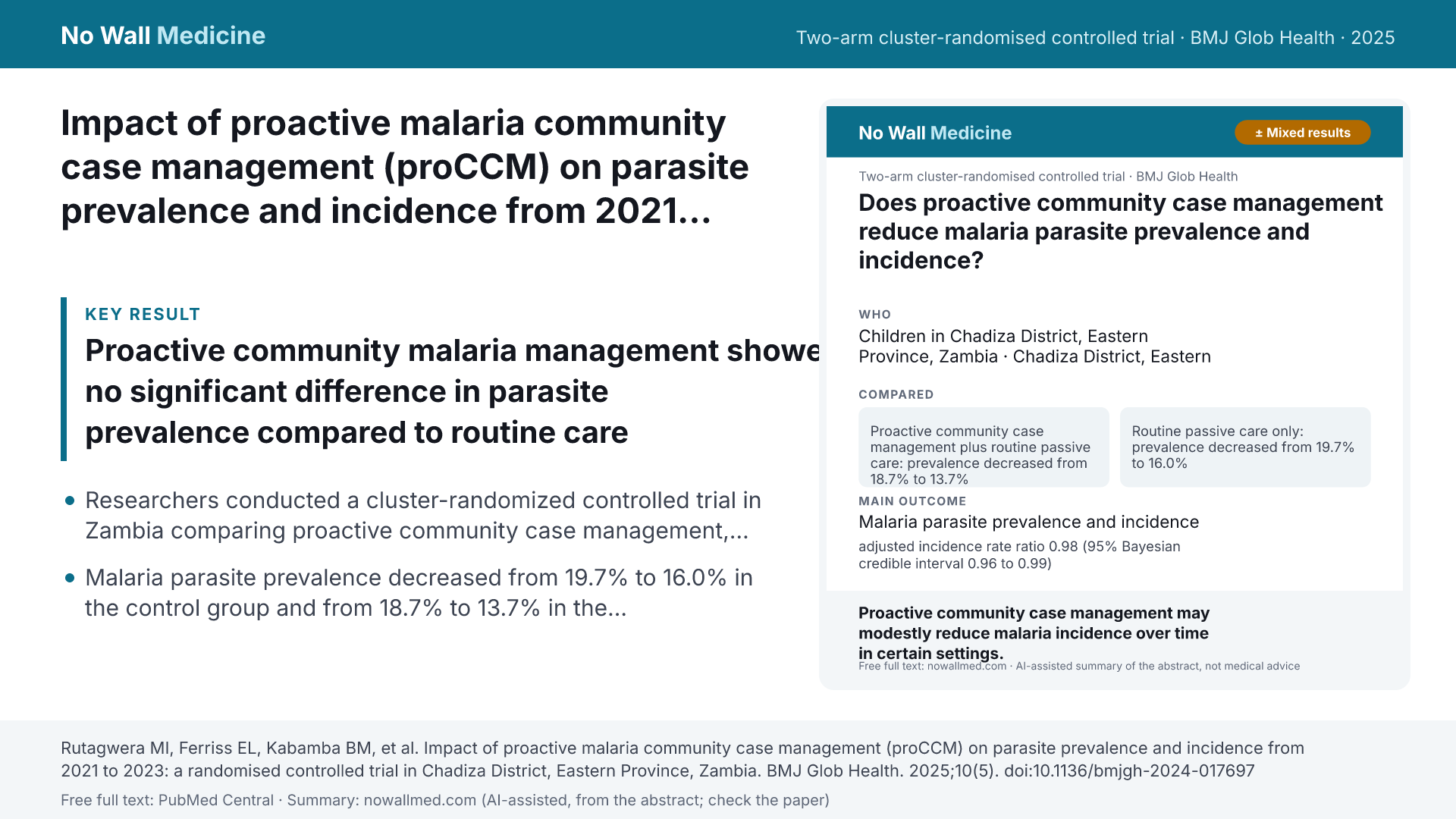
Proactive community malaria management showed no significant difference in parasite prevalence compared to routine care
Impact of proactive malaria community case management (proCCM) on parasite prevalence and incidence from 2021 to 2023: a randomised controlled trial in Chadiza District, Eastern Province, Zambia
Two-arm cluster-randomised controlled trialMixed results
Does proactive community case management reduce malaria parasite prevalence and incidence?
Who
Children in Chadiza District, Eastern Province, Zambia · Chadiza District, Eastern Province, Zambia
Compared
Proactive community case management plus routine passive care: prevalence decreased from 18.7% to 13.7%
Routine passive care only: prevalence decreased from 19.7% to 16.0%
Main outcome
Malaria parasite prevalence and incidence
Result: adjusted incidence rate ratio 0.98 (95% Bayesian credible interval 0.96 to 0.99)
Bottom line: Proactive community case management may modestly reduce malaria incidence over time in certain settings.
BMJ Glob Health · 2025-05-24Download image
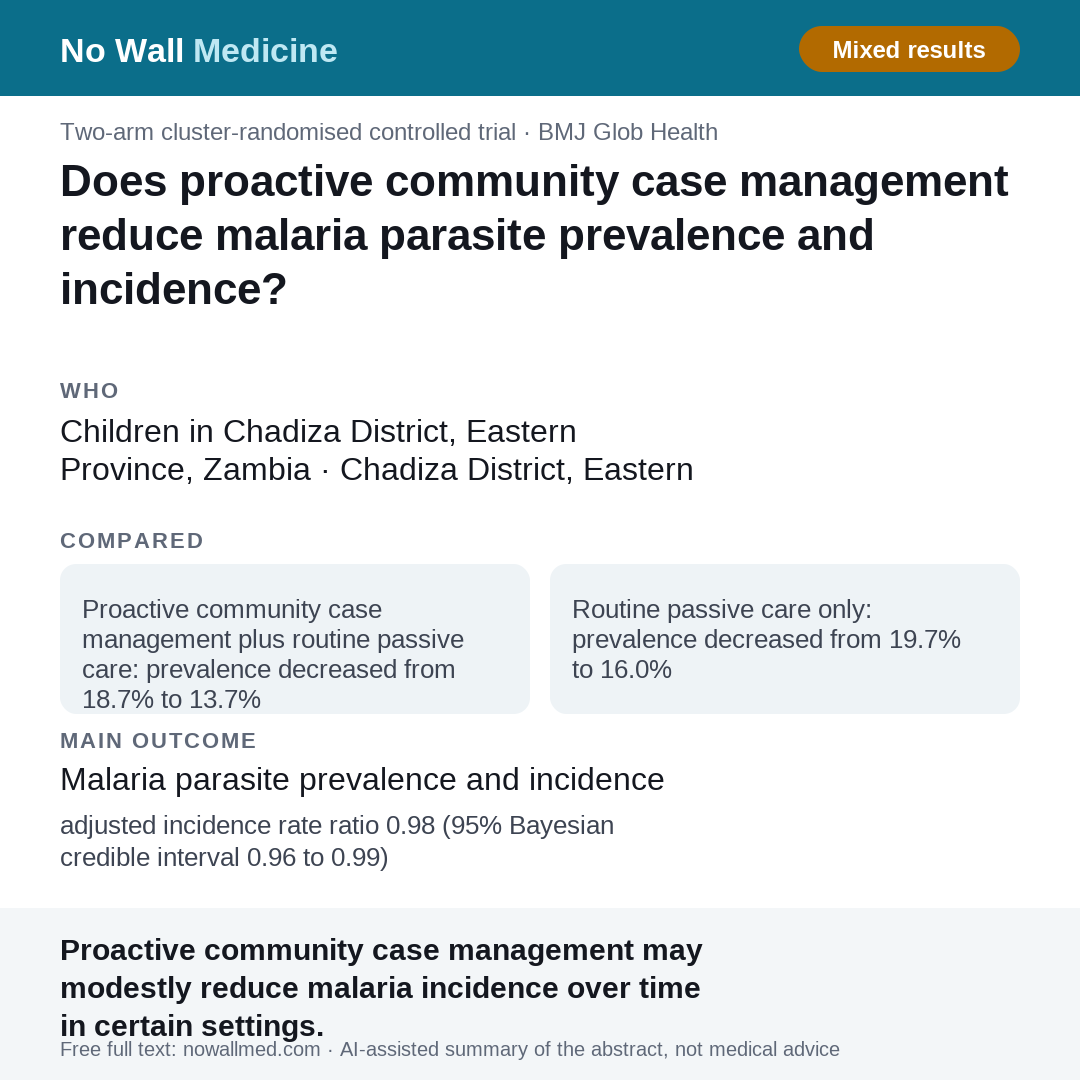
Clinical question: Does proactive community case management reduce malaria parasite prevalence and incidence?
Why it matters: Care is not sought for roughly 40% of febrile children under 5 years of age in Zambia, creating a need to evaluate if proactive household visits improve malaria outcomes.
Key points
- Researchers conducted a cluster-randomized controlled trial in Zambia comparing proactive community case management, where health workers visit homes, to routine passive care.
- Malaria parasite prevalence decreased from 19.7% to 16.0% in the control group and from 18.7% to 13.7% in the intervention group, but the difference was not statistically significant.
- The proactive approach was associated with a small, ongoing monthly decline in malaria incidence compared to the control group.
Headline and key points written with AI from the paper’s abstract, with every number checked against it. Read the paper before relying on them.
Was this summary helpful?
Abstract
Ensuring prompt and effective case management of malaria remains an ongoing challenge in Zambia, where care is not sought for roughly 40% of febrile children under 5 years of age. To expand access, the Ministry of Health has scaled up routine malaria community case management (mCCM) for all ages over the past decade. As of 2018, nearly a quarter of children who received antimalarials obtained them from a community health worker (CHW), but gaps in treatment seeking remain. Proactive community case management (proCCM), under which CHWs regularly visit households to screen, test and treat individuals for malaria, aims to improve timely case management, avert severe disease and potentially reduce transmission. To evaluate the impact of weekly proCCM on malaria parasite prevalence and incidence in the context of strong routine community case management, we conducted a two-arm cluster-randomised controlled trial, comparing proCCM plus routine passive care to routine passive care only in Chadiza District, Eastern Province, Zambia, between April 2021 and May 2023. Baseline and endline surveys were conducted during peak transmission season to ascertain parasite prevalence, while facility, routine mCCM and proCCM incidence data were collected through routine surveillance systems and weekly household visits, respectively. In the control arm, malaria prevalence decreased from 19.7% in 2021 to 16.0% in 2023, and in the intervention arm, from 18.7% to 13.7%. No significant difference between arms in the change in parasite prevalence was estimated (adjusted relative risk=0.97, 95% CI=0.77 to 1.23). However, there was a small, ongoing decline in malaria incidence each month in proCCM clusters compared with control clusters (adjusted incidence rate ratio=0.98, 95% Bayesian credible interval=0.96 to 0.99). Our study suggests proCCM may modestly reduce malaria incidence over time in some settings with high baseline utilisation of routine facility and community case management. Trial registration number: NCT04839900.
Abstract reproduced under the article’s CC BY NC licence.
Subject terms
Cite this article
Rutagwera MI, Ferriss EL, Kabamba BM, Porter T, Kangale CC, Gallalee S. Impact of proactive malaria community case management (proCCM) on parasite prevalence and incidence from 2021 to 2023: a randomised controlled trial in Chadiza District, Eastern Province, Zambia. BMJ Glob Health. 2025. doi:10.1136/bmjgh-2024-017697
Spotted a mistake? Suggest a correction
Top studies every Monday
The week’s key trials and guidelines in your specialties, plus any topics you follow. By email, free.
Get the weekly digest