Impact of proactive malaria community case management (proCCM) on parasite prevalence and incidence from 2021 to 2023: a randomised controlled trial in Chadiza District, Eastern Province, Zambia
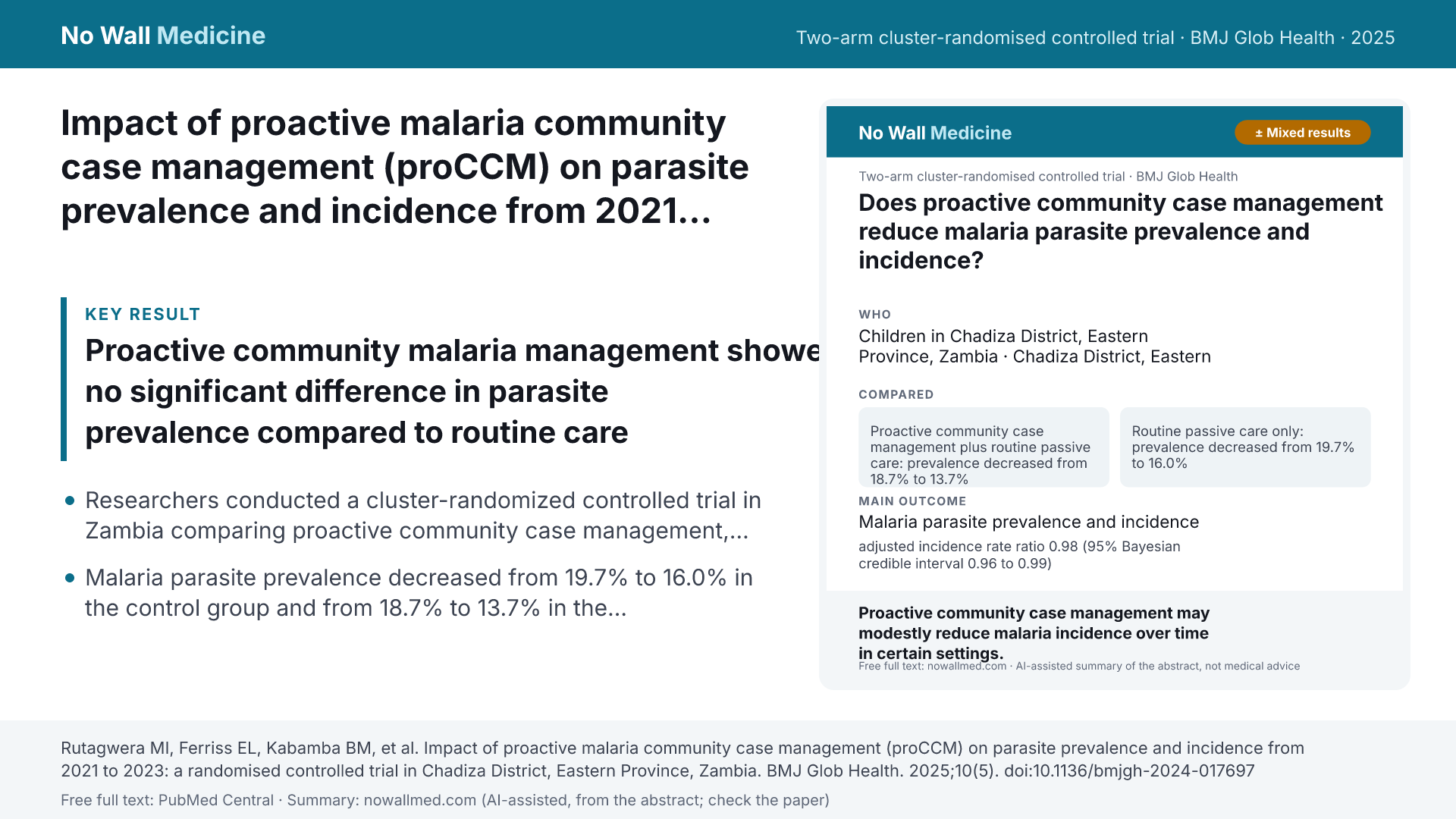
Key result: Proactive community malaria management showed no significant difference in parasite prevalence compared to routine care
Key points
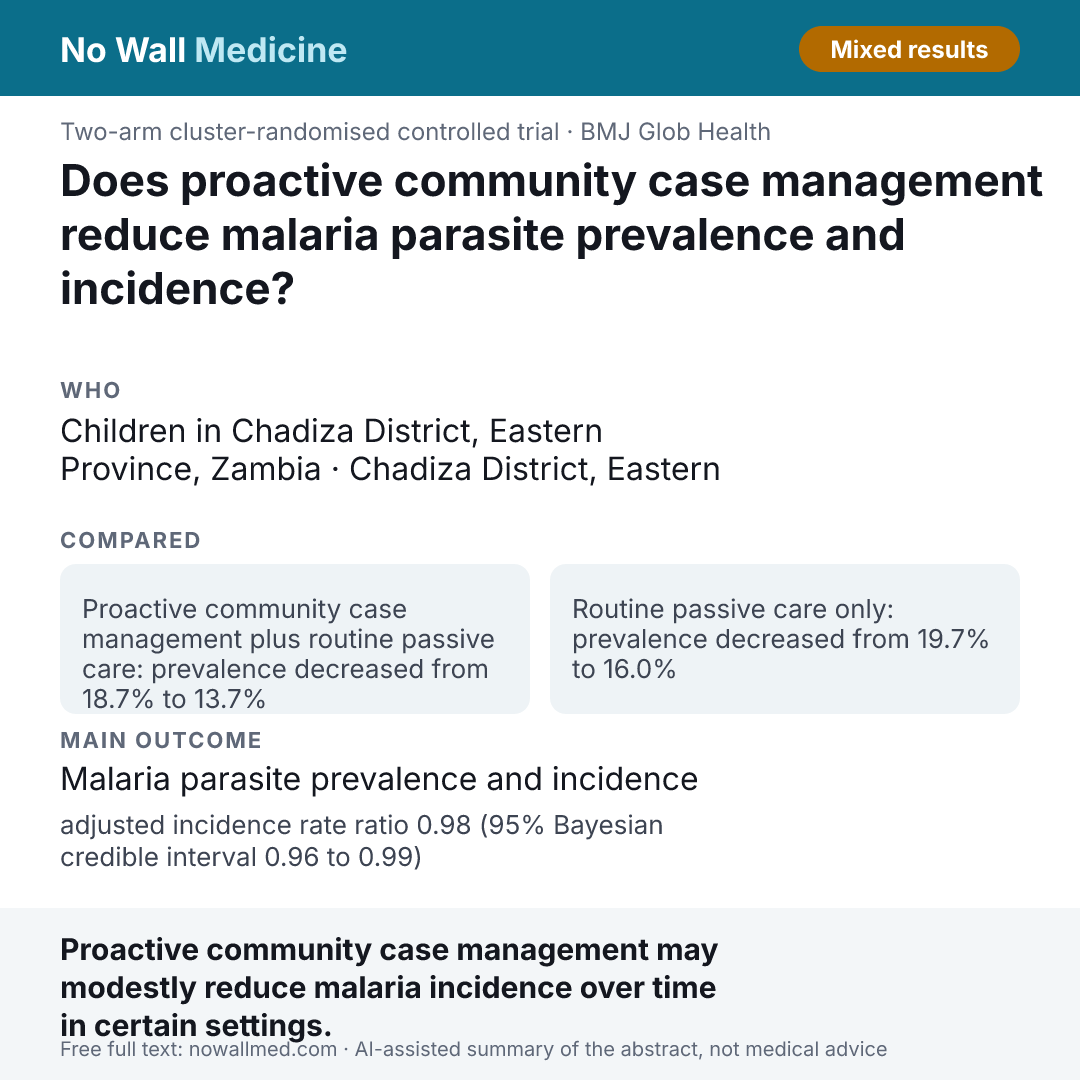
- Researchers conducted a cluster-randomized controlled trial in Zambia comparing proactive community case management, where health workers visit homes, to routine passive care.
- Malaria parasite prevalence decreased from 19.7% to 16.0% in the control group and from 18.7% to 13.7% in the intervention group, but the difference was not statistically significant.
- The proactive approach was associated with a small, ongoing monthly decline in malaria incidence compared to the control group.
Why it matters: Care is not sought for roughly 40% of febrile children under 5 years of age in Zambia, creating a need to evaluate if proactive household visits improve malaria outcomes.
Discussion prompts
- Would these patients look like yours? Who was left out?
- Is the main outcome one that matters to patients?
- Is the difference large enough to change what you do?
Cite: Rutagwera MI, Ferriss EL, Kabamba BM, et al. Impact of proactive malaria community case management (proCCM) on parasite prevalence and incidence from 2021 to 2023: a randomised controlled trial in Chadiza District, Eastern Province, Zambia. BMJ Glob Health. 2025;10(5). doi:10.1136/bmjgh-2024-017697
Free full text: PubMed Central · Summary and visual abstract: nowallmed.com/a/impact-of-proactive-malaria-community-case-management-proccm-on-1fnv30c/ (AI-assisted from the abstract; check the paper before relying on it).