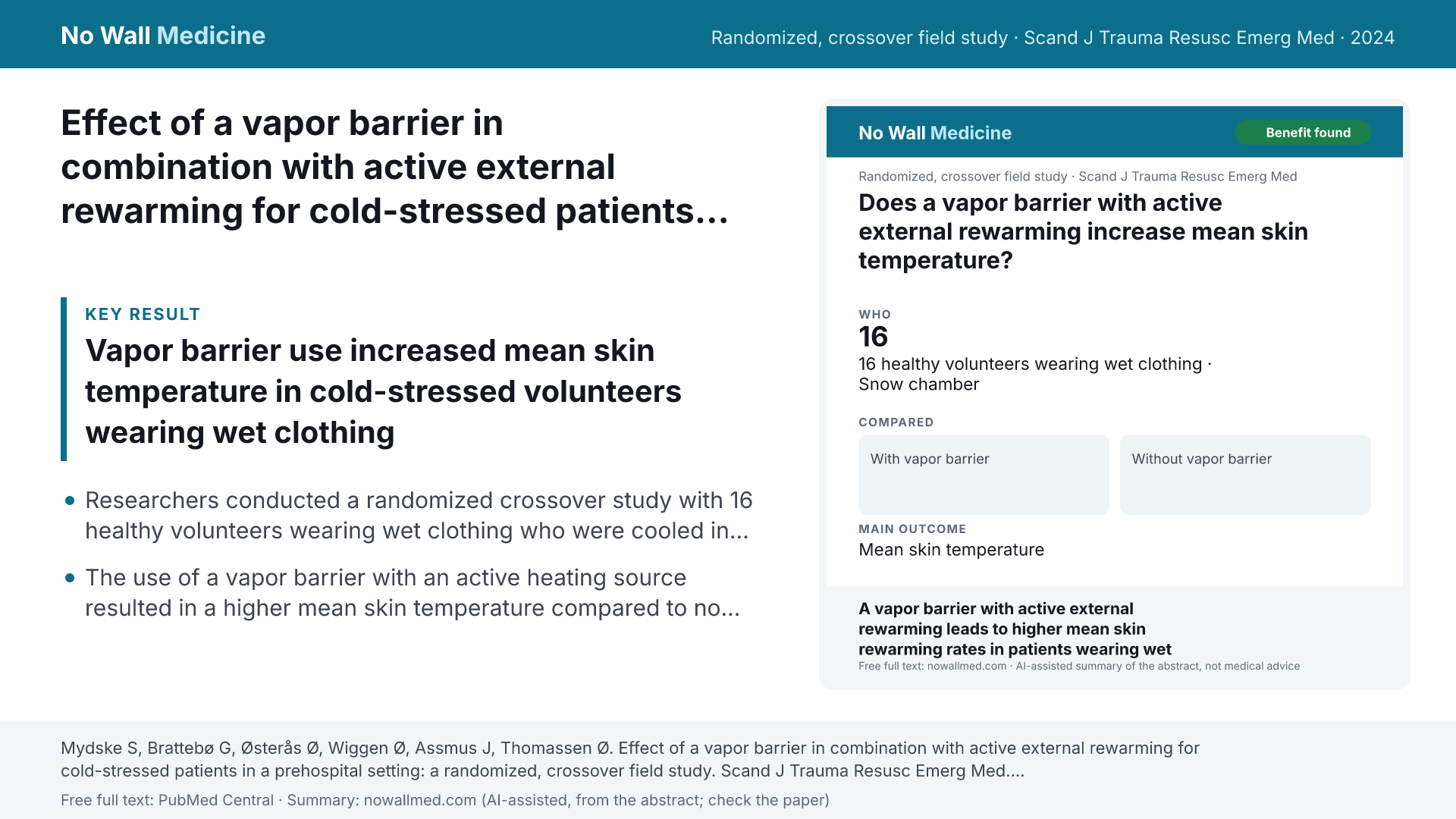
Effect of a vapor barrier in combination with active external rewarming for cold-stressed patients in a prehospital setting: a randomized, crossover field study
Key result: Vapor barrier use increased mean skin temperature in cold-stressed volunteers wearing wet clothing
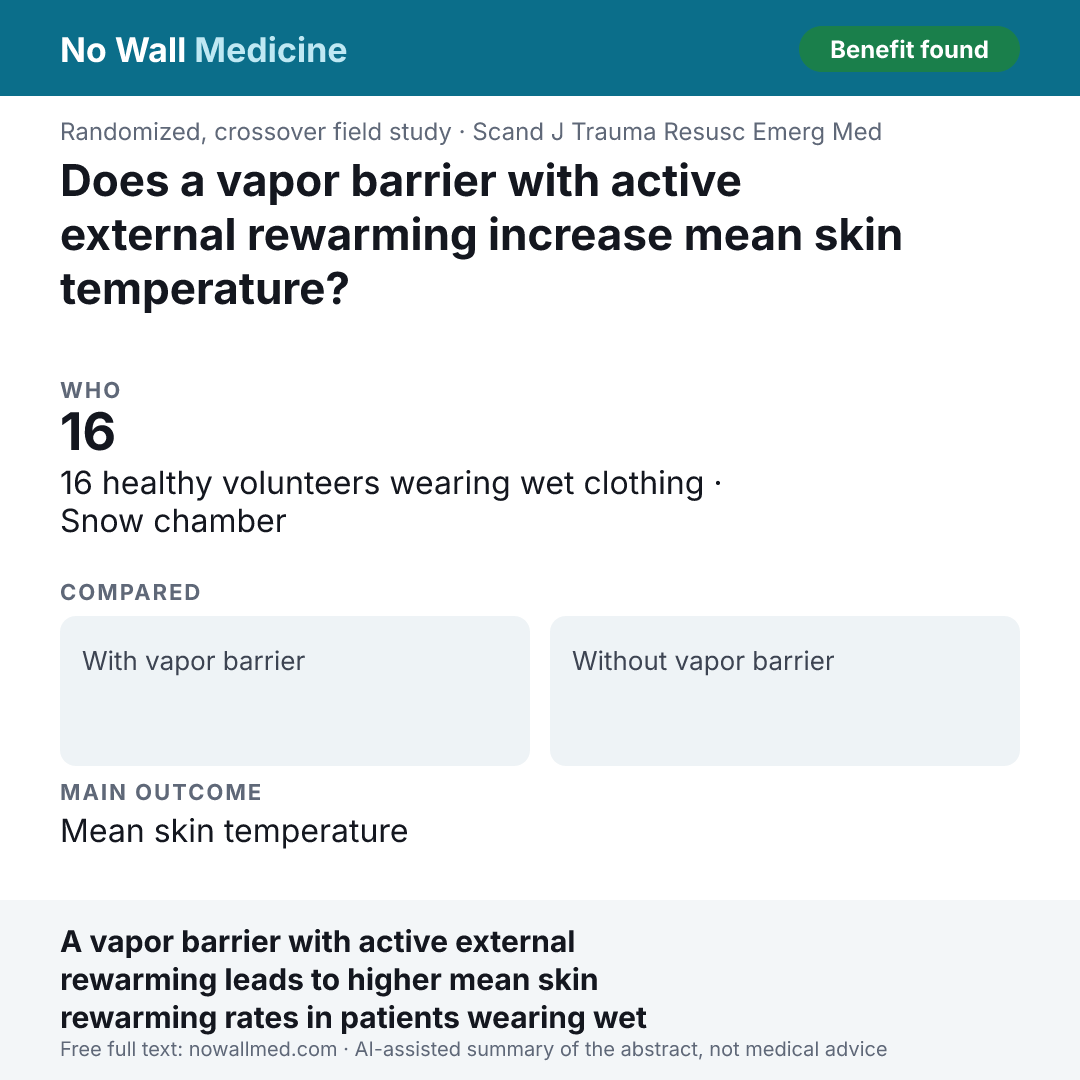
Randomized, crossover field studyBenefit found
Does a vapor barrier with active external rewarming increase mean skin temperature?
Who
16
16 healthy volunteers wearing wet clothing · Snow chamber
Compared
With vapor barrier
Without vapor barrier
Main outcome
Mean skin temperature
Result: largest difference in mean skin temperature was 0.93 °C after 60 min
Bottom line: A vapor barrier with active external rewarming leads to higher mean skin rewarming rates in patients wearing wet clothing.
Scand J Trauma Resusc Emerg Med · 2024-04-25 · Save PNG
Key points
- Researchers conducted a randomized crossover study with 16 healthy volunteers wearing wet clothing who were cooled in a snow chamber for 30 minutes.
- The use of a vapor barrier with an active heating source resulted in a higher mean skin temperature compared to no vapor barrier, with a maximum difference of 0.93 °C after 60 min.
- Humidity levels outside the barrier were significantly higher in the control group than in the intervention group after 5 min, though subjective thermal comfort showed no significant differences.
Discussion prompts
- Would these patients look like yours? Who was left out?
- Is the main outcome one that matters to patients?
- Is the difference large enough to change what you do?
Cite: Mydske S, Brattebø G, Østerås Ø, Wiggen Ø, Assmus J, Thomassen Ø. Effect of a vapor barrier in combination with active external rewarming for cold-stressed patients in a prehospital setting: a randomized, crossover field study. Scand J Trauma Resusc Emerg Med. 2024;32(1):35. doi:10.1186/s13049-024-01204-2
Free full text: PubMed Central · Summary and visual abstract: nowallmed.com/a/effect-of-a-vapor-barrier-in-combination-with-active-external-1ibxzfx/ (AI-assisted from the abstract; check the paper before relying on it).