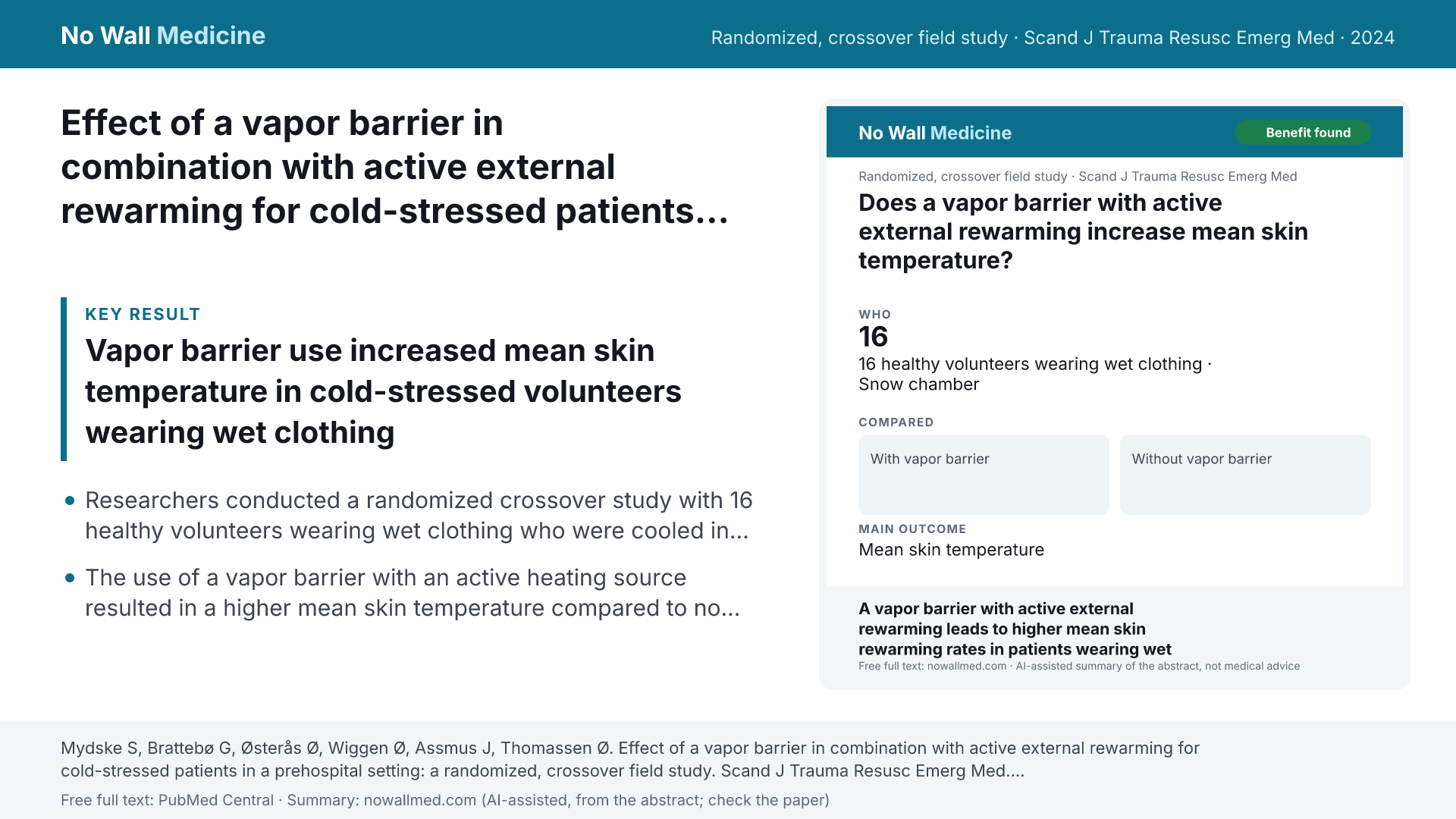
Vapor barrier use increased mean skin temperature in cold-stressed volunteers wearing wet clothing
Effect of a vapor barrier in combination with active external rewarming for cold-stressed patients in a prehospital setting: a randomized, crossover field study
Randomized, crossover field studyBenefit found
Does a vapor barrier with active external rewarming increase mean skin temperature?
Who
16
16 healthy volunteers wearing wet clothing · Snow chamber
Compared
With vapor barrier
Without vapor barrier
Main outcome
Mean skin temperature
Result: largest difference in mean skin temperature was 0.93 °C after 60 min
Bottom line: A vapor barrier with active external rewarming leads to higher mean skin rewarming rates in patients wearing wet clothing.
Scand J Trauma Resusc Emerg Med · 2024-04-25Download image
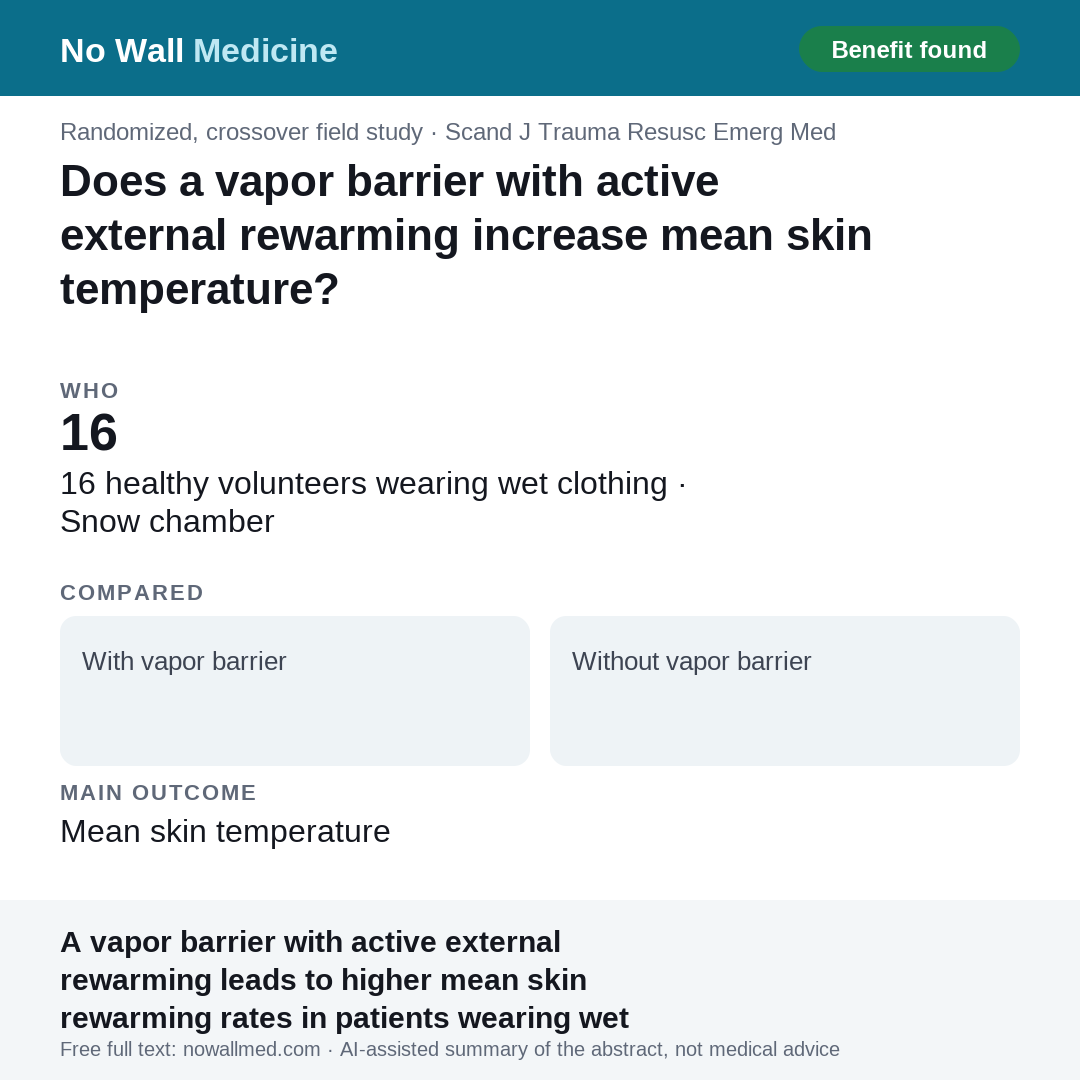
Clinical question: Does a vapor barrier with active external rewarming increase mean skin temperature?
Why it matters: It is unknown if adding a vapor barrier as the innermost layer in the recommended wrapping model effectively increases skin rewarming for patients in the field.
Key points
- Researchers conducted a randomized crossover study with 16 healthy volunteers wearing wet clothing who were cooled in a snow chamber for 30 minutes.
- The use of a vapor barrier with an active heating source resulted in a higher mean skin temperature compared to no vapor barrier, with a maximum difference of 0.93 °C after 60 min.
- Humidity levels outside the barrier were significantly higher in the control group than in the intervention group after 5 min, though subjective thermal comfort showed no significant differences.
Headline and key points written with AI from the paper’s abstract, with every number checked against it. Read the paper before relying on them.
Was this summary helpful?
Subject terms
Cite this article
Mydske S, Brattebø G, Østerås Ø, Wiggen Ø, Assmus J, Thomassen Ø. Effect of a vapor barrier in combination with active external rewarming for cold-stressed patients in a prehospital setting: a randomized, crossover field study. Scand J Trauma Resusc Emerg Med. 2024. doi:10.1186/s13049-024-01204-2
Spotted a mistake? Suggest a correction