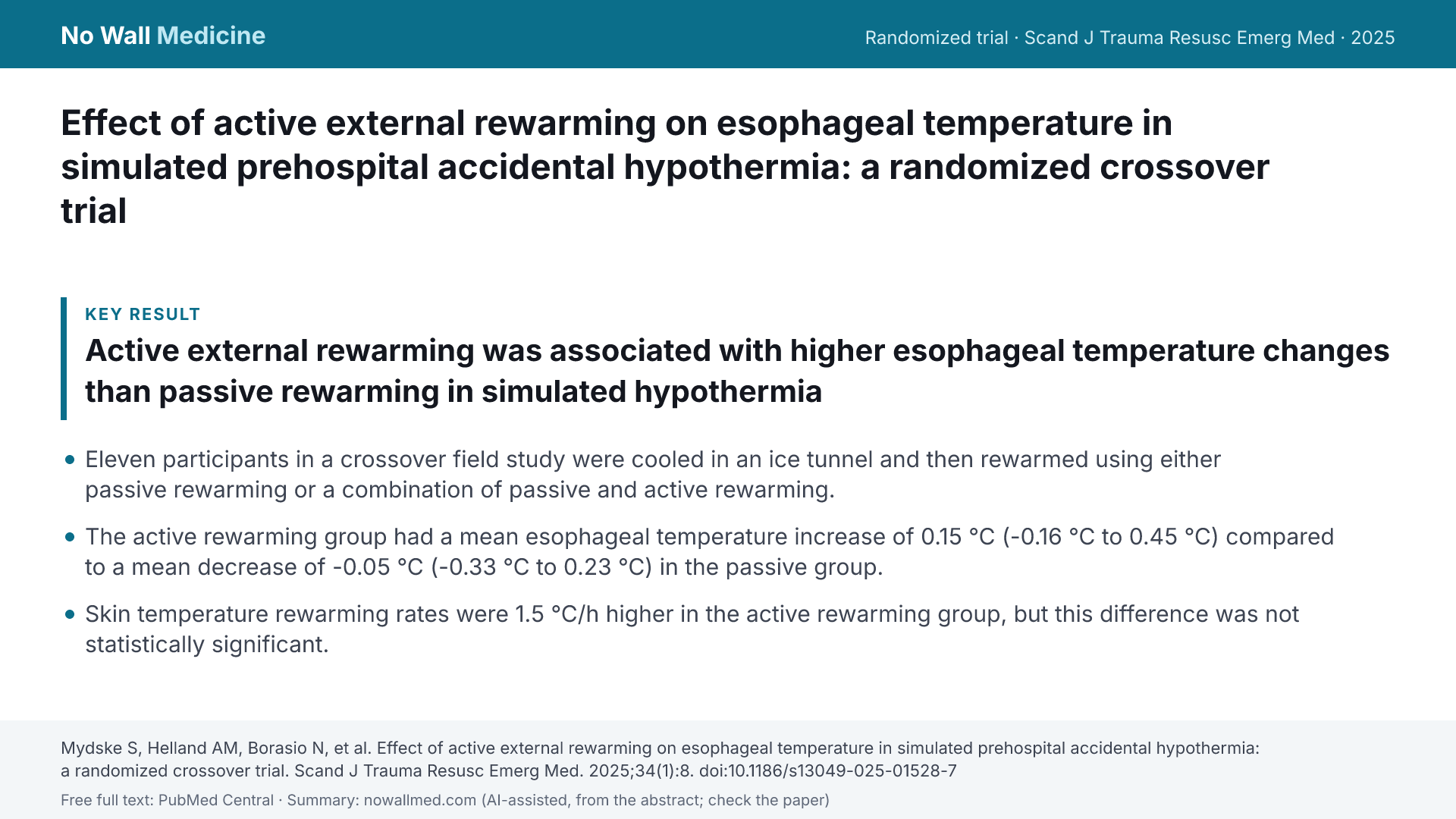
Active external rewarming was associated with higher esophageal temperature changes than passive rewarming in simulated hypothermia
Effect of active external rewarming on esophageal temperature in simulated prehospital accidental hypothermia: a randomized crossover trial
Why it matters: The effect of active external rewarming on esophageal temperature remains unclear despite international guidelines recommending its use alongside passive rewarming for accidental hypothermia.
Key points
- Eleven participants in a crossover field study were cooled in an ice tunnel and then rewarmed using either passive rewarming or a combination of passive and active rewarming.
- The active rewarming group had a mean esophageal temperature increase of 0.15 °C (-0.16 °C to 0.45 °C) compared to a mean decrease of -0.05 °C (-0.33 °C to 0.23 °C) in the passive group.
- Skin temperature rewarming rates were 1.5 °C/h higher in the active rewarming group, but this difference was not statistically significant.
Headline and key points written with AI from the paper’s abstract, with every number checked against it. Read the paper before relying on them.
Was this summary helpful?
Subject terms
Cite this article
Mydske S, Helland AM, Borasio N, et al. Effect of active external rewarming on esophageal temperature in simulated prehospital accidental hypothermia: a randomized crossover trial. Scand J Trauma Resusc Emerg Med. 2025. doi:10.1186/s13049-025-01528-7
Spotted a mistake? Suggest a correction