Effect of active external rewarming on esophageal temperature in simulated prehospital accidental hypothermia: a randomized crossover trial
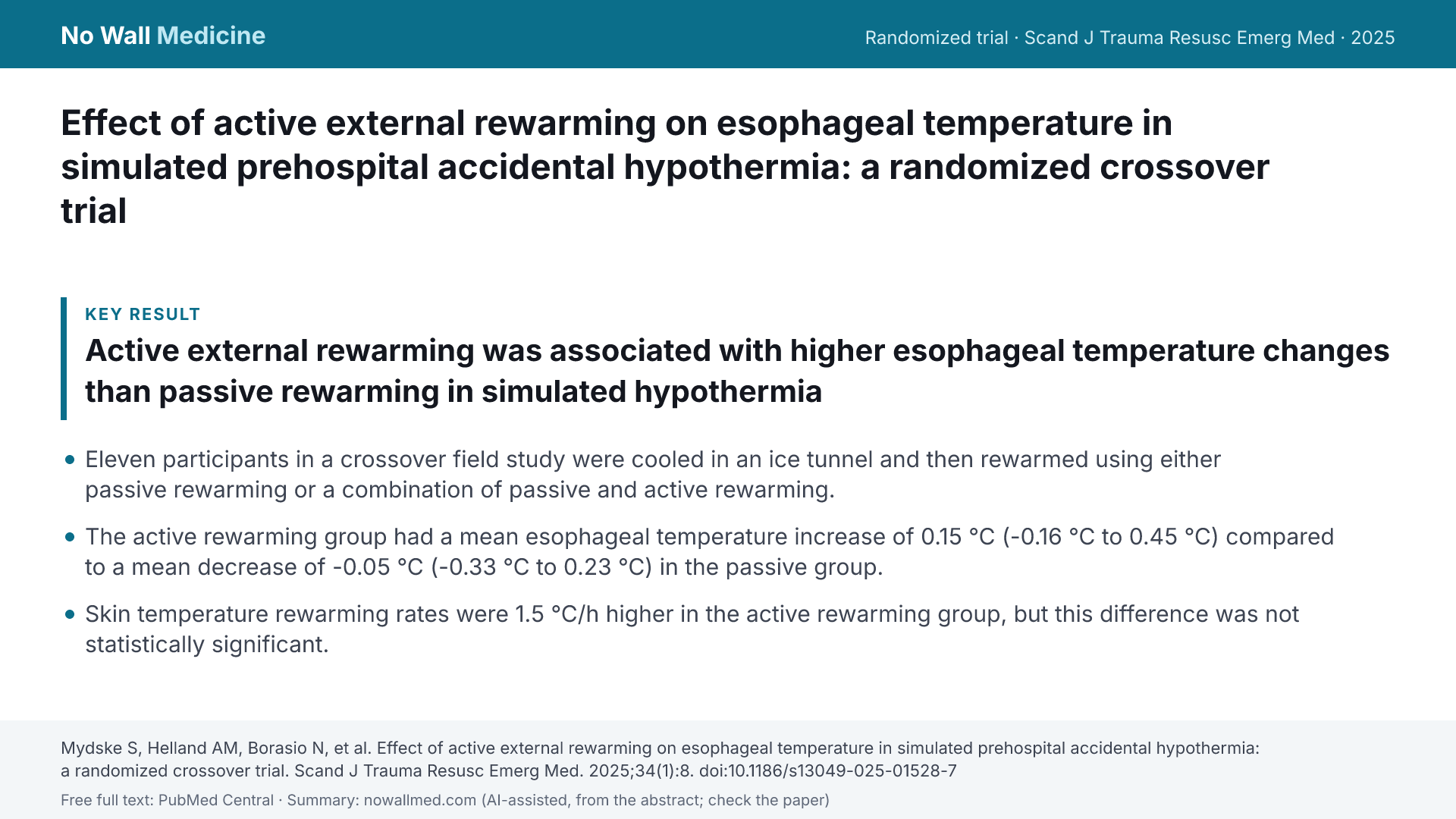
Key result: Active external rewarming was associated with higher esophageal temperature changes than passive rewarming in simulated hypothermia
Key points
- Eleven participants in a crossover field study were cooled in an ice tunnel and then rewarmed using either passive rewarming or a combination of passive and active rewarming.
- The active rewarming group had a mean esophageal temperature increase of 0.15 °C (-0.16 °C to 0.45 °C) compared to a mean decrease of -0.05 °C (-0.33 °C to 0.23 °C) in the passive group.
- Skin temperature rewarming rates were 1.5 °C/h higher in the active rewarming group, but this difference was not statistically significant.
Why it matters: The effect of active external rewarming on esophageal temperature remains unclear despite international guidelines recommending its use alongside passive rewarming for accidental hypothermia.
Discussion prompts
- Would these patients look like yours? Who was left out?
- Is the main outcome one that matters to patients?
- Is the difference large enough to change what you do?
Cite: Mydske S, Helland AM, Borasio N, et al. Effect of active external rewarming on esophageal temperature in simulated prehospital accidental hypothermia: a randomized crossover trial. Scand J Trauma Resusc Emerg Med. 2025;34(1):8. doi:10.1186/s13049-025-01528-7
Free full text: PubMed Central · Summary and visual abstract: nowallmed.com/a/effect-of-active-external-rewarming-on-esophageal-temperature-in-1w6gx42/ (AI-assisted from the abstract; check the paper before relying on it).