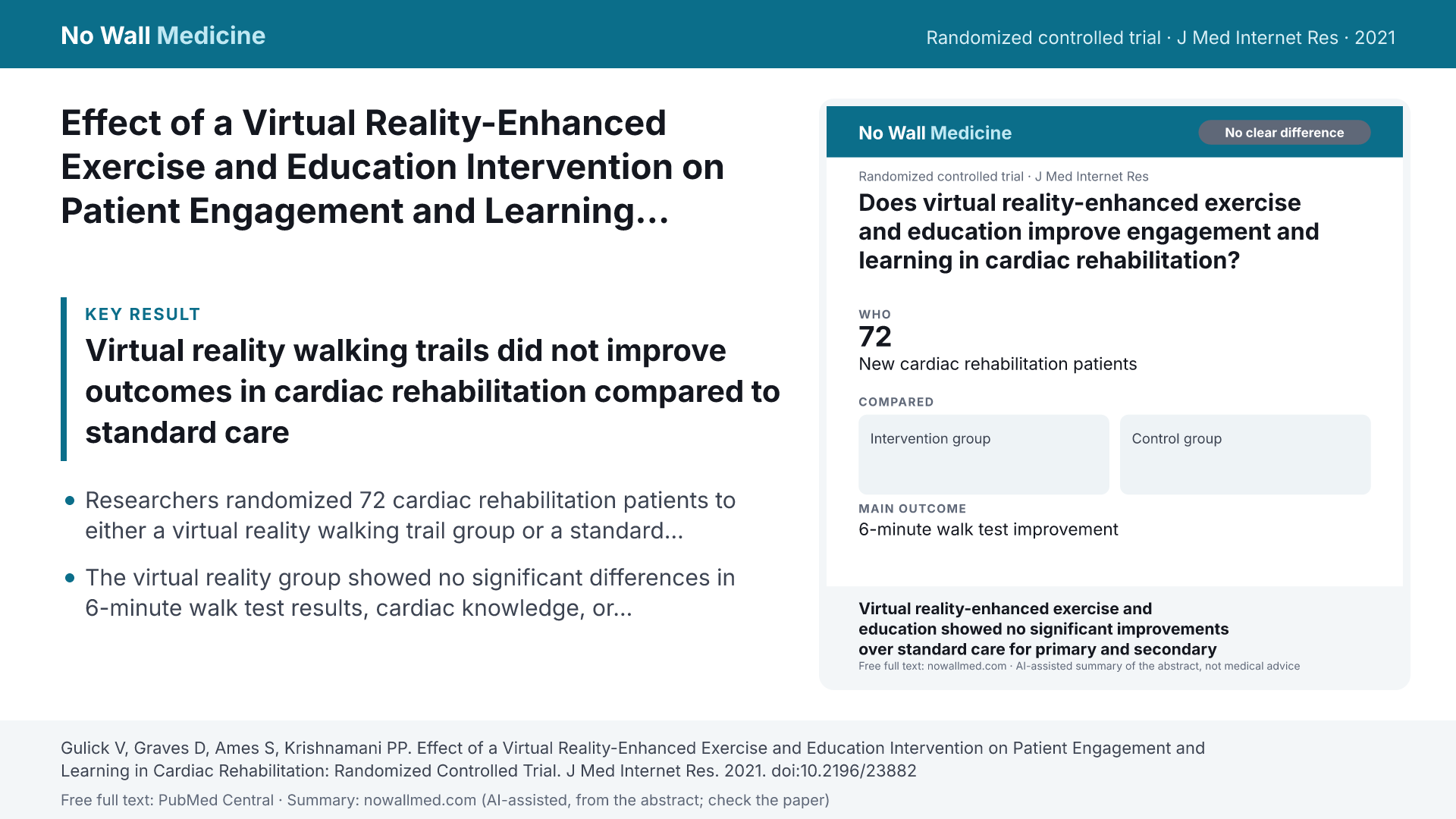
Virtual reality walking trails did not improve outcomes in cardiac rehabilitation compared to standard care
Effect of a Virtual Reality-Enhanced Exercise and Education Intervention on Patient Engagement and Learning in Cardiac Rehabilitation: Randomized Controlled Trial
Randomized controlled trialNo clear difference
Does virtual reality-enhanced exercise and education improve engagement and learning in cardiac rehabilitation?
Who
72
New cardiac rehabilitation patients
Compared
Intervention group
Control group
Main outcome
6-minute walk test improvement
Bottom line: Virtual reality-enhanced exercise and education showed no significant improvements over standard care for primary and secondary outcomes.
Limitation: Limitations in the study design may have influenced the outcomes.
J Med Internet Res · 2021-04-15Download image
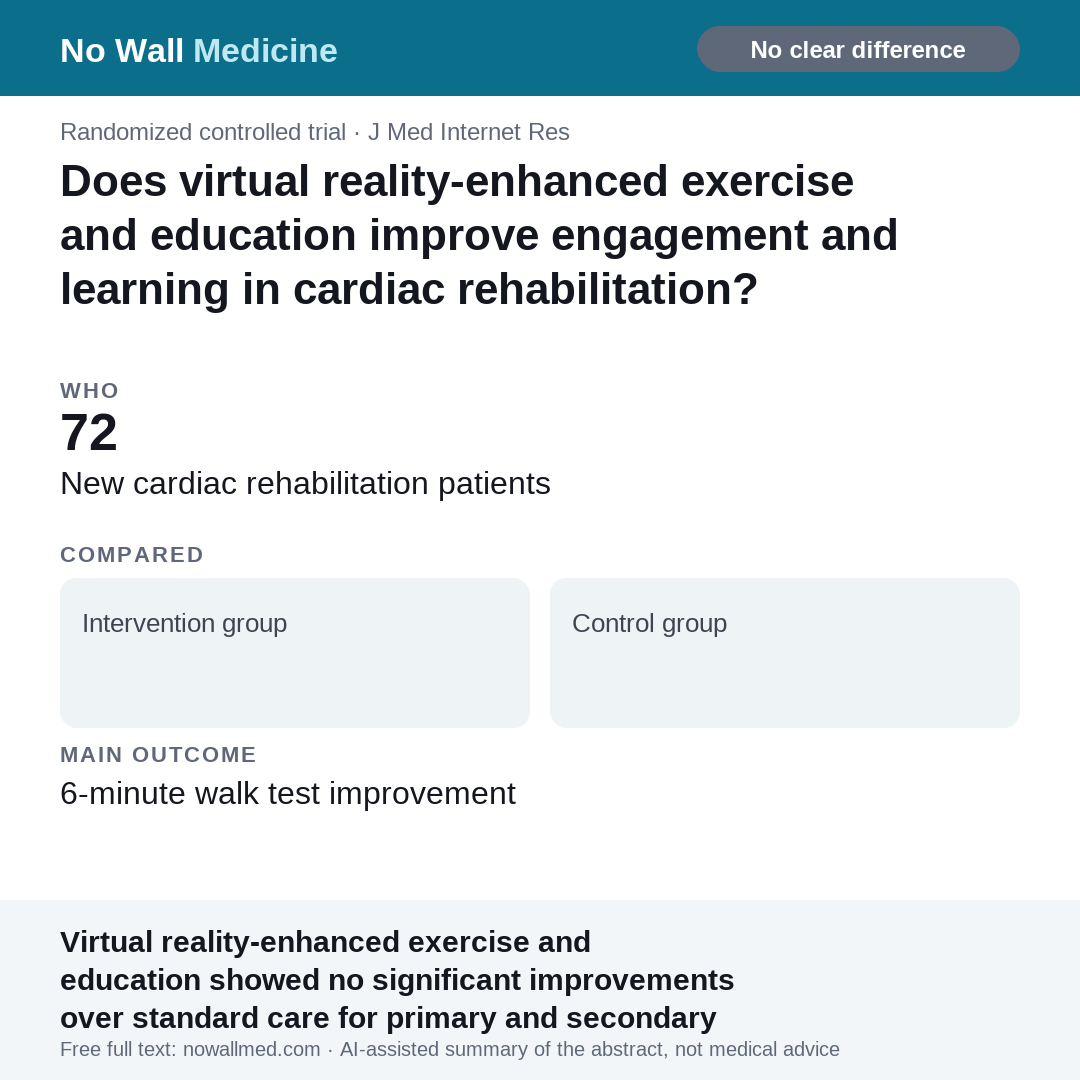
Clinical question: Does virtual reality-enhanced exercise and education improve engagement and learning in cardiac rehabilitation?
Why it matters: It is unknown if using virtual reality walking trails with audio education can improve patient knowledge, satisfaction, or attendance during cardiac rehabilitation.
Key points
- Researchers randomized 72 cardiac rehabilitation patients to either a virtual reality walking trail group or a standard care control group.
- The virtual reality group showed no significant differences in 6-minute walk test results, cardiac knowledge, or satisfaction compared to the control group.
- The control group had statistically more favorable rates of attendance and session completion than the virtual reality group.
Headline and key points written with AI from the paper’s abstract, with every number checked against it. Read the paper before relying on them.
Was this summary helpful?
Subject terms
Cite this article
Gulick V, Graves D, Ames S, Krishnamani PP. Effect of a Virtual Reality-Enhanced Exercise and Education Intervention on Patient Engagement and Learning in Cardiac Rehabilitation: Randomized Controlled Trial. J Med Internet Res. 2021. doi:10.2196/23882
Spotted a mistake? Suggest a correction